{
"run_id": "2026-09-04-r1",
"tool": "firecrawl",
"mode": "search",
"query_id": "Q48",
"query_text": "Serper SOC 2 Type II audit completion date",
"input_file": 3,
"timestamp_utc": "2026-09-04T09:26:46Z",
"region": "ap-south-1",
"latency_ms": 7485.1,
"http_status": 200,
"error": null,
"credits_reported": 11,
"tokens_reported": null,
"results": [
{
"rank": 1,
"url": "https://security.gallagher.com/en/Blog/SOC-2-Type-2-certification-what-it-is-and-why-it-matters",
"title": "SOC 2 Type 2 certification: what it is and why it matters",
"content": "# SOC 2 Type 2 certification: what it is and why it matters\n\nWritten by\n\n[Gallagher Content Team](https://security.gallagher.com/en/Blog/Authors/Gallagher-Content-Team \"Gallagher Content Team\")\n\nTuesday, 17 Feb, 2026\n\n- Created with Fabric.js 1.7.22\n\n\n\nData security is essential in the digital age. With cyber threats just a few clicks away, businesses need stringent protocols in place to protect customers\u2019 data. Fortunately, there are many reports, standards, and certifications to help you identify businesses committed to the protection and privacy of your personal data.\n\nOne such report is the SOC2 Type 2 attestation report. This is an important tool for a business with cloud-hosted solutions that are serious about their data protection and privacy measures. At Gallagher Security, we are proud that our cloud-hosted solutions for Command Centre are SOC 2 Type 2 certified, providing you with peace of mind that we care about the privacy of your information.\n\n## Key takeaways\n\n- SOC 2 is a voluntary AICPA standard auditing service organizations' controls for information security and privacy.\n- Type II reports assess control effectiveness over time, typically six to twelve months, unlike Type I at a point.\n- SOC 2 uses five trust principles, security, availability, processing integrity, confidentiality, and privacy, audited by a third party.\n- Gallagher\u2019s Command Centre cloud services are SOC 2 Type 2 certified, first achieved early 2023, recertified 16th December 2024.\n\n## What is a SOC 2 Type 2 Certification?\n\nThe System and Organization Controls 2 (referred to as SOC2) is a voluntary compliance standard for service organizations. SOC 2 is maintained by the [American Institute of Certified Public Accountants](http://www.aicpa-cima.com/) (AICPA) and audits are completed by accredited businesses.\n\n## What is the Purpose of a SOC 2 Type 2 Certification?\n\nThe purpose of a SOC 2 audit is to test an organization\u2019s internal controls for information security and privacy.\u00a0 It ensures that the organization processes and stores client data securely and aligns with established best practices outlined in the American Institute of Certified Public Accountants (AICPA) Trust Service Criteria (TSC).\n\nBeyond mere compliance, a SOC 2 Type 2 certification serves as a symbol of trust and transparency for organizations handling sensitive data in the constantly changing world of digital technology. The resulting report demonstrates that a business\u2019s security and confidentiality controls, meet or exceed the requirements established by the AICPA.\n\n## SOC 2 Type 2 Principles\n\nThere are five principles in the SOC 2 framework:\n\n1. Security\n2. Availability\n3. Processing Integrity\n4. Confidentiality\n5. Privacy\n\nA business can be audited against any combination of these principles. During the audit process, all systems are reviewed by a trusted external third party to ensure they comply with the AICPA trust principles. This audit captures how a company safeguards customer data and how well the controls are operating.\n\n## What are the Types of SOC 2 Reports?\n\nThere are two main types of SOC 2 reports, each offering distinct insights:\n\n1. **Type I Report:** This report examines the design of a vendor's system. Specifically, it assesses whether the system is suitably designed to meet the relevant trust principles at a particular fixed point in time. It essentially answers the question, \"Is the system structured to ensure security, availability, processing integrity, confidentiality, and privacy?\"\n2. **Type II Report:** This goes a step further by evaluating the operational effectiveness of these systems over a certain period, usually a six to twelve-month time frame. It provides details on whether the controls in place are functioning as intended and effectively maintain the trust principles throughout the stated timeframe.\n\n## Benefits of SOC 2 Type 2 Certification\n\nSOC 2 Type 2 certification is a must-have for organizations serious about their data protection measures. With data breaches increasing at an alarming rate, businesses are under constant pressure to provide their clients and customers with assurance that their information remains secure. By conducting a SOC2 Type 2 audit, companies demonstrate their commitment to data security and privacy.\n\nAdditionally, achieving SOC 2 Type 2 complements existing ISO 27001 standards and can be used to verify that businesses prioritize the security of their customer\u2019s information and data through an independent validation audit. Both certifications determine that proper procedures are in place to ensure customers data is secure, private, and confidential while looking at a business\u2019s service availability and processing integrity.\n\nA SOC 2 Type 2 attestation report not only demonstrates that you have robust controls in place to protect your business and customers from data breaches, but it\u2019s also a great competitive advantage when tendering for new projects and retaining customers.\n\n## How Often Should Organizations Undergo Audits to Ensure SOC 2 Compliance?\n\nOrganizations aiming to maintain SOC 2 compliance must undergo regular audits. Industry standard of the frequency of these audits is annually, this helps businesses identify and address gaps before they become significant concerns.\n\nAlthough the formal audit occurs annually, continuous monitoring and internal reviews should be in place to quickly identify and mitigate risks between audits.\n\nEngaging third-party auditors can provide an objective assessment, ensuring that the organization meets all requirements.\n\nAnnual audits combined with continuous monitoring are essential for organizations to ensure they remain SOC 2-compliant year-round.\n\n## What Does SOC 2 Ensure for Service Providers?\n\nSOC 2 focuses on ensuring that service providers maintain rigorous standards for data security and privacy. This auditing procedure shows that your service providers implement comprehensive measures to protect your organization's data and safeguard client information.\n\nKey points that SOC 2 covers include:\n\n- **Data Security:** Ensures that service providers have robust controls in place to prevent unauthorized access and data breaches of systems and information.\n- **Privacy Protection:** Verifies that client data is handled with the highest level of confidentiality and used solely for its intended purpose.\n- **Availability:** Confirms that systems are operational and accessible as needed, maintaining consistent performance levels.\n- **Processing Integrity:** Ensures that data processing is accurate, timely, and authorized to achieve the intended objective.\n- **Confidentiality:** Ensures that sensitive information is protected from unauthorized disclosure.\n\nBy adhering to SOC 2 standards, service providers demonstrate their commitment to safeguarding your organization's data and upholding the trust and privacy of your clients.\n\n## Why Choosing a SOC 2 Certified Solution is Important for your Organization?\n\nCompanies in many industries, such as financial services and healthcare, are expected to have SOC 2 certification by their clients. Depending on the complexity and sensitivity of data handled by the organization, some government agencies also demand SOC 2 Type 2 compliance.\n\nSOC 2 Type 2 empowers businesses to comprehensively evaluate their existing controls against established market benchmarks regularly. This proactive audit is important for businesses looking to continuously improve their internal data security controls and identify any gaps or issues that may not have been otherwise identified. By embracing this leap towards transparency, businesses enable robust security measures that safeguard sensitive information while fostering a culture of accountability. A SOC 2 Type 2 is an invaluable tool for any businesses looking to actively demonstrate their commitment to the on-going protection of customer data.\n\n## What is Included the Gallagher Security SOC 2 Type 2 Report?\n\nGallagher Security has conducted a SOC 2 Type 2 audit via an accredited third-party. The report covers applications that are grouped under the following Command Centre cloud-hosted services:\n\n- Mobile Connect\n- Command Centre Web\n- API Gateway, enabling access to Command Centre Mobile\n\nFirst achieved in early 2023, the report outlines our internal controls for the development processes of these products and confirms that they adequately safeguard data internally within Gallagher as well as customer data in accordance with the trust services criteria. We have since\u00a0[achieved SOC 2 Type 2 recertification](https://security.gallagher.com/en/News/Gallagher-Security-boosts-customer-trust-with-renewed-SOC2-Type-2-recertification)\u00a0twice, most recently after a fresh audit of our cloud-hosted services on December 16, 2024.\n\nAt Gallagher, we believe that data security is of the utmost importance and conducting this audit is one way we can show our dedication to protecting our clients\u2019 data. We are proud of the many regulations, standards, accreditations, and awards we\u2019ve earned by being an industry-leading, cybersecurity responsible vendor. The SOC 2 Type 2 certification further demonstrates our commitment to being the most cyber secure physical security manufacturer.\n\nIs data security important to you? Choose the only physical access control manufacturer, worldwide, with this set of certifications: ISO27001, CAPSS CPNI 2021, AACS 2022,\u00a0EN50131-4, SOC 2 Type 2.\n\n**What if security is capable of so much more?**\n\nBy challenging what's possible, Gallagher empowers businesses to be more connected with their people, their goals, and their potential.\n\n[Unlock More](https://security.gallagher.com/en/Unlock-More)\n\n* * *\n\n**Do you have a question?**\n\nLet us put you in contact with one of our team members.\n\n[CONTACT US](https://security.gallagher.com/en/Contact-Us)\n\n* * *\n\n**Want to hear more from Gallagher?**\n\nGet the latest Gallagher news, updates, and event information delivered straight to your inbox.\n\n[SUBSCRIBE](https://security.gallagher.com/en/Subscribe)\n\n[Talk to us](https://security.gallagher.com/Contact-Us) [Back to blogs](https://security.gallagher.com/Blog)\n\n## Stay up to date with Gallagher\n\n**Get the latest Gallagher news, updates, and event information delivered straight to your inbox.**\n\n[Subscribe](https://security.gallagher.com/en/Subscribe)",
"content_chars": 10569,
"published_date": null
},
{
"rank": 2,
"url": "https://cloud.google.com/security/compliance/soc-2",
"title": "SOC 2: compliance - Google Cloud",
"content": "# SOC 2\n\nThe [Service and Organization Controls](https://www.aicpa-cima.com/topic/audit-assurance/audit-and-assurance-greater-than-soc-2) (SOC) 2 is a report based on the [Auditing Standards Board of the American Institute of Certified Public Accountants](https://www.aicpa-cima.com/home) (AICPA) SSAE 18, which evaluates the service organization\u2019s controls relevant to the Trust Services Criteria of security, availability, processing integrity, confidentiality, or privacy.\n\nLooking for Google Cloud and Google Workspace SOC 2reports? Customers can request the reports at their convenience via [Compliance Reports Manager](https://cloud.google.com/security/compliance/compliance-reports-manager#/ReportType=Audit_Report,Vendor_Risk_Assessment).\n\n### Reference\n\n- [AICPA](https://www.aicpa-cima.com/home)\n- [SOC 2](https://www.aicpa-cima.com/topic/audit-assurance/audit-and-assurance-greater-than-soc-2)\n- [SSAE 16](https://www.aicpa-cima.com/resources/download/aicpa-ssaes-currently-effective)\n- [ISAE 3402](https://www.iaasb.org/)\n- [SOC Toolkit for Service Organizations](https://www.aicpa-cima.com/resources/download/soc-for-service-organizations-toolkit)\n\n## Google Cloud and SOC 2 compliance\n\n### Accessing Google Cloud\u2019s SOC 2 reports\n\nGoogle Cloud regularly undergoes third-party audits for our products, systems, and infrastructure related to this standard. The SOC 2 reports are generated by an objective third party attesting to a set of assertions made by Google Cloud about its controls that are in place to protect customer data. The audit firm\u2019s evaluation includes comprehensive testing of the design and operating effectiveness of the controls within the audit period.\n\nCustomers may use the SOC 2 report to assess the risks arising from interactions with the assessed Google Cloud and Google Workspace systems throughout the period.\n\n## Google Cloud\u2019s SOC 2 timelines\n\n### Core Google Cloud and Google Workspace SOC 2 reports\n\nThe core Google Cloud and Google Workspace SOC 2 Type II reports are issued quarterly and can be downloaded via the [Compliance Reports Manager](https://cloud.google.com/security/compliance/compliance-reports-manager#/ReportType=Audit_Report,Vendor_Risk_Assessment). The coverage periods and issuance dates for these reports are:\n\n- **First quarter of the year**\n- Coverage period: February 1 XX - January 31 X1\n- Estimated issuance: late March\n- **Second quarter of the year**\n- Coverage period: May 1 XX - April 30 X1\n- Estimated issuance: late June\n- **Third quarter of the year**\n- Coverage period: August 1 XX - July 31 X1\n- Estimated issuance: late September\n- **Fourth quarter of the year**\n- Coverage period: November 1 XX - October 31 X1\n- Estimated issuance: late December\n\n### Additional Google Cloud SOC 2 reports\n\nWe issue separate SOC 2 Type II reports for a small subset of Google Cloud products, including Actifio Heritage, Apigee Edge, AppSheet, Bare Metal Solution, Bare Metal HSM, BigQuery Omni, Google Cloud NetApp Volumes, Google Cloud VMware Engine, Google Distributed Cloud connected, StratoZone, and Mandiant. These reports are issued semi-annually or annually and customers can obtain these reports by contacting [sales](https://cloud.google.com/contact) or [support](https://cloud.google.com/support-hub).\n\n### Bridge letters\n\nBridge letters are attestations made by the management of the service provider, in this case, Google Cloud, and are intended to \u201cbridge\u201d the gap from the end date of the SOC report to the customer\u2019s period end date. Bridge letters summarize material changes or issues identified within the internal control environment beyond the period end date of the most recent SOC report. Bridge letters are available for SOC 1 and SOC 2 reports.\n\nGoogle Cloud creates monthly bridge letters with each letter designed to cover the period since the most recent SOC report. For example, Google Cloud issues a bridge letter in early January to cover the look-back period of November 1 to December 31, which extends the coverage period of the previously issued SOC report with a period end date of October 31.\n\nSOC bridge letters for the core Google Cloud and Google Workspace SOC 2 reports are made available on [Compliance Reports Manager](https://cloud.google.com/security/compliance/compliance-reports-manager#/ReportType=Audit_Report,Vendor_Risk_Assessment) for the periods ending March 31, June 30, September 30, and December 31 and can be downloaded directly. If a bridge letter covering a different period end date or product scope is required, please contact [sales](https://cloud.google.com/contact) or [support](https://cloud.google.com/support-hub).\n\n### FAQs\n\nExpand all\n\n#### Who performs the independent third-party audit?\n\nGoogle Cloud\u2019s independent auditors are Ernst & Young LLP and Coalfire.\n\n#### How does a SOC 2 Type II report differ from a SOC 2 Type I report?\n\nA SOC 2 Type I report covers the design of the service organization's controls at a specific point in time. A SOC 2 Type II report covers the design and operating effectiveness of the service organization's controls over a period of time. For example, a SOC 2 Type I may assess the service organization\u2019s controls as of today, but a SOC 2 Type II assesses the service organization\u2019s controls within the past six months. Google Cloud only issues SOC 2 Type II reports.\n\n### Services in scope\n\nBelow are Google Cloud services that are in scope for SOC 2.\n\nExpand all\n\n#### Google Cloud\n\nWhere we are simplifying the name of our service, we have also included its former name in parentheses.\n\n**Artificial Intelligence (AI) and Machine Learning (ML)**\n\n[**Agent Assist**](https://cloud.google.com/agent-assist)\n\n[**Agent Conversation on Gemini Enterprise Agent Platform (Formerly Vertex AI Conversation)**](https://docs.cloud.google.com/gemini/enterprise/docs)\n\n[**Agent Search on Gemini Enterprise Agent Platform (Formerly Vertex AI Search)**](https://cloud.google.com/enterprise-search)\n\n[**AI Platform Deep Learning Container**](https://cloud.google.com/deep-learning-containers)\n\n[**Anti-Money Laundering AI**](https://cloud.google.com/anti-money-laundering-ai)\n\n[**AutoML Tables**](https://cloud.google.com/automl-tables)\n\n[**Cloud Natural Language API**](https://cloud.google.com/natural-language)\n\n[**Cloud Speaker ID**](https://cloud.google.com/speaker-id)\n\n[**Cloud Translation**](https://cloud.google.com/translate)\n\n[**Cloud Vision**](https://cloud.google.com/vision/docs)\n\n[**Contact Center as a Service (CCaaS)**](https://cloud.google.com/solutions/contact-center-ai-platform)\n\n[**Conversational Agents (formerly\u00a0Dialogflow**](https://cloud.google.com/dialogflow/) **)**\n\n[**CX Agent Studio**](https://docs.cloud.google.com/gemini-enterprise-cx/cx-agent-studio)\n\n[**CX Insights (formerly Conversational Insights**](https://cloud.google.com/solutions/ccai-insights) **)**\n\n[**Database Center**](https://docs.cloud.google.com/database-center/docs/overview)\n\n[**Document AI**](https://cloud.google.com/solutions/document-ai)\n\n[**Document AI Warehouse**](https://cloud.google.com/document-ai-warehouse)\n\n[**Food Ordering AI Agent**](https://docs.cloud.google.com/food-ai)\n\n[**Gemini Code Assist**](https://codeassist.google/products/business?hl=en)\n\n[**Gemini Enterprise (including Agentspace)**](https://docs.cloud.google.com/gemini/enterprise/docs)\n\n[**Gemini Enterprise Agent Platform Colab Enterprise (Vertex AI Colab Enterprise)**](https://cloud.google.com/colab/docs)\n\n[**Gemini Enterprise Agent Platform (formerly Vertex AI Platform)**](https://cloud.google.com/vertex-ai/docs)\n\n[**Gemini Enterprise Agent Platform Workbench Instances (formerly Vertex AI Workbench Instances)**](https://cloud.google.com/vertex-ai/docs/workbench/introduction)\n\n[**Gemini Enterprise for Customer Experience (GECX)** **(formerly Conversational AI and Contact Center AI)**](https://cloud.google.com/solutions/contact-center)\n\n[**Gemini for Google Cloud**](https://cloud.google.com/products/gemini?hl=en)\n\n[**Gemini in BigQuery**](https://cloud.google.com/gemini/docs/bigquery/overview)\n\n[**Generative AI on Gemini Enterprise Agent Platform (formerly Generative AI on Vertex AI)**](https://cloud.google.com/products/gemini-enterprise-agent-platform)\n\n[**NotebookLM for enterprise**](https://docs.cloud.google.com/gemini/enterprise/notebooklm-enterprise/docs/overview)\n\n[**Ray on Gemini Enterprise Agent Platform (formerly Ray on Vertex)**](https://cloud.google.com/vertex-ai/docs/open-source/ray-on-vertex-ai/overview)\n\n[**Recommendations AI**](https://cloud.google.com/recommendations)\n\n[**Retail Search**](https://cloud.google.com/retail/docs/search-basic)\n\n[**Speech-to-Text**](https://cloud.google.com/speech-to-text/)\n\n[**Talent Solution**](https://cloud.google.com/solutions/talent-solution)\n\n[**Text-to-Speech**](https://cloud.google.com/text-to-speech)\n\n[**Video Intelligence API**](https://cloud.google.com/video-intelligence)\n\n**Application Programming Interface (API) Management**\n\n[**Advanced API Security**](https://cloud.google.com/apigee/docs/api-security)\n\n[**Apigee**](https://cloud.google.com/apigee)\n\n[**API Gateway**](https://cloud.google.com/api-gateway)\n\n[**Application Integration**](https://cloud.google.com/application-integration/docs/overview)\n\n[**Cloud Endpoints**](https://cloud.google.com/endpoints)\n\n[**Integration Connectors**](https://cloud.google.com/integration-connectors/docs/overview)\n\n**Compute**\n\n[**App Engine**](https://cloud.google.com/appengine)\n\n[**Batch**](https://cloud.google.com/batch/docs/get-started)\n\n[**Compute Engine**](https://cloud.google.com/compute)\n\n[**Managed Lustre**](https://cloud.google.com/products/managed-lustre)\n\n[**Workload Manager**](https://cloud.google.com/workload-manager/docs)\n\n**Data Analytics**\n\n[**BigQuery**](https://cloud.google.com/bigquery)\n\n[**BigQuery Omni**](https://cloud.google.com/bigquery/docs/omni-introduction)\n\n[**Cloud Data Fusion**](https://cloud.google.com/data-fusion)\n\n[**Data Catalog**](https://cloud.google.com/data-catalog/docs/concepts/overview)\n\n[**Dataflow**](https://cloud.google.com/dataflow)\n\n[**Dataform**](https://cloud.google.com/dataform)\n\n[**Dataproc Metastore**](https://cloud.google.com/dataproc-metastore/docs)\n\n[**Data Studio (formerly Looker Studio)**](https://lookerstudio.google.com/)\n\n[**Google Cloud Managed Service for Apache Kafka**](https://cloud.google.com/products/managed-service-for-apache-kafka?hl=en&e=0)\n\n[**Knowledge Catalog (formerly Dataplex)**](https://cloud.google.com/dataplex)\n\n[**Looker (Google Cloud core)**](https://docs.cloud.google.com/looker/docs/looker-core-overview)\n\n[**Managed Service for Apache Airflow (formerly Cloud Composer)**](https://cloud.google.com/composer)\n\n[**Managed Service for Apache Spark (formerly Dataproc)**](https://cloud.google.com/dataproc)\n\n[**Pub/Sub**](https://cloud.google.com/pubsub)\n\n**Databases**\n\n[**AlloyDB**](https://cloud.google.com/alloydb)\n\n[**Bigtable**](https://cloud.google.com/bigtable)\n\n[**Cloud SQL**](https://cloud.google.com/sql)\n\n[**Datastore**](https://cloud.google.com/datastore)\n\n[**Firestore**](https://cloud.google.com/firestore)\n\n[**Memorystore**](https://cloud.google.com/memorystore)\n\n[**Spanner**](https://cloud.google.com/spanner)\n\n**Developer Tools**\n\n[**Artifact Analysis**](https://cloud.google.com/artifact-analysis/docs)\n\n[**Artifact Registry**](https://cloud.google.com/artifact-registry)\n\n[**Cloud Build**](https://cloud.google.com/cloud-build)\n\n[**Cloud Source Repositories**](https://cloud.google.com/source-repositories)\n\n[**Cloud Workstations**](https://cloud.google.com/workstations)\n\n[**Developer Connect**](https://docs.cloud.google.com/developer-connect/docs/overview)\n\n[**Firebase Test Lab**](https://firebase.google.com/products/test-lab)\n\n[**Google Cloud Deploy**](https://cloud.google.com/deploy)\n\n[**Google Cloud SDK**](https://cloud.google.com/sdk)\n\n[**Infrastructure Manager**](https://cloud.google.com/infrastructure-manager/docs)\n\n[**Secure Source Manager**](https://cloud.google.com/secure-source-manager/docs)\n\n**Healthcare and Life Sciences**\n\n[**Cloud Healthcare API (formerly Cloud Healthcare)**](https://cloud.google.com/healthcare)\n\n[**Healthcare Data Engine (HDE)**](https://cloud.google.com/blog/topics/healthcare-life-sciences/introducing-healthcare-data-engine-accelerators)\n\n**Hybrid and Multi-cloud**\n\n[**Config Connector**](https://docs.cloud.google.com/config-connector/docs/overview)\n\n[**Config Controller**](https://docs.cloud.google.com/kubernetes-engine/config-controller/docs/overview)\n\n[**Connect**](https://cloud.google.com/anthos/multicluster-management/connect/)\n\n[**Google Kubernetes Engine** **(GKE)**](https://cloud.google.com/kubernetes-engine)\n\n[**GKE Config Sync (formerly Config Sync)**](https://docs.cloud.google.com/kubernetes-engine/config-sync/docs/overview)\n\n[**GKE Identity Service**](https://cloud.google.com/anthos/identity#:~:text=Anthos%20Identity%20Service%20is%20an,using%20your%20existing%20identity%20provider.)\n\n[**Hub**](https://cloud.google.com/anthos/multicluster-management/connect)\n\n[**Knative serving**](https://docs.cloud.google.com/kubernetes-engine/enterprise/knative-serving/docs)\n\n[**Policy Controller**](https://docs.cloud.google.com/kubernetes-engine/policy-controller/docs/overview)\n\n[**Service Mesh**](https://cloud.google.com/anthos/service-mesh)\n\n**Management Tools**\n\n[**App Hub**](https://cloud.google.com/products/app-hub)\n\n[**Cloud Console App**](https://cloud.google.com/console-app)\n\n[**Cloud Console Platform**](https://cloud.google.com/cloud-console)\n\n[**Cloud Deployment Manager**](https://cloud.google.com/deployment-manager)\n\n[**Cloud Shell**](https://cloud.google.com/shell)\n\n[**Recommender**](https://cloud.google.com/recommender/docs/overview)\n\n[**Service Infrastructure**](https://cloud.google.com/service-infrastructure/docs/overview)\n\n**Media and Gaming**\n\n[**Media CDN**](https://cloud.google.com/media-cdn/docs/overview)\n\n[**Transcoder API**](https://cloud.google.com/transcoder/docs)\n\n[**Video Stitcher API**](https://docs.cloud.google.com/video-stitcher/docs)\n\n**Migration**\n\n[**BigQuery Data Transfer Service**](https://docs.cloud.google.com/bigquery/docs/dts-introduction)\n\n[**Database Migration Service**](https://cloud.google.com/database-migration)\n\n[**Migration Center**](https://cloud.google.com/migration-center/docs)\n\n[**Migrate to Virtual Machines**](https://cloud.google.com/migrate/compute-engine)\n\n[**Storage Transfer Service**](https://cloud.google.com/storage-transfer/docs/overview)\n\n**Networking**\n\n[**Cloud CDN**](https://cloud.google.com/cdn)\n\n[**Cloud DNS**](https://cloud.google.com/dns)\n\n[**Cloud Intrusion Detection System (Cloud IDS)**](https://cloud.google.com/security/products/intrusion-detection-system)\n\n[**Cloud Interconnect**](https://cloud.google.com/interconnect)\n\n[**Cloud Load Balancing**](https://cloud.google.com/load-balancing)\n\n[**Cloud NAT (Network Address Translation)**](https://cloud.google.com/nat?hl=en)\n\n[**Cloud Next Generation Firewall (Cloud NGFW)**](https://cloud.google.com/security/products/firewall)\n\n[**Cloud Router**](https://cloud.google.com/router/docs)\n\n[**Cloud Service Mesh**](https://cloud.google.com/products/service-mesh?hl=en)\n\n[**Cloud VPN**](https://docs.cloud.google.com/network-connectivity/docs/vpn/concepts/overview)\n\n[**Firebase App Hosting**](https://firebase.google.com/docs/app-hosting)\n\n[**Google Cloud Armor**](https://cloud.google.com/armor)\n\n[**Network Connectivity Center**](https://cloud.google.com/network-connectivity-center)\n\n[**Network Intelligence Center**](https://cloud.google.com/network-intelligence-center)\n\n[**Network Security Integration**](https://docs.cloud.google.com/network-security-integration/docs/nsi-overview)\n\n[**Network Service Tiers**](https://cloud.google.com/network-tiers)\n\n[**Secure Web Proxy (Cloud SWP)**](https://cloud.google.com/security/products/secure-web-proxy?hl=en)\n\n[**Service Directory**](https://cloud.google.com/service-directory)\n\n[**Spectrum Access System**](https://cloud.google.com/spectrum-access-system/docs)\n\n[**Traffic Director**](https://cloud.google.com/traffic-director/)\n\n[**Virtual Private Cloud (VPC)**](https://cloud.google.com/vpc)\n\n**Operations**\n\n[**Backup and DR Service**](https://cloud.google.com/backup-disaster-recovery)\n\n[**Cloud Logging**](https://cloud.google.com/logging/docs)\n\n[**Cloud Monitoring**](https://cloud.google.com/monitoring)\n\n[**Cloud Profiler**](https://cloud.google.com/profiler)\n\n[**Cloud Trace**](https://cloud.google.com/trace)\n\n[**Personalized Service Health**](https://cloud.google.com/service-health)\n\n**Security and Identity**\n\n[**Access Approval**](https://cloud.google.com/access-approval/docs/)\n\n[**Access Context Manager**](https://cloud.google.com/access-context-manager/docs)\n\n[**Access Transparency**](https://cloud.google.com/access-transparency)\n\n[**Assured Workloads**](https://cloud.google.com/assured-workloads)\n\n[**Audit Manager**](https://cloud.google.com/products/audit-manager?hl=en)\n\n[**Binary Authorization**](https://cloud.google.com/binary-authorization)\n\n[**Certificate Authority Service**](https://cloud.google.com/certificate-authority-service/docs/request-and-view-certificates?hl=en)\n\n[**Certificate Manager**](https://cloud.google.com/certificate-manager/docs)\n\n[**Chrome Enterprise Premium**](https://chromeenterprise.google/products/chrome-enterprise-premium/)\n\n[**Cloud Asset Inventory**](https://docs.cloud.google.com/asset-inventory/docs)\n\n[**Cloud Domains**](https://docs.cloud.google.com/domains/docs/overview)\n\n[**Cloud External Key Manager (Cloud EKM)**](https://cloud.google.com/kms/docs/ekm)\n\n[**Cloud HSM (Hardware Security Module)**](https://docs.cloud.google.com/kms/docs/hsm)\n\n[**Cloud Key Management Service (KMS)**](https://cloud.google.com/security-key-management)\n\n[**Cloud Quotas**](https://docs.cloud.google.com/docs/quotas/overview)\n\n[**Cyber Insurance Hub (formerly RIsk Manager)**](https://cloud.google.com/risk-protection-program)\n\n[**Firebase App Check**](https://cloud.google.com/identity-platform/docs/admin/app-check-integration)\n\n[**Firebase Authentication**](https://firebase.google.com/docs/auth)\n\n[**Google Security Operations (SIEM)**](https://cloud.google.com/security/products/security-operations)\n\n[**Google Security Operations (SOAR)**](https://docs.cloud.google.com/chronicle/docs/soar/overview-and-introduction/soar-overview)\n\n[**Google Threat Intelligence**](https://cloud.google.com/security/products/threat-intelligence?hl=en)\n\n[**GTI for Google Security Operations**](https://cloud.google.com/chronicle/docs/reference)\n\n[**Identity & Access Management (IAM)**](https://cloud.google.com/iam)\n\n[**Identity Platform**](https://cloud.google.com/identity-platform)\n\n[**Identity-Aware Proxy (IAP)**](https://cloud.google.com/iap)\n\n[**Key Access Justifications (KAJ)**](https://cloud.google.com/security-key-management#section-8)\n\n[**Managed Service for Microsoft Active Directory (AD)**](https://cloud.google.com/managed-microsoft-ad/)\n\n[**Model Armor**](https://cloud.google.com/security/products/model-armor)\n\n[**Organization Policy Service (formerly Cloud Org Policy)**](https://cloud.google.com/resource-manager/docs/organization-policy/overview)\n\n[**Privileged Access Manager**](https://cloud.google.com/iam/docs/pam-overview)\n\n[**reCAPTCHA Enterprise**](https://cloud.google.com/recaptcha-enterprise)\n\n[**Resource Manager (formerly Resource Manager API)**](https://cloud.google.com/resource-manager)\n\n[**SecLM**](https://cloud.google.com/chronicle/docs/secops/gemini-chronicle)\n\n[**Secret Manager**](https://cloud.google.com/secret-manager)\n\n[**Security Command Center**](https://cloud.google.com/security-command-center/)\n\n[**Sensitive Data Protection (including Cloud Data Loss Prevention)**](https://cloud.google.com/security/products/sensitive-data-protection?hl=en)\n\n[**VirusTotal**](https://cloud.google.com/chronicle/docs/investigation/view-virustotal-information)\n\n[**VPC Service Controls**](https://cloud.google.com/vpc-service-controls)\n\n[**Web Risk API**](https://docs.cloud.google.com/web-risk/docs/reference/rest)\n\n**Serverless Computing**\n\n[**Cloud Functions for Firebase**](https://firebase.google.com/docs/functions)\n\n[**Cloud Run**](https://cloud.google.com/run)\n\n[**Cloud Run Functions (formerly Cloud Functions)**](https://cloud.google.com/functions)\n\n[**Cloud Scheduler**](https://cloud.google.com/scheduler)\n\n[**Cloud Tasks**](https://cloud.google.com/tasks)\n\n[**DataStream**](https://cloud.google.com/datastream/docs)\n\n[**Eventarc**](https://cloud.google.com/eventarc/docs)\n\n[**Workflows**](https://cloud.google.com/workflows)\n\n**Storage**\n\n[**Backup for GKE**](https://cloud.google.com/kubernetes-engine/docs/add-on/backup-for-gke)\n\n[**Cloud Storage**](https://cloud.google.com/storage)\n\n[**Cloud Storage for Firebase**](https://firebase.google.com/products/storage)\n\n[**Filestore**](https://cloud.google.com/filestore?hl=en)\n\n[**Google Cloud NetApp Volumes (GCNV)**](https://cloud.google.com/netapp/volumes/docs/discover/overview)\n\n[**Parallelstore**](https://cloud.google.com/parallelstore?hl=en&e=0)\n\n[**Persistent Disk**](https://cloud.google.com/persistent-disk)\n\n**Firebase**\n\n[**Firebase A/B Testing**](https://firebase.google.com/docs/ab-testing)\n\n[**Firebase AI logic**](https://firebase.google.com/products/firebase-ai-logic)\n\n[**Firebase App Distribution**](https://firebase.google.com/docs/app-distribution)\n\n[**Firebase Cloud Messaging**](https://firebase.google.com/docs/cloud-messaging)\n\n[**Firebase Console**](https://firebase.google.com/docs)\n\n[**Firebase Crashlytics**](https://firebase.google.com/docs/crashlytics)\n\n[**Firebase Data Connect**](https://firebase.google.com/docs/data-connect)\n\n[**Firebase Dynamic Links**](https://firebase.google.com/docs/dynamic-links)\n\n[**Firebase Hosting**](https://firebase.google.com/docs/hosting)\n\n[**Firebase In-App Messaging**](https://firebase.google.com/docs/in-app-messaging)\n\n[**Firebase Machine Learning (ML)**](https://firebase.google.com/docs/ml)\n\n[**Firebase Performance Monitoring**](https://firebase.google.com/docs/perf-mon)\n\n[**Firebase Realtime Database**](https://firebase.google.com/docs/database)\n\n[**Firebase Registry**](https://firebase.google.com/docs/functions)\n\n[**Firebase Remote Config**](https://firebase.google.com/docs/remote-config)\n\n[**Firebase Rules**](https://firebase.google.com/docs/rules)\n\n[**Gemini in Firebase**](https://firebase.google.com/docs/ai-assistance/gemini-in-firebase)\n\n**Other**\n\n[**Cloud Billing**](https://cloud.google.com/billing/docs)\n\n[**Earth Engine**](https://earthengine.google.com/)\n\n[**Google Cloud Marketplace**](https://cloud.google.com/marketplace)\n\n[**Google Cloud Skills Boost**](https://cloud.google.com/resources/boost-your-cloud-skills-with-google)\n\n[**Google Cloud VMware Engine (GCVE)**](https://cloud.google.com/vmware-engine)\n\n[**SaaS Runtime**](https://cloud.google.com/products/saas-runtime)\n\n[**Tables**](https://support.google.com/area120-tables#topic=9904105)\n\n#### Google Workspace\n\n[**Admin Console**](https://gsuite.google.com/products/admin/)\n\n[**Appsheet**](https://cloud.google.com/appsheet?hl=en&e=0)\n\n[**Assignments**](https://edu.google.com/intl/ALL_us/assignments/)\n\n[**Classroom**](https://edu.google.com/products/classroom/?modal_active=none)\n\n[**Cloud Identity**](https://storage.googleapis.com/gfw-touched-accounts-pdfs/google-identity-takeaway.pdf)\n\n[**Cloud Search**](https://developers.google.com/workspace/cloud-search)\n\n[**Gemini app (formerly Gemini)**](https://gemini.google.com/corp/app?enterprise_mode=true)\n\n[**Gemini in Workspace apps (formerly Gemini for Google Workspace)**](https://workspace.google.com/solutions/ai/)\n\n[**Gmail**](https://gsuite.google.com/products/gmail/)\n\n[**Google Beam**](https://beam.google/)\n\n[**Google Calendar**](https://workspace.google.com/products/calendar/)\n\n[**Google Chat**](https://workspace.google.com/products/chat/)\n\n[**Google Contacts**](https://support.google.com/a/users/answer/9310148)\n\n[**Google Docs**](https://workspace.google.com/products/docs/)\n\n[**Google Drive**](https://workspace.google.com/products/drive/)\n\n[**Google Forms**](https://workspace.google.com/products/forms/)\n\n[**Google Groups**](https://support.google.com/a/users/answer/9304805)\n\n[**Google Keep**](https://workspace.google.com/products/keep/)\n\n[**Google Meet**](https://workspace.google.com/products/meet/)\n\n[**Google Sheets**](https://workspace.google.com/products/sheets/)\n\n[**Google Sites**](https://workspace.google.com/products/sites/)\n\n[**Google Slides**](https://workspace.google.com/products/slides/)\n\n[**Google Tasks**](https://support.google.com/a/users/answer/9308887)\n\n[**Google Vault**](https://workspace.google.com/products/vault/)\n\n[**Google Vids**](https://workspace.google.com/products/vids/)\n\n[**Google Voice**](https://workspace.google.com/products/voice)\n\n[**Google Workspace Migrate**](https://support.google.com/workspacemigrate#topic=9223062)\n\n[**Google Workspace Studio**](https://workspace.google.com/studio/)\n\n[**Mobile Device Management**](https://gsuite.google.com/products/admin/endpoint/)\n\n[**NotebookLM**](https://workspace.google.com/products/notebooklm/)\n\n[**Read Along**](https://support.google.com/readalong/answer/12279471?hl=en&co=GENIE.Platform%3DDesktop)\n\n[**Workspace LTI (formerly Assignments)**](https://edu.google.com/intl/ALL_us/workspace-lti/)\n\n#### Application Programming Interfaces and Developer Offerings\n\n[**Apps Script**](https://developers.google.com/apps-script)\n\n[**Gmail Rest API**](https://developers.google.com/gmail/)\n\n[**Google Calendar API**](https://developers.google.com/calendar/)\n\n[**Google Drive Activity API**](https://developers.google.com/drive/activity/)\n\n[**Google Drive Rest API**](https://developers.google.com/drive/api/v3/about-sdk/)\n\n[**Google Sheets API**](https://developers.google.com/sheets/api/)\n\n[**Google Tasks API**](https://developers.google.com/tasks/)\n\n[**People API**](https://developers.google.com/people)\n\n#### Google Workspace Admin SDK\n\n[**Alert Center API**](https://developers.google.com/admin-sdk/alertcenter/guides/)\n\n[**Data Transfer API**](https://developers.google.com/admin-sdk/data-transfer/)\n\n[**Directory API**](https://developers.google.com/admin-sdk/directory/)\n\n[**Domain Shared Contacts API**](https://developers.google.com/admin-sdk/domain-shared-contacts/)\n\n[**Email Audit API**](https://developers.google.com/admin-sdk/email-audit/)\n\n[**Enterprise License Manager API**](https://developers.google.com/admin-sdk/licensing/v1/get-start/getting-started/)\n\n[**Groups Migration API**](https://developers.google.com/admin-sdk/groups-migration/v1/get-start/getting-started/)\n\n[**Groups Settings API**](https://developers.google.com/admin-sdk/groups-settings/get_started)\n\n[**Reports API**](https://developers.google.com/admin-sdk/reports/v1/get-start/getting-started/)\n\n[**Reseller API**](https://developers.google.com/admin-sdk/reseller/v1/get-start/getting-started/)\n\n[**SAML-based SSO API**](https://developers.google.com/admin-sdk/admin-settings/#managing_single_sign-on_settings)\n\n### Relevant products and services\n\n### \\#\\#\\#\\# Access Transparency\n\nWhen Google Cloud administrators access your content, Access Transparency gives you near real-time logs of their actions.\n\n[Learn more](https://cloud.google.com/security/products/access-transparency)\n\n### \\#\\#\\#\\# Cloud Key Management Service\n\nManage cryptographic keys for your cloud services the same way you do on-premises, to protect secrets and other sensitive data that you store in Google Cloud.\n\n[Learn more](https://cloud.google.com/security/products/security-key-management)\n\n### \\#\\#\\#\\# Google Cloud Armor\n\nDelivers defense at scale against infrastructure and application DDoS attacks using Google\u2019s global infrastructure and security systems.\n\n[Learn more](https://cloud.google.com/security/products/armor)\n\n### \\#\\#\\#\\# Security Command Center\n\nPrevent and detect threats in virtual machines, networks, applications, and storage from one location, and act on them before they cause damage or loss.\n\n[Learn more](https://cloud.google.com/security/products/security-command-center)\n\n### **Sensitive Data Protection (including Cloud Data Loss Prevention)**\n\nProvides fast, scalable classification and redaction for sensitive data elements like names, credit card numbers, Google Cloud credentials, and more.\n\n[Learn more](https://cloud.google.com/security/products/dlp?hl=en)\n\n### \\#\\#\\#\\# VPC Service Controls\n\nKeeps sensitive data private by defining a security perimeter around Google Cloud resources like Cloud Storage buckets, Bigtable instances, and BigQuery datasets.\n\n[Learn more](https://cloud.google.com/security/vpc-service-controls)\n\n## Related documentation\n\nSOC 2 reports may be requested via the [Compliance Reports Manager](https://cloud.google.com/security/compliance/compliance-reports-manager/). Potential customers can contact [sales](https://cloud.google.com/contact) for more information.\n\n## Related offerings\n\n- [\\\\\n\\\\\nSOC 1\\\\\n\\\\\nGoogle Cloud undergoes a regular third-party audit to certify individual products against SOC 2 standards.](https://cloud.google.com/security/compliance/soc-1/)\n- [\\\\\n\\\\\nSOC 3\\\\\n\\\\\nGoogle Cloud and Google Workspace undergo a regular third-party audit to certify individual products against SOC 3 standards.](https://cloud.google.com/security/compliance/soc-3/)\n\n#### Take the next step\n\nStart building on Google Cloud with $300 in free credits and 20+ always free products.\n\nGet started for free [Get started for free](https://console.cloud.google.com/freetrial)\n\n- ##### Learn security best practices\n\n[See our best practices](https://cloud.google.com/security/best-practices/)\n- ##### Solve common problems\n\n[Watch security use-case videos](https://cloud.google.com/security/showcase/)\n- ##### Work with a partner\n\n[See our security partners](https://cloud.google.com/security/partners/)",
"content_chars": 30040,
"published_date": null
},
{
"rank": 3,
"url": "https://sprinto.com/soc-2/type-2-report/",
"title": "SOC 2 Type II Report: Timelines, Cost, Components, Steps - Sprinto",
"content": "\n\n[Skip to content](https://sprinto.com/soc-2/type-2-report/#main)\n\n[Blog](https://sprinto.com/blog/) [SOC 2](https://sprinto.com/blog/category/soc-2/) SOC 2 Type II Report: Timelines, Cost, Components, Steps\n\nUpdated on:Aug 11, 2026\n\n15 minutes\n\n# SOC 2 Type II Report: Timelines, Cost, Components, Steps\n\nWRITTEN BY\n\n\n\nPansy[](https://www.linkedin.com/in/pansythakuria/)\n\nSenior Content Marketer\n\n[Talk to an expert](https://sprinto.com/get-a-demo/?utm_source=blog&utm_medium=cta-button&utm_campaign=talk-to-an-expert)\n\n\n\nDo you know that [29% of organizations](https://go.a-lign.com/benchmarkreport2023?_ga=2.54619182.406184446.1709584867-1681479690.1709584867) have lost at least one new business deal simply because they lacked the required compliance certification? This should alert you if you\u2019re selling software or services in today\u2019s environment. B2B buyers have become more selective; they expect clear, verifiable proof that their data is safe with you.\n\nA SOC 2 Type II report does precisely that, and it\u2019s quickly becoming a minimum standard requirement rather than a competitive bonus.\n\nHere\u2019s everything you need to know about SOC 2 Type II.\n\n## TL;DR\n\n| |\n| --- |\n| A SOC 2 Type II report is a third-party audit that assesses whether your security controls are correctly designed and functioning, typically conducted over 3\u201312 months.
**Key Characteristics of a SOC 2 Type 2 Report:**
1\\. Issued by an independent CPA
2\\. Based on AICPA Trust Services Criteria
3\\. Evaluates control design AND operating effectiveness
4\\. Covers a monitoring period (typically 3\u201312 months)
5\\. Provides higher assurance than Type 1 |\n\n## **What\u2019s a SOC 2 Type II report?**\n\nA SOC 2 Type 2 report is an independent, third-party attestation that measures the design and effectiveness of your company\u2019s security controls over an observation period, typically spanning between 3 and 12 months.\n\nA SOC 2 attestation is issued by a licensed CPA firm based on criteria set by the [American Institute of Certified Public Accountants](https://www.aicpa-cima.com/) (AICPA). It\u2019s a rigorous test of how your systems, policies, and processes perform in practice.\n\n\n\nEvery SOC 2 report is based on five Trust Services Criteria (TSC) developed by the AICPA. These are:\n\n1. **Security**: Mandatory. Covers protection against unauthorized access.\n2. **Availability**: Uptime, disaster recovery, and incident response.\n3. **Processing integrity**: Accuracy and reliability of your system\u2019s operations.\n4. **Confidentiality**: Handling of sensitive information like IP, contracts, or business data.\n5. **Privacy**: Focused on personal information and how it\u2019s collected, used, and retained.\n\n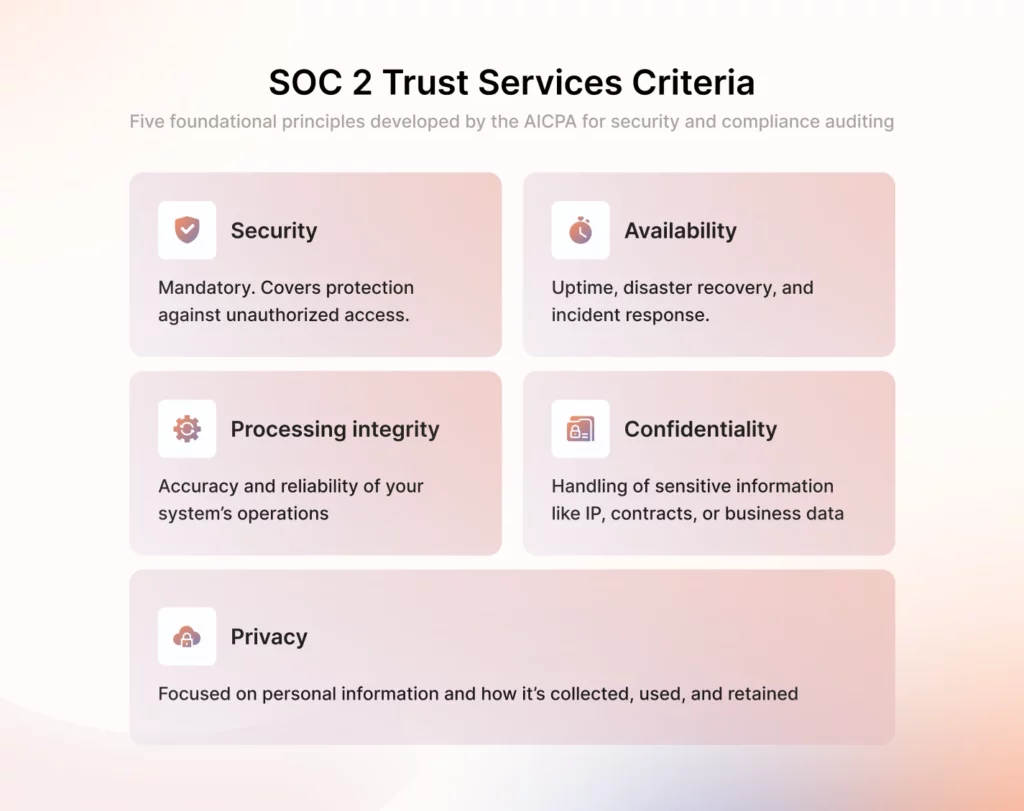\n\nMost companies start with Security and optionally include one or more of the others, depending on their industry or client needs.\n\nExpect the SOC 2 Type 2 report to be anywhere from 50 to even 100+ pages.\n\n## **SOC 2 Type 1 vs Type 2 reports: What\u2019s the difference?**\n\nBefore diving into what a SOC 2 Type 2 report includes, it\u2019s essential to understand the different types of SOC 2 reports and their purposes.\n\nWhile a\u00a0**SOC 2 Type 1 report**\u00a0evaluates the design of controls at a single point in time, a\u00a0**SOC 2 Type 2 report**\u00a0assesses how those controls operate over an extended period, typically\u00a0**3 to 12 months**.\n\n- **SOC 2 Type 1:** A SOC 2 Type 1 report is a snapshot of an organization\u2019s operational controls at a given point in time. It\u2019s useful if you\u2019re new to compliance. It\u2019s also faster to complete, but carries less weight with the security-conscious buyer.\n- **SOC 2 Type 2:** A SOC 2 type 2 report observes an organization\u2019s operational controls over a defined period, known as the observation period, and assesses both the design and effectiveness of controls. Procurement and security teams consider it more credible and thorough.\n\nHere\u2019s are the key difference between\u00a0[SOC 2 Type I vs Type 2](https://sprinto.com/soc-2/type-1-vs-type-2/)\n\n| | | |\n| --- | --- | --- |\n| **Feature** | **SOC 2 Type 1** | **SOC 2 Type 2** |\n| **Scope** | Point-in-time assessment | Ongoing assessment over a period |\n| **Focus** | Control design | Control design and operating effectiveness |\n| **Audit timeline** | Shorter (a few weeks) | Longer (3+ months) |\n| **Report frequency** | Typically once, or prior to Type 2 | Renewed annually (or biannually) |\n\n**Ready to move from Type I to Type II\u2014fast?**\n\nSee a mapped plan for your scope, gaps, and audit timeline.\n\n\ud83d\udc49 **[Get a tailored demo \u2192](https://sprinto.com/get-a-demo/)**\n\n## **Why is having a SOC 2 Type 2 report important?**\n\nA\u00a0[SOC 2 Type 2](https://sprinto.com/soc-2/type-2/)\u00a0report provides third-party validation that a service organization\u2019s controls are not only suitably designed (Type 1) but also operating effectively over a sustained period (at least 6 months), giving customers and partners assurance of reliable data security, availability, integrity, confidentiality, and/or privacy.\n\nThere\u2019s also the cost of not having it. Companies now spend up to [25% of their annual revenue](https://www.northrow.com/blog/compliance-in-2023-report) on compliance activities. Without a framework like SOC 2, those efforts become duplicated, manual, and reactive.\n\nA proper SOC 2 Type II process brings structure and repeatability to [risk management](https://sprinto.com/blog/risk-management-process/). Over time, this reduces audit fatigue and compliance overhead.\n\nAccording to Gartner,\u00a0[78% of buyers](https://www.gartner.com/en/newsroom/press-releases/2024-02-22-gartner-identifies-top-cybersecurity-trends-for-2024)\u00a0now ask for SOC 2 compliance before signing a contract. For companies in SaaS, healthtech, and fintech, not having a SOC 2 Type 2 report means you\u2019re out of the running before the first call.\n\nIn Sprinto\u2019s [Pulse of Cyber GRC 2025](https://sprinto.com/report-pulse-of-cyber-grc-2025/) survey, 40% of GRC experts said enhancing customer trust is one of the most important outcomes for GRC programs. That\u2019s exactly what a SOC 2 Type II report delivers: a recognizable, third-party trust artifact.\n\n## **Benefits of having a SOC 2 Type 2 report**\n\nA SOC 2-compliant organization indicates that the organization has the infrastructure, tools, and processes to safeguard its data from threats from the firm and externally. Here are some benefits of getting a SOC 2 Type 2 report:\n\n### **1\\. Increases trust**\n\nArguably, the biggest benefit of achieving SOC 2 Type 2 compliance is trust. When you\u2019re selling to larger organizations or handling sensitive customer data, buyers want assurance that you\u2019re not approaching it without a proper strategy and processes. A clean SOC 2 Type 2 report reduces uncertainty and builds\u00a0[confidence with stakeholders](https://sprinto.com/blog/stakeholder-alignment-in-cybersecurity/)\u00a0at every level.\n\n### **2\\. Accelerates operations**\n\n[SOC 2 compliance](https://sprinto.com/soc-2/)\u00a0helps you move faster. If you\u2019ve ever filled a 200-question security questionnaire, you already know how tedious and time-consuming that process can be. But when you have a SOC 2 Type 2 report, you can bypass much of that red tape.\n\nMany procurement teams will skip large portions of due diligence if you\u2019ve already passed a third-party audit. That can shave weeks, sometimes months, off the sales cycle.\n\n### **3\\. Operationalizes your security posture**\n\nWith SOC 2, you have systems in place to monitor access controls, encryption,\u00a0[change management](https://sprinto.com/blog/grc/regulatory-change-management/), incident response, and evidence that they\u2019re working. This pushes maturity across your organization. You\u2019ll be better prepared for security incidents and more capable of handling risk.\n\n### **4\\. Makes you stand out**\n\nWhile many peers are still scrambling to meet basic security requirements, showing up with a recent SOC 2 Type 2 report instantly sets your organization apart. It proves your systems, processes, and controls have been independently verified over time.\n\nIn fact,\u00a0[29% of organizations](https://go.a-lign.com/benchmarkreport2023?_ga=2.54619182.406184446.1709584867-1681479690.1709584867)\u00a0have lost potential new business due to the absence of a required compliance certification, like SOC 2 Type 2.\n\n## **Who needs a SOC 2 Type 2 report?**\n\n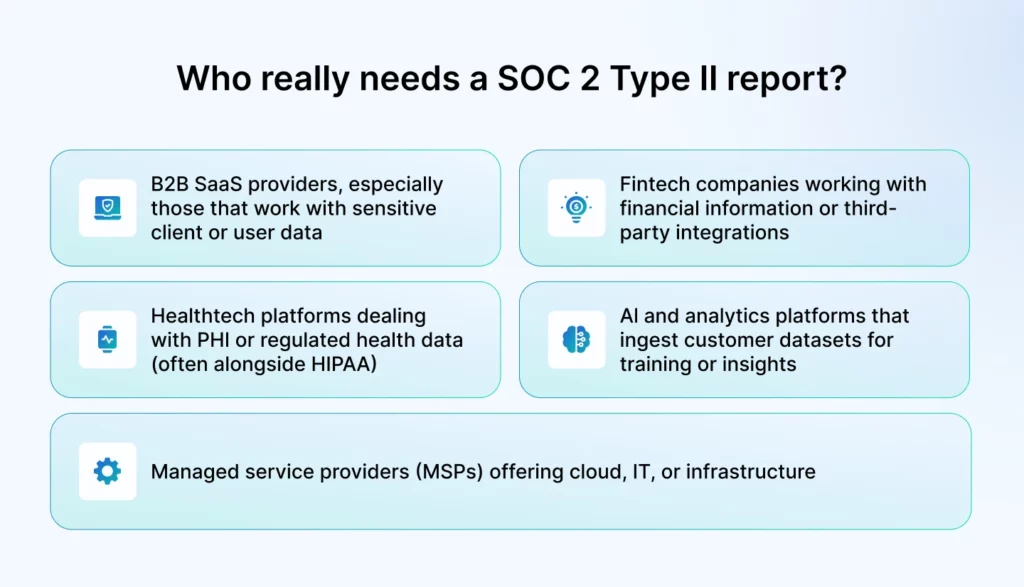\n\nIf your business stores, processes, or transmits customer data, in the cloud or otherwise, you need a SOC 2 Type 2 report. No, it\u2019s not only for publicly traded companies or enterprise vendors. It\u2019s becoming the baseline for trust across data-driven service providers.\n\n**A simple way to think about it**: If your customers are asking about data security during onboarding or procurement, a SOC 2 Type 2 report answers that question in a way they\u2019ll recognize and respect.\n\nTypical companies that benefit from SOC 2 Type 2:\n\n- **B2B SaaS providers**, especially those that work with sensitive client or user data\n- **Fintech companies**\u00a0working with financial information or third-party integrations\n- **Healthtech platforms**\u00a0dealing with\u00a0[PHI](https://sprinto.com/blog/hipaa/what-is-phi-in-hipaa/)\u00a0or regulated health data (often alongside HIPAA)\n- **AI and analytics platforms**\u00a0that ingest customer datasets for training or insights\n- **Managed service providers (MSPs**) offering cloud, IT, or infrastructure services\n\nAs SMBs move upstream or enter more regulated markets, SOC 2 Type 2 becomes less optional and more expected.\n\n## **What must your SOC 2 Type 2 report contain?**\n\nThe [SOC 2 report](https://sprinto.com/soc-2/report-example/) itself usually has many components, including:\n\n### **1\\. Management assertion**\n\nThis is your official statement signed by leadership, asserting that the controls you\u2019ve implemented to meet the relevant Trust Services Criteria (TSC) are designed and operating effectively. It shows that your organization takes ownership and responsibility before the auditor weighs in.\n\n### **2\\. Independent auditor\u2019s opinion**\n\nThe independent auditor\u2019s opinion section contains the final verdict from the CPA firm. Based on their testing, they\u2019ll state whether your controls met the required criteria over the audit period. A clean, or \u201cunqualified,\u201d opinion means the auditor found no significant issues.\n\n### **3\\. System description**\n\nThe system description contains a detailed overview of the systems, services, and boundaries covered by the audit. This includes everything from infrastructure and software to people and processes, giving context for how your environment supports security, availability, processing integrity, confidentiality, and privacy.\n\n### **4\\. Control activities**\n\nThe control activities section includes a full list of your implemented controls for each applicable TSC. It outlines what each control is intended to do (e.g., restrict access, monitor activity, respond to incidents) and how it relates to the TSC. This section often maps each control directly to specific risks and requirements.\n\n### **5\\. Testing results**\n\nFinally, the testing results is where the auditor shares what they did to evaluate each control\u2014what evidence they reviewed, what tests they ran, and whether each control passed or failed. This section gives readers a transparent view into the rigor of the audit and how your organization performed under scrutiny.\n\n**Organize your audit pack in one click**.\n\nPolicies, controls, tests, and artifacts\u2014centralized and audit-ready.\n\n\ud83d\udc49 **[See Sprinto in action \u2192](https://sprinto.com/get-a-demo/)**\n\n## **How much does a SOC 2 Type 2 audit cost?**\n\n[SOC 2 audits](https://sprinto.com/soc-2/audit/) don\u2019t come cheap, but the investment is lower than the cost of not being compliant. Although not written in stone, here\u2019s what you need to expect:\n\n- **Audit firm fees range from** [**$7,000 to $50,000,**](https://sprinto.com/soc-2/certification-cost/) **depending on the complexity of your systems, the number of controls, and whether** you\u2019ll be including criteria beyond Security.\n- **Preparation and tooling:** [Compliance automation tools](https://sprinto.com/blog/compliance-automation-tools/) help automate evidence collection and manage controls. These alone cost $5,000 to $20,000 a year.\n- **Internal resource time:** Expect anywhere between [100 to 300 hours](https://sprinto.com/soc-2/type-2-timeline/) from your team over the course of preparation and audit, if you\u2019re starting from zero.\n- **Remediation work:** If your environment isn\u2019t ready, you will need to invest in infrastructure upgrades, documentation, access control policies, or incident response plans.\n\nThe total cost can easily exceed $75K for a mid-size team. Many startups and smaller companies can do it for far less by narrowing the scope and using automation to lighten the load.\n\nHowever, the time and cost of SOC 2 prep can quickly add up for growing teams. Consider compliance automation tools like Sprinto that allow you to pay for what you use.\n\n[Sprinto](https://sprinto.com/) offers you a personalized dashboard with specific features and workflows to minimize manual effort and maximize efficiency, reducing the time and cost to achieve the SOC 2 Type 2 report marginally.\n\n[Sprinto helped Ripl](https://sprinto.com/customers/ripl/) achieve SOC 2 readiness in just **25 days** and complete their Type 2 audit in **14 days** after surveillance. With Sprinto\u2019s automation in place, Ripl now manages ongoing compliance with just 10 minutes of oversight per week.\n\n## **When should you conduct a SOC 2 Type 2 audit?**\n\nYou should conduct a SOC 2 Type II audit once your security controls are fully implemented and once you have reasonable confidence and evidence that they have functioned consistently (through monitoring) over a period of the observation period.\n\nThis audit is especially important when customers or partners require proof of sustained compliance and operational reliability.\n\nA common path is to begin with a SOC 2 Type I to validate your control design, then transition to a Type II once your systems have stabilized, as this Redditor exemplifies.\n\n\n\nVia [Reddit](https://www.reddit.com/r/cybersecurity/comments/1gnzdzf/cheapest_ideally_quickest_way_to_get_soc2_for_a/)\n\nFor many high-growth SaaS companies, on the other hand, the right time to kick off a Type II audit is just after raising a seed or Series A round, when you\u2019re scaling, building trust with enterprise prospects, and trying to close larger deals.\n\n**Also, read:** What Is a [Trust Center](https://sprinto.com/blog/what-is-a-trust-center/)?\n\nWith all that said, let\u2019s see how you have to prepare for a SOC Type II audit.\n\n## **How to prepare for a SOC 2 Type 2 audit?**\n\nFollow these proven preparation steps, which have been used by companies with successful audits, to complete the audit without disrupting your team\u2019s workflow.\n\n### **Step 1: Define your scope early on**\n\nSOC 2 scope defines the boundaries for assessing internal controls during a SOC 2 audit. It clarifies which service providers control and which systems must be evaluated to ensure the protection of customer data.\n\nTo define your SOC 2 Type 2 scope, typically involves the following steps:\n\n- **Identify key services**: Focus on the services that handle sensitive customer data.\n- **Map supporting systems**: List the apps, infrastructure, and workflows behind those services.\n- **Document policies**: Include the security and availability policies that guide your operations.\n- **List involved personnel**: Call out the teams and roles directly managing in-scope services.\n- **Align with trust criteria**: Ensure your scope matches relevant Trust Services Criteria like security or availability.\n\n### **Step 2: Document your policies and procedures**\n\nAuditors want to see written, approved, and distributed policies. That means access control policies, vendor risk management, change management, incident response, encryption standards, and more. It doesn\u2019t count if it\u2019s not documented,\n\nDon\u2019t just download templates and call it done. Review and adapt them to reflect how your team works. Auditors are quick to catch on when policy and reality don\u2019t match.\n\n### **Step 3: Implement the technical controls**\n\nTechnical controls depend on your SOC 2 scope and the Trust Services Criteria (TSC) selected by your organization. These controls must be precisely mapped to the specific SOC 2 requirements, as SOC 2 does not mandate any particular controls by default.\n\nAt a minimum, make sure you have:\n\n- SSO and MFA are enabled for all critical systems\n- Role-based access control with provisioning and deprovisioning processes\n- Logging and monitoring on production systems\n- Secure development and deployment practices like code reviews, CI/CD controls\n- Regular backups and disaster recovery testing\n\nThe tools we mentioned earlier can automate much of this, but they don\u2019t replace the need for operational discipline.\n\nGetting ready for a SOC 2 Type II audit can feel overwhelming, especially when you\u2019re juggling documentation, tooling, and team coordination. This is where a platform like [Sprinto](https://go.sprinto.com/lp-soc-2-india-pmax) can make a big difference.\n\nIt maps controls to the SOC 2 framework out of the box, automates evidence collection, and guides you through what needs to happen next.\n\nInstead of duct-taping your way through spreadsheets and screenshots, Sprinto plugs into your existing systems and helps you stay audit-ready without the heavy lift.\n\n### **Step 4: Carry out a readiness assessment**\n\nA [SOC 2 readiness assessment](https://sprinto.com/soc-2/readiness-assessment/) is a pre-audit evaluation that helps your organization determine how prepared it is to undergo a formal SOC 2 audit.\n\nEither self-led or conducted with a consultant, before you invite an auditor, it helps point out gaps and broken processes before they become official audit findings.\n\nAfter the assessment, your next steps are to review the findings, fix any gaps, update your policies, and make sure your security practices are clearly documented.\n\nOnce everything\u2019s in place, you\u2019re ready to bring in a certified auditor to start the official SOC 2 process.\n\n### **Step 5: Choose an audit partner**\n\nYou\u2019ll work with this firm for at least a few months, possibly years. Choose a CPA firm with evidential SOC 2 experience; ideally, one that\u2019s worked with companies your size and in your industry.\n\nHere are some more things to keep in mind:\n\n- **Must be a licensed CPA firm**: If they\u2019re not licensed, the SOC 2 report won\u2019t be valid.\n- **Relevant industry experience**: Choose an auditor who understands your specific industry (e.g., SaaS vs. healthcare).\n- **Pre-audit support:** Some firms offer readiness assessments to help you prepare before the formal audit.\n- **Clear pricing and timelines:** Make sure you know what you\u2019re paying for and how long the process will take.\n- **Strong security knowledge**: Auditors should be familiar with modern DevOps, cloud environments, and compliance tools.\n\nAlso, consider whether they work well with your tech stack. Misalignment here creates unnecessary friction.\n\n### **Step 6: Train your team**\n\nEveryone should understand their role in compliance, from engineers and IT to HR and support. Even a 10-minute security awareness session does a lot.\n\nSOC 2 Type 2 auditors often speak with team members during virtual or onsite walkthroughs to see if policies are being followed in practice. These are usually casual interviews or quick chats with people across IT, HR, support, or engineering.\n\nThe goal isn\u2019t to quiz anyone deeply, but to confirm that basic processes like access control or incident response are understood and followed. It can raise red flags if someone seems unaware of key security steps relevant to their role.\n\nSo while not everyone will be interviewed, it\u2019s best to prepare your team as if they might be.\n\n## **Expedite your SOC 2 Type 2 report with Sprinto**\n\nGetting SOC 2 Type II compliant is a big step, but it doesn\u2019t have to drain your time or budget. [Sprinto](https://sprinto.com/) makes it easier.\n\nSprinto handles up to 90% of the heavy lifting while getting you a SOC 2 Type 2 report. From pre-mapped [SOC 2 controls](https://sprinto.com/soc-2/controls/) and real-time evidence collection to built-in security training and expert guidance, it helps you get audit-ready without burning out your team.\n\nBecause compliance isn\u2019t a one-time event, Sprinto keeps you on track year-round with smart alerts, continuous monitoring, and support for other frameworks like ISO 27001 and GDPR.\n\n\n\nSOC 2 draining effort and time?\n\nAutomate and Fastrack with Sprinto.\n\n[Let\u2019s talk](https://sprinto.com/get-a-demo/?utm_source=organic&utm_medium=inline_cta-1&utm_campaign=blog) [Learn more >](https://sprinto.com/frameworks/iso-27001/?utm_source=organic&utm_medium=inline_cta-2&utm_campaign=blog)\n\n## **FAQs**\n\n**How long is a SOC 2 Type II report valid?**\n\nSOC 2 Type II reports are generally valid for 12 months from the end of the audit period. After that, customers may start asking for an updated report to confirm that your controls are still working.\n\n**What\u2019s the difference between SOC 2 Type I and SOC 2 Type II?**\n\nSOC 2 Type I provides a snapshot evaluation of your controls at a single point in time, while SOC 2 Type II provides a more robust assessment of ongoing effectiveness over time (often 3\u201312 months). Although Type I is quicker, Type II earns greater credibility with enterprise buyers, clearly demonstrating your sustained commitment to security.\n\n**How often are SOC 2 reports required?**\n\nMost companies update their SOC 2 Type II report annually. The newest version must not be more than a year old if you\u2019re working with regulated or enterprise clients.\n\n**How long does a SOC 2 Type 2 audit take?**\n\nA SOC 2 Type II audit typically spans 3 to 12 months, as it evaluates how controls operate over a period of time, unlike Type I which assesses them at a single point in time.\n\n**Who needs a SOC 2 Type 2 report?**\n\nAny company that handles or stores customer data on behalf of clients, particularly SaaS providers, cloud service providers, or technology vendors, typically requires a SOC 2 Type II report to demonstrate trust and security assurance.\n\n\n\n##### Author\n\n## Pansy\n\nPansy is an ISC2 Certified in Cybersecurity content marketer with a background in Computer Science engineering. Lately, she has been exploring the world of marketing through the lens of GRC (Governance, risk & compliance) with Sprinto. When she\u2019s not working, she\u2019s either deeply engrossed in political fiction or honing her culinary skills. You may also find her sunbathing on a beach or hiking through a dense forest.\n\nSubscribe to Ctrl+GRC\n\nGo beyond the surface and uncover the governance, risk, and compliance insights that actually matter.\n\nSpin to win big\n\n\n\nGrab your top 1% ticketSubscribe to our newsletter to spin.\n\nWin digital goodies for boardroom success\n\n\n\nCongratulations!You\u2019ve unlocked\u2028Boardroom-Ready InsightsCheck your inbox for your reward\n\n\n\n## Explore more SOC 2 articles\n\n### SOC 2 Compliance Overview\n\n- [What is SOC 2 Compliance](https://sprinto.com/soc-2/)\n- [What is SOC 2 Framework](https://sprinto.com/soc-2/framework/)\n- [SOC 2 Compliance Checklist](https://sprinto.com/soc-2/checklist/)\n- [SOC 2 Certification](https://sprinto.com/soc-2/certification/)\n- [SOC 2 Controls List](https://sprinto.com/soc-2/controls/)\n- [SOC 2 Attestation Guide](https://sprinto.com/soc-2/attestation/)\n- [SOC 2 Type 2 Guide](https://sprinto.com/soc-2/type-2/)\n\n### SOC 2 Preparation and Documentation\n\n- [What is SOC 2 Scope](https://sprinto.com/soc-2/scope/)\n- [List of SOC 2 Compliance Documentation](https://sprinto.com/soc-2/documentation/)\n- [SOC 2 Requirements List](https://sprinto.com/soc-2/requirements/)\n- [SOC 2 Compliance Cost Breakdown](https://sprinto.com/soc-2/certification-cost/)\n- [SOC 2 Policies](https://sprinto.com/soc-2/policies-and-procedures/)\n- [SOC 2 Readiness Assessment List](https://sprinto.com/soc-2/readiness-assessment/)\n- [SOC 2 Self-Assessment](https://sprinto.com/soc-2/self-assessment/)\n- [SOC 2 Disaster Recovery Plan](https://sprinto.com/soc-2/disaster-recovery/)\n- [SOC 2 Password Security Requirements](https://sprinto.com/soc-2/password-requirements/)\n\n### SOC 2 Audit and Reporting\n\n- [How to Prepare for SOC 2 Audit](https://sprinto.com/soc-2/how-to-prepare-for-soc-2-audit/)\n- [SOC 2 Audit Guide](https://sprinto.com/soc-2/audit/)\n- [SOC 2 Audit Cost Breakdown](https://sprinto.com/soc-2/audit-cost/)\n- [SOC 2 Type 1 Report](https://sprinto.com/soc-2/type-1/)\n- [SOC 2 Reports](https://sprinto.com/soc-2/report/)\n- [SOC 2 Report Example](https://sprinto.com/soc-2/report-example/)\n- [SOC 2 Type 2 Report](https://sprinto.com/soc-2/type-2-report/)\n- [List of SOC 2 Auditors](https://sprinto.com/soc-2/auditors/)\n\n### SOC 2 Differences and Similarities\n\n- [Difference between SOC 1 vs SOC 2](https://sprinto.com/blog/soc-1-vs-soc-2/)\n- [Difference between SOC 2 vs SOC 3](https://sprinto.com/blog/soc-2-vs-soc-3/)\n- [Difference between SOC 2 vs ISO 27001](https://sprinto.com/blog/soc-2-vs-iso-27001/)\n- [Difference between SOC 1 vs SOC 2 vs SOC 3](https://sprinto.com/blog/soc-1-soc-2-soc-3/)\n- [Difference between SOC 2 Type 1 vs Type 2](https://sprinto.com/soc-2/type-1-vs-type-2/)\n- [Difference between SOC 2 vs NIST](https://sprinto.com/blog/soc-2-vs-nist/)\n- [Difference between HITRUST vs SOC 2](https://sprinto.com/blog/hitrust-vs-soc-2/)\n- [Difference between FedRAMP vs SOC 2](https://sprinto.com/blog/fedramp-vs-soc-2/)\n\n### SOC 2 Updates & Management\n\n- [SOC 2 Automation](https://sprinto.com/soc-2/automation/)\n- [SOC 2 Evidence Collection](https://sprinto.com/soc-2/evidence-collection/)\n- [SOC 2 Vendor Management](https://sprinto.com/soc-2/vendor-management/)\n- [SOC 2 Compliance for Data Centers](https://sprinto.com/soc-2/data-centers/)\n- [SOC 2 Change Management](https://sprinto.com/soc-2/change-management/)\n- [SOC 2 Compliance Questionnaire](https://sprinto.com/soc-2/compliance-questionnaire/)\n\n### SOC 2 Industry-Specific Applications\n\n- [SOC 2 for Startups](https://sprinto.com/blog/soc-2-guide-for-startups/)\n- [SOC 2 for Healthcare](https://sprinto.com/blog/soc-2-for-healthcare/)\n- [SOC 2 for Cloud](https://sprinto.com/blog/soc-2-for-cloud/)\n- [SOC 2 for Fintech](https://sprinto.com/blog/soc-2-for-fintech/)\n- [SOC 2 for Small Business](https://sprinto.com/soc-2/audit-for-small-business/)\n- [SOC 2 for SAAS](https://sprinto.com/soc-2/for-saas-companies/)\n\n**Tired of fluff GRC and cybersecurity content?**Subscribe to our newsletter and get detailed\n\nresearch & insights curated to help you earn a seat at the table.\n\n\n\n##### **Book your personal demo** today! Get your questions answered\n\n[Looking to partner with Sprinto?](https://sprinto62612.e.wpstage.net/partners-program/)\n\n\n\nMeet Sprinto AI\n\n[Check it out](https://sprinto.com/products/ai/)",
"content_chars": 29261,
"published_date": null
},
{
"rank": 4,
"url": "https://secureframe.com/hub/soc-2/audit-timeline",
"title": "How Long Does a SOC 2 Audit Take? - Secureframe",
"content": "\n\n[Skip to main content](https://secureframe.com/hub/soc-2/audit-timeline#main-content)\n\n[CMMC Pause: What DoW & Primes Still Require\\\\\n](https://secureframe.com/blog/cmmc-news-2026-phase-2-pause) [CMMC Phase 2 on Hold: What the DoW and Primes Still Require\\\\\nRead the update](https://secureframe.com/blog/cmmc-news-2026-phase-2-pause)\n\n\n\n# How Long Does a SOC 2 Audit Take?\n\n- [soc-2](https://secureframe.com/hub/soc-2)\n- How Long Does a SOC 2 Audit Take?\n\nThe traditional process of getting a SOC 2 report can be pretty lengthy and involved. Especially if you [opt for a SOC 2 Type II report](https://secureframe.com/blog/soc-2-type-ii).\n\nCompliance automation software can slash this timeline from months to weeks. By automatically monitoring your infrastructure and collecting evidence, it cuts audit preparation from months to weeks.\n\nRegardless of which approach you choose, SOC 2 has three phases: the pre-audit, audit window, and the audit itself.\n\nWatch the video below for a quick answer to how long a SOC 2 audit itself takes.\n\nHow long does a SOC 2 audit take? \\| Secureframe - YouTube\n\nTap to unmute\n\n[How long does a SOC 2 audit take? \\| Secureframe](https://www.youtube.com/watch?v=Yb7Xxg2_hSs) [Secureframe](https://www.youtube.com/channel/UCgLRXVQAveomOrDgvK-sJXA)\n\n\n\nSecureframe942 subscribers\n\n[Watch on](https://www.youtube.com/watch?v=Yb7Xxg2_hSs)\n\nThen keep reading to understand how long it takes to get a [SOC 2 report with and without automation](https://secureframe.com/hub/soc-2/automation).\n\n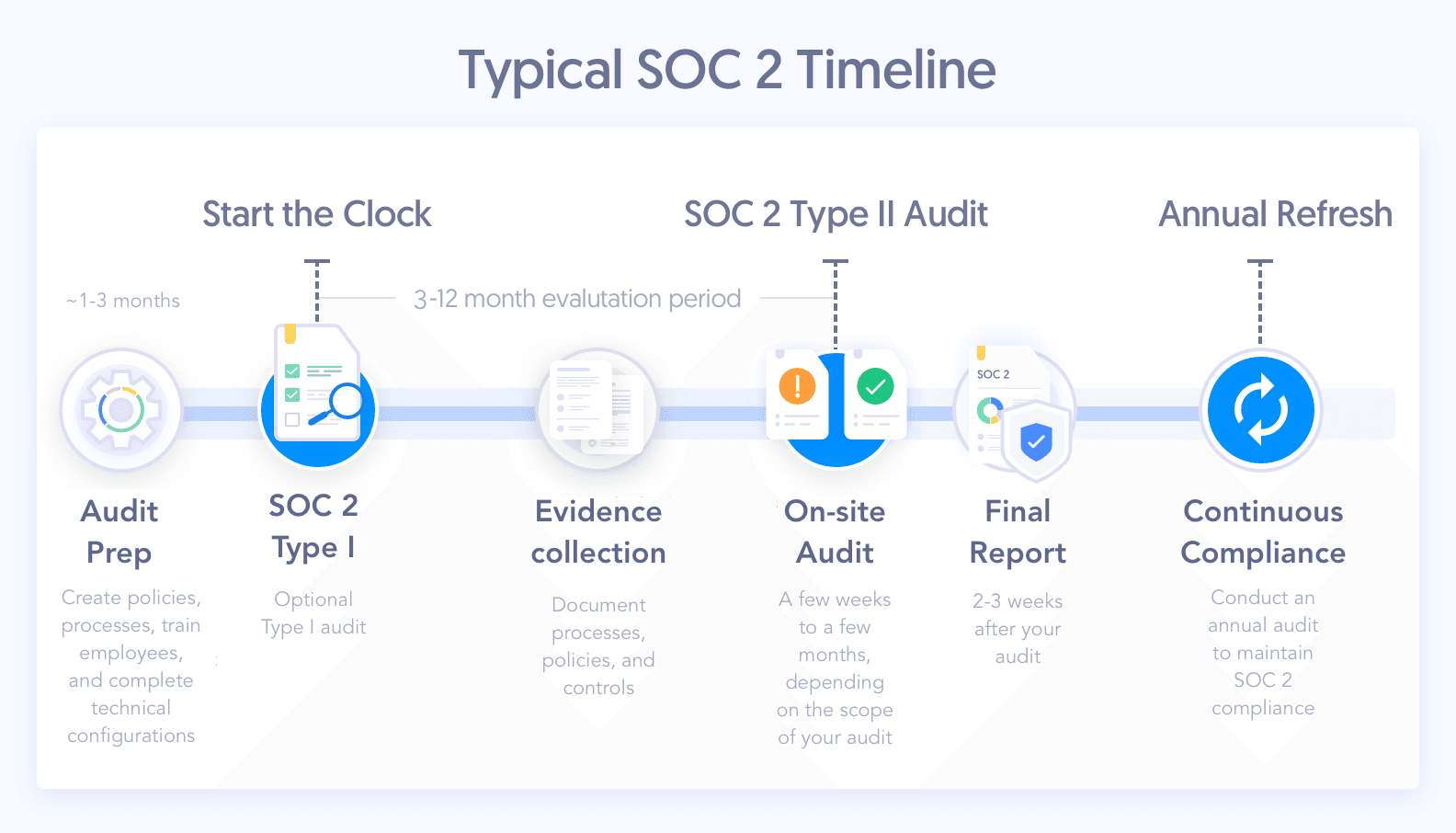\n\n# SOC 2 Type I Audit Timeline\n\nPre-Audit Phase Month 1 - Month 3\n\nStep 1: Create policies\n\nStep 2: Establish and document procedures\n\nStep 3: Update internal processes\n\nStep 4: Complete technical configuration remediation\n\nStep 5: Train and educate employees\n\nAudit Phase Month 4\n\nStep 6: Begin the Type I audit\n\nStep 7: Receive your SOC 2 Type I report\n\n# SOC 2 Type II Audit Timeline\n\nPre-Audit Phase Month 1 - Month 9\n\nStep 1: Select SOC 2 Type I or Type II\n\nStep 2: Define the audit scope\n\nStep 3: Conduct a gap analysis\n\nStep 4: Complete technical configuration remediation\n\nStep 5: Collect documentation\n\nStep 6: Complete a readiness assessment\n\nAudit Window Phase\n\nStep 7: Begin 3, 6, 9, or 12 month review period\n\nAudit Phase Month 9 - Month 12\n\nStep 8: Start the formal audit process\n\nStep 9: Receive your SOC 2 report\n\n# How Long Does It Take to Get SOC 2 Compliance?\n\n### Pre-audit phase: 2 weeks-9 months\n\nFirst, you\u2019ll choose your report type, Type I or Type II, and select your Trust Services Criteria. You can include only Security or all five TSC. You\u2019ll also determine the time frame and scope of your audit.\n\nNext, you\u2019ll assess the current state of your systems. Conduct a gap analysis to determine what you need to bring your controls in line with [SOC 2 requirements](https://secureframe.com/hub/soc-2/requirements).\n\nThen you can work to close the gaps and compile the necessary documentation. You may also complete a readiness assessment to ensure you\u2019re prepared. After passing the readiness test, you can start the SOC 2 audit process.\n\n\n\n### Audit Window Phase (Type II Report): 3, 6, 9, or 12 months\n\nThis is your audit window and will determine the period of time that\u2019s covered in your final SOC 2 Type II report. This is when you\u2019ll collect evidence and document how your controls are performing.\n\n### Audit phase: 1-3 months\n\nYour auditor will set a list of deliverables and perform a series of control tests based on the [Trust Service Criteria](https://secureframe.com/hub/soc-2/trust-services-criteria) you\u2019ve selected.\n\nNext, your auditor will gather evidence, collect and review documentation, and interview members of your team.\n\nOnce they have the information they need, they'll write up your [formal SOC 2 report](https://secureframe.com/hub/soc-2/what-is-a-soc-2-report). This report will include the auditor\u2019s decision on whether you passed the audit.\n\nThe actual SOC 2 audit typically takes between five weeks and three months. This depends on factors like [the scope of your audit](https://secureframe.com/hub/soc-2/scope) and the number of controls involved.\n\n# How Compliance Automation Streamlines SOC 2\n\nTraditional SOC 2 [audits require a ton of prep work](https://secureframe.com/hub/soc-2/preparation).\n\nYou have to [write a bunch of policies](https://secureframe.com/hub/soc-2/policies-and-procedures), collect and organize hundreds of pieces of evidence, hunt down vendor security certificates, and do a slew of other tedious, time-consuming tasks. It's a slog.\n\nSecureframe can make the entire audit process way more efficient.\n\nWe help companies get their SOC 2 in a fraction of the time \u2014 even compared to other [compliance automation](https://secureframe.com/hub/soc-2/manual-vs-automated) vendors.\n\nHere's how:\n\n### Automated Evidence Collection\n\nOur platform automatically collects evidence during your audit window. It also ensures you stay secure by alerting you of any vulnerabilities in your tech stack and telling you how to fix them.\n\n### Policy Libraries\n\nInstead of writing a bunch of policies from scratch, you can choose from our library of templated policies and customize from there. They're all vetted and approved by ex-auditors and compliance experts.\n\n### Vendor Management\n\nInstead of you requesting security certificates from all of your vendors, Secureframe fetches their security data for you. We'll also perform [vendor risk](https://secureframe.com/blog/vendor-risk-management) assessments and provide detailed risk reports.\n\n### Audit Prep Dashboards\n\nAssign tasks to individuals on your team and track your progress towards being audit-ready. You\u2019ll get a real-time view of what\u2019s looking good and what you can do to improve before bringing in an auditor.\n\n[Our customers](https://secureframe.com/customers) have gotten ready for a successful SOC 2 audit in just a few weeks.\n\n# SOC 2 Audit Window FAQs\n\n### 1\\. What is the industry standard window for a SOC 2 Type 2 report?\n\nTypically, more mature enterprises settle into a 1 year Type 2 window for their SOC 2.\n\nHowever, shorter windows for Type 2 reports are acceptable when first going through the compliance process, with the minimum window being 3 months. This allows organizations with an urgent need for a report to get their SOC 2 quickly.\n\nIf you don't have an urgent demand for a SOC 2 Type 2 report, consider at least a 6-month reporting window for your first report, since a\u00a0 longer window signals greater maturity in your security posture.\n\n### 2\\. I'm new to SOC 2. How do I determine what the start date of my audit window should be?\n\nThe biggest consideration is the date you became \"ready\" for your audit, which includes implementing any remediation activities that were pointed out to you either during the readiness phase or the Type 1 audit phase.\n\nWhen you go through a Type 2 audit, the auditor can sample any event, access, or change that existed starting from the first date of your window, so you want to make sure that you don't start the window until you're truly ready to be operating your controls. This means all key configurations are in place, and all processes are in place and followed for things like documenting new user access, etc.\n\n### 3\\. I already have a previously issued SOC 2 Type 1 report. What should the start date of my Type 2 audit window be?\n\nThere are two considerations. First, if the auditor pointed out some controls in your Type 1 audit that you had to fix before your Type 1 date, then you should consider postponing your window until all of those items are fixed.\n\nSecond, if you didn't need to fix anything during your Type 1, you could consider starting your Type 2 window at a date earlier than your Type 1 date. This way the auditor could potentially leverage some of the audit work already done for the Type 1 report, reducing your time spent with the Type 2 auditor. You\u2019ll need to talk with your auditor about whether this situation is feasible and fits their methodology beforehand.\n\n### 4\\. I already have a previously issued SOC 2 Type 2 report. What should the start date of my audit window be this time around? Is it ok if there is a gap? Should there be a gap?\n\nGenerally, you should aim to have your next Type 2 window start the day after your first Type 2 ended. So, if you have a Type 2 report issued for the period January 1, 2021, to December 31, 2021, the best-case scenario is for your next period to be January 1, 2022, to December 31, 2022.\n\nIf you're not able to do this it's OK to have a gap. But you might have some explaining to do to key customers who review your report, so make sure you have a good explanation!\n\n### 5\\. When I choose an audit window, am I then locked into that window for all subsequent years? Can I change my audit window, and when should I consider a change?\n\nYour window can change year over year as you see fit. Generally, organizations settle into a routine that their customers come to expect.\n\nReasons to consider a change in timing might be:\n\n- To extend your window (i.e., from a 3-month to a 12-month)\n- To move your timing based on the needs of a client\n- To align with other compliance initiatives such as ISO 27001, PCI DSS, SOC 1, SOX, etc,\n- To add a new product in scope\n\n### 6\\. What effect does switching auditors or compliance tools have on my SOC 2 Type 2 audit period?\n\nA switch in auditor or compliance tool doesn't necessarily mean that any timing needs to change. However, depending on the circumstances that necessitated the switch, you should always consider whether your controls have operated seamlessly over the entire time period for your next Type 2 window. Be realistic about when your new Type 2 window should be so that your Type 2 report does not contain deviations.\n\n[The SOC 2 Audit Process](https://secureframe.com/hub/soc-2/audit-process)\n\n[How Much Does a SOC 2 Audit Cost?](https://secureframe.com/hub/soc-2/audit-cost)\n\n- [Tweet](http://twitter.com/share?text=How%20Long%20Does%20a%20SOC%202%20Audit%20Take?&url=https://secureframe.com/hub/soc-2/audit-timeline)\n- [Share](https://www.facebook.com/sharer/sharer.php?u=https://secureframe.com/hub/soc-2/audit-timeline)\n- [Share](http://www.linkedin.com/shareArticle?mini=true&title=How%20Long%20Does%20a%20SOC%202%20Audit%20Take?&url=https://secureframe.com/hub/soc-2/audit-timeline)\n- [Send](mailto:?subject=How%20Long%20Does%20a%20SOC%202%20Audit%20Take?&body=https://secureframe.com/hub/soc-2/audit-timeline)\n\n## SOC 2 Overview\n\n- [**What is SOC 2\u00ae\u00a0?**](https://secureframe.com/hub/soc-2/what-is-soc-2)\n- [**Why is SOC 2 Important?**](https://secureframe.com/hub/soc-2/why-is-soc-2-important)\n- [**SOC 1 vs SOC 2 vs SOC 3**](https://secureframe.com/hub/soc-2/soc-1-vs-soc-2-vs-soc-3)\n- [**Trust Services Criteria**](https://secureframe.com/hub/soc-2/trust-services-criteria)\n- [**SOC 2 Common Criteria**](https://secureframe.com/hub/soc-2/common-criteria)\n- [**SOC 2 Controls List: What Controls Do You Need to Implement?**](https://secureframe.com/hub/soc-2/controls)\n- [**The History of SOC 2**](https://secureframe.com/hub/soc-2/history)\n\n## Report Structures\n\n- [**What is a SOC 2 Report?**](https://secureframe.com/hub/soc-2/what-is-a-soc-2-report)\n- [**What Does a SOC 2 Report Cover?**](https://secureframe.com/hub/soc-2/report-coverage)\n- [**A Real-World SOC 2 Report Example Explained \\[+ Free PDF Download\\]**](https://secureframe.com/hub/soc-2/report-example)\n- [**SOC 2 Report Validity**](https://secureframe.com/hub/soc-2/report-validity)\n- [**Common SOC 2 Audit Exceptions and How to Avoid Them**](https://secureframe.com/hub/soc-2/audit-exceptions)\n- [**What is a SOC 2 Bridge Letter? + Template**](https://secureframe.com/hub/soc-2/bridge-letter)\n\n## Audit Process, Timeline, & Costs\n\n- [**SOC 2 Type 1 vs Type 2**](https://secureframe.com/hub/soc-2/type-1-vs-type-2)\n- [**The SOC 2 Audit Process**](https://secureframe.com/hub/soc-2/audit-process)\n- [**How Long Does a SOC 2 Audit Take?**](https://secureframe.com/hub/soc-2/audit-timeline)\n- [**How Much Does a SOC 2 Audit Cost?**](https://secureframe.com/hub/soc-2/audit-cost)\n- [**Who Performs a SOC 2 Audit?**](https://secureframe.com/hub/soc-2/who-performs-a-soc-2-audit)\n- [**SOC 2 Audit Frequency**](https://secureframe.com/hub/soc-2/audit-frequency)\n\n## How to Prepare for an Audit\n\n- [**How to Define Your SOC 2 Audit Scope**](https://secureframe.com/hub/soc-2/scope)\n- [**SOC 2 Compliance Requirements**](https://secureframe.com/hub/soc-2/requirements)\n- [**Establishing a SOC 2 Project Plan**](https://secureframe.com/hub/soc-2/project-plan)\n- [**SOC 2 Policies and Procedures**](https://secureframe.com/hub/soc-2/policies-and-procedures)\n- [**SOC 2 Compliance Documentation**](https://secureframe.com/hub/soc-2/compliance-documentation)\n- [**The SOC 2 Readiness Assessment Explained + Free Checklist**](https://secureframe.com/hub/soc-2/readiness)\n\n## Automating SOC 2 Compliance\n\n- [**What Is SOC 2 Compliance Automation? How to Simplify Your SOC 2**](https://secureframe.com/hub/soc-2/manual-vs-automated)\n- [**The Cost Benefits of SOC 2 Automation**](https://secureframe.com/hub/soc-2/cost-and-time-savings)\n- [**Security Insights**](https://secureframe.com/hub/soc-2/security-insights)\n- [**Maintaining SOC 2 Compliance Year Round**](https://secureframe.com/hub/soc-2/maintain-compliance)\n\n## SOC 2 Resources and Tools\n\n- [**SOC 2 Audit Training**](https://secureframe.com/hub/soc-2/audit-trainings)\n- [**SOC 2\u00ae FAQs: Common Compliance Questions Answered**](https://secureframe.com/hub/soc-2/faq)",
"content_chars": 18088,
"published_date": null
},
{
"rank": 5,
"url": "https://www.scrut.io/hub/soc-2/soc-2-compliance-timeline",
"title": "SOC 2 compliance timeline: How long does it really take? - Scrut Automation",
"content": "From Dashboards to Action: The Rise of Agentic GRC \\| [Watch the webinar on demand](https://www.scrut.io/webinars/the-rise-of-agentic-grc)\n\n\n\nThe Business Impact of Compliance Automation with Scrut 2026\n\n\\|\n\nSee the business outcomes real companies reported after automating compliance.\n\n[Watch Now\\\\\n\\\\\nWatch Now](https://www.scrut.io/webinars/running-a-lean-grc-program) [Read Now\\\\\n\\\\\nRead Now](https://www.scrut.io/lp1/business-impact-compliance-automation-report-2026)\n\n[](https://www.scrut.io/)\n\nX\n\n%20(1).png)\n\n[Login](https://app.scrut.io/) [Book a Demo\\\\\n\\\\\nBook a Demo](https://www.scrut.io/book-a-demo)\n\nRegister a Deal\n\nRegister a Deal\n\n[Go back to blogs](https://www.scrut.io/blog)\n\n# SOC 2 compliance timeline: How long does it really take?\n\nLast updated on\n\nAugust 7, 2026\n\n10\n\nmin. read\n\n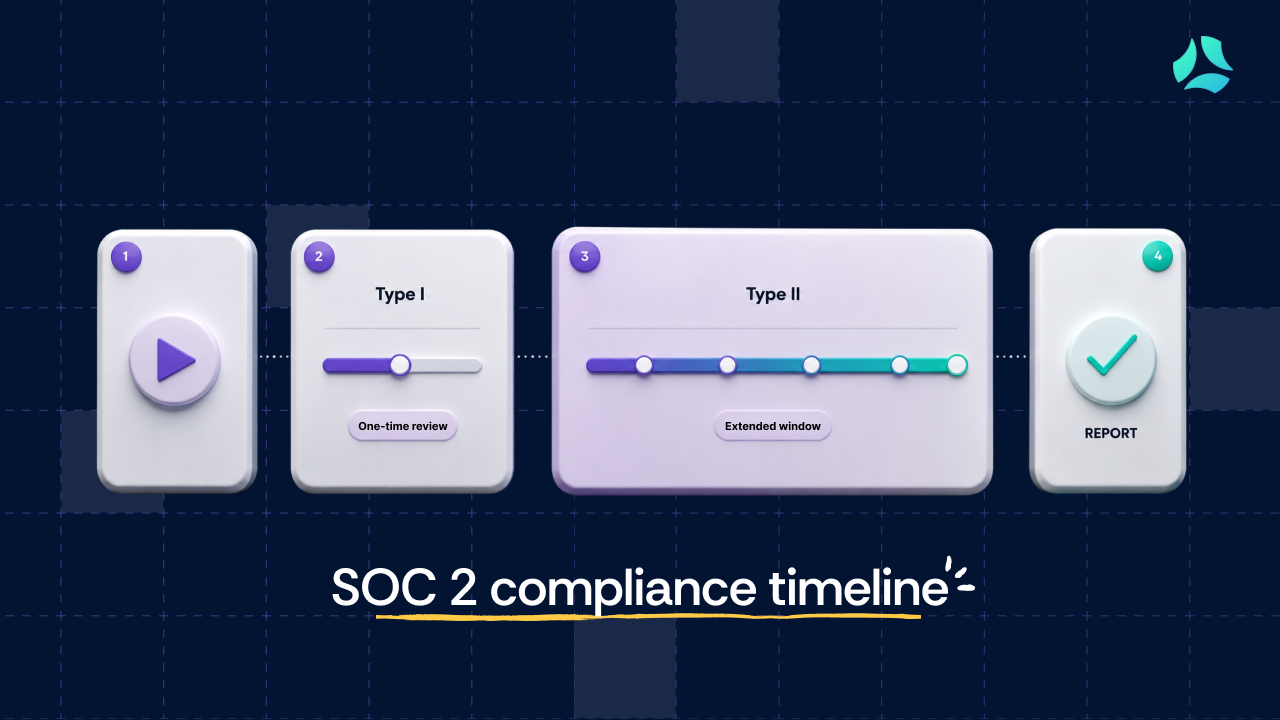\n\nMost organizations get to their first SOC 2 in 3 to 6 months for a Type I and 6 to 12 months for a Type II. If you are a GRC manager, security lead, or founder being asked for a SOC 2 report, this guide breaks down every phase of the timeline with specific numbers.\n\nThe timeline is not fixed. It is determined by three variables you control: control maturity, audit scope, and resource bandwidth. And two you do not: auditor availability and third-party dependencies. Where a team lands inside those ranges comes down almost entirely to how much of the control work is already practiced and evidenced before the clock starts.\n\nOne assumption worth examining early: the standard advice is to start with Type I and upgrade later. However, in practice, as Kush Kaushik, Co-founder of Scrut Automation, notes from vendor data: up to 70% of companies skip Type I entirely and go directly to Type II. That does not make the default advice wrong, but it does mean the decision deserves more thought than a reflex.\n\nWe cover that decision in full below, along with how to run a [readiness assessment](https://www.scrut.io/post/soc-2-readiness-assessments) and the mechanics of [defining your audit scope](https://www.scrut.io/post/soc-2-scope-a-step-by-step-guide) before you engage an auditor.\n\n## **Key takeaways**\n\n- The SOC 2 compliance timeline is 3 to 6 months for Type I and 6 to 12 months for Type II, but the real variable is how ready your controls are on day one.\n- Type I assesses control design at a single point in time. Type II adds a 3 to 12-month observation period to prove operating effectiveness.\n- Four common stall points: late auditor engagement, manual evidence collection, scope creep, and gaps in periodic controls like access reviews.\n- SOC 2 reports are treated as valid for 12 months; renewals typically complete in 6 to 8 months.\n- Compliance automation can cut audit prep time significantly. Contentstack reduced its SOC 2 timeline by about 2 months after moving from spreadsheets to Scrut.\n\n## **SOC 2 Type I audit process and timeline**\n\nA SOC 2 Type I audit assesses whether your controls are designed effectively at a single point in time. The auditor\u2019s opinion is essentially: \u201cthese controls exist and are architected correctly as of this date.\u201d That word \u201carchitected\u201d matters. For a first-timer, design is not just that a control exists on paper. It is that the control is built the right way to address the relevant Trust Services Criteria. A password policy that exists but does not enforce MFA is a control that exists and is poorly designed.\n\nEnd-to-end, most organizations complete Type I in 3 to 6 months across three phases.\n\n### **Phase 1: Pre-audit preparation (1 to 3 months)**\n\nThis is where most of the work happens. You define scope, draft and implement policies, and remediate the gaps surfaced by a [gap assessment](https://www.scrut.io/post/soc-2-readiness-assessments). Type I is faster and cheaper than Type II for one specific reason: because the auditor verifies your controls as of a single date, they review far fewer pieces of evidence, not evidence accumulated across a period of time. That compresses both cost and calendar. Getting your [required policies](https://www.scrut.io/post/soc-2-compliance-policies) in place is usually the longest single task in this phase.\n\n### **Phase 2: Audit fieldwork (2 to 5 weeks)**\n\nThe audit date for Type I is agreed between your organization and the auditor in advance. During fieldwork, the auditor reviews controls, interviews key people, and tests documentation as of that agreed date. One point that first-timers miss: the auditor may request and review evidence before the official audit date to test certain controls ahead of time. Because Type I does not involve observing controls over a period, fieldwork is short.\n\n### **Phase 3: Report creation and delivery (2 to 6 weeks)**\n\nFieldwork is not the finish line. Once it is complete, the auditor compiles findings and shares a draft report for management review. Your team confirms or prepares the system description (Section III of the report), which is your document, not the auditor\u2019s. Only after this review does the auditor issue the final report. Teams that forget this phase exists routinely underestimate their timeline by a month.\n\n### **SOC 2 Type 1 audit timeline breakdown**\n\n| Phase | Duration | What happens |\n| --- | --- | --- |\n| Pre-audit preparation | 1 to 3 months | Scoping, policy implementation, gap remediation, auditor engagement |\n| Audit fieldwork | 2 to 5 weeks | Evidence review, control testing as of the agreed date |\n| Report creation and delivery | 2 to 6 weeks | Draft report, management review of the system description, final report |\n| Total | ~3 to 6 months | |\n\n## **SOC 2 Type II audit process and timeline**\n\nA SOC 2 Type II audit builds on Type I. It does not just ask whether controls are designed correctly. It tests whether they operated effectively across a defined observation period. The auditor\u2019s opinion becomes: \u201cthese controls existed, were designed correctly, and actually worked throughout this period.\u201d Because the assessment spans time, the auditor\u2019s testing is deeper, the evidence set is larger, and the fees are higher. The whole process usually runs 6 to 12 months.\n\n### **Phase 1: Pre-audit preparation (1 to 3 months)**\n\nSame groundwork as Type I: scope, policies, gap remediation, and auditor engagement. If you have recently completed a Type I, much of this is already done.\n\n### **Phase 2: Observation period (3 to 12 months)**\n\nThis is the phase unique to Type II, and it is the one most teams misjudge. The AICPA does not specify a formal minimum observation period, but 3 months is the practical floor. The reason is concrete: certain controls only produce evidence on a periodic cadence, and the auditor needs at least one completed cycle inside the window to test them. The clearest example is [access reviews](https://www.scrut.io/post/access-reviews), which run quarterly as an industry best practice. A 3-month window captures one access review cycle. Go shorter, and there is no cycle to evidence, and the auditor cannot test around a gap.\n\nA 6-month window captures two access review cycles and picks up semi-annual [BCP testing](https://www.scrut.io/post/business-continuity-disaster-recovery-plan), which is why many practitioners treat 6 months as the comfortable middle ground for a first Type II. Most organizations, after their first report, move to a 12-month observation window to avoid coverage gaps between reports and to build a [continuous compliance posture](https://www.scrut.io/post/continuous-compliance) rather than a stop-start one.\n\n### **Phase 3: Audit fieldwork (2 to 5 weeks)**\n\nType II fieldwork splits into two distinct activities. Interim or design testing can begin during the observation period, where the auditor confirms that automated and configured controls were in place at the start. Operating effectiveness sampling happens at or after the end of the period, where the auditor pulls population samples for periodic controls and tests whether they operated consistently throughout.\n\n### **Phase 4: Report creation and delivery (2 to 6 weeks)**\n\nAs with Type I, the auditor drafts the report, management reviews the system description, and the final report is issued.\n\n### **SOC 2 Type 2 timeline summary**\n\n| Phase | Duration | What happens |\n| --- | --- | --- |\n| Pre-audit preparation | 1 to 3 months | Scoping, policy work, gap remediation, auditor engagement |\n| Observation period | 3 to 12 months | Controls operate; interim testing may begin; evidence accumulates |\n| Audit fieldwork | 2 to 5 weeks | Operating effectiveness sampling; auditor reviews population samples |\n| Report creation and delivery | 2 to 6 weeks | Draft report, management review, final issuance |\n| Total | ~6 to 12 months | |\n\n### **Choosing your observation period**\n\n| Observation window | Best for | Minimum periodic controls captured |\n| --- | --- | --- |\n| 3 months | First-time Type 2, speed to report | Quarterly access reviews (1 cycle) |\n| 6 months | Balanced assurance, includes semi-annual BCP | Quarterly access reviews (2 cycles), BCP testing |\n| 12 months | Renewal cycles, maximum stakeholder assurance | All periodic controls across the full year |\n\n## **Type I vs. Type II: Which should you start with?**\n\nThe old default was \u201cstart with Type I, upgrade to Type II.\u201d It is still sometimes right, but it is not automatic. Both the maturity of your controls and the commercial pressure you are under determine the answer, and in practice, a large majority of organizations with modern cloud stacks and solid security hygiene go directly to Type II.\n\nType I is genuinely useful when controls are newly implemented and have not yet been practiced. It lets you signal seriousness to early customers while your control environment matures, and it is faster and cheaper because the auditor verifies fewer pieces of evidence. But if your controls have been operating for 3 or more months and the evidence already exists, delaying with a Type I mostly costs you time.\n\nA common Scrut pattern looks like this: a client comes in, runs a gap assessment, fixes the gaps within the first month, practices the full framework for 3 months, and then goes straight to a Type II with a 3-month audit period. No Type I in between.\n\nOne rule holds regardless of path: never represent a Type I report as equivalent to a Type II. If a customer explicitly asks for Type II, a Type I will not satisfy their procurement requirement. If you must start with Type I as a bridge, commit to a Type II timeline and communicate it proactively to the prospect. For a deeper treatment of how audit type intersects with security maturity, see [a CISO's perspective on audit type selection](https://www.scrut.io/post/soc-2-and-your-security-posture-a-cisos-perspective).\n\n### **When to start with Type 1 vs. go directly to Type 2**\n\n| Scenario | Recommended path | Reason |\n| --- | --- | --- |\n| Controls newly implemented, no prior evidence | Type 1 first | Auditor needs to confirm design before effectiveness testing |\n| Controls in place 3+ months with evidence | Direct to Type 2 | A 3-month observation window is achievable; no need to delay |\n| Customer explicitly requires Type 2 | Direct to Type 2 | Type 1 will not satisfy the procurement requirement |\n| Seed/early stage, first enterprise deal | Type 1 as bridge | Faster to deliver; buys time while building toward Type 2 |\n| Series B+, enterprise sales motion | Type 2 required | Enterprise InfoSec reviewers ask specifically for Type 2 |\n| Post-acquisition due diligence | Type 2 non-negotiable | Acquirers require demonstrated operating effectiveness over time |\n\n## **Factors affecting the SOC 2 audit timeline**\n\nThere is no fixed timeline. Some teams get through in a few months; others take closer to a year. Here are the variables that move the needle.\n\n**1\\. Audit scope (number of Trust Services Criteria)**\n\nSecurity is mandatory. Kush Kaushik recommends bundling Security, Confidentiality, and Availability as a baseline, noting that adding Confidentiality and Availability typically increases total cost marginally (~1.2x of Security alone) while satisfying the most common enterprise buyer requests.\n\nHe adds that Privacy and Processing Integrity are conditional: Privacy is only necessary if handling PII directly, and Processing Integrity applies primarily to organizations executing large batch file processing operations.\n\n### **2\\. Maturity of your security program**\n\nMaturity here has a specific meaning, and it is not team size or headcount. It is whether your periodic controls have been practiced and evidenced at least once before the audit begins. A 15-person team with a clean quarter of access reviews is more \u201cmature\u201d for audit purposes than a 200-person team that has never run one.\n\n### **3\\. Complexity of systems and infrastructure**\n\nA single-cloud SaaS product on AWS with one application is a materially different audit scope than a hybrid environment with three cloud providers, on-premise infrastructure, and dozens of integrations.\n\n### **4\\. Organizational size and complexity**\n\nLarger organizations face more coordination overhead. The auditor samples people who joined and left during the period, so more employees mean larger sample sets and more evidence to assemble.\n\n### **5\\. Auditor scheduling and communication**\n\nAuditor calendars fill during peak seasons. Engaging early and communicating proactively avoids avoidable delays.\n\n### **6\\. Availability of internal resources**\n\nThe most common bandwidth problem is not headcount. It is the absence of a single owner for evidence collection, policy approvals, and auditor communication.\n\n### **7\\. Third-party dependencies**\n\nIf you rely on vendors for evidence or certifications, their responsiveness can stall your timeline in ways you do not directly control.\n\n### **8\\. Use of compliance automation**\n\nManual processes create bottlenecks. Beyond speed, automation affects auditor fees directly. When a [compliance automation software](https://www.scrut.io/post/compliance-automation) platform is integrated with the auditor\u2019s systems, the auditor can fetch technical control data on a continuous basis and reduce their own hours, because controls like antivirus, access management, and vulnerability scanning are continuously logged rather than reconstructed after the fact. This is not marketing framing; it is a real dynamic that affects both cost and timeline.\n\n### **9\\. Industry-specific requirements**\n\nRegulated sectors like healthcare and financial services face additional scrutiny that can extend preparation and testing.\n\nFor a full walkthrough of the control set behind these factors, see the [SOC 2 controls](https://www.scrut.io/post/soc-2-control-list) list.\n\n## **SOC 2 renewal audits: What the timeline looks like**\n\nSOC 2 reports do not expire. But enterprise buyers treat anything older than 12 months as stale, and most will not accept it. That practical convention is what makes renewal a recurring event rather than a one-time project.\n\nThe renewal cycle is different from your first audit. The controls are already in place, the observation period runs continuously, and the primary work shifts to maintaining evidence quality, ensuring no coverage gap between report periods, and managing auditor scheduling. Because the heavy lifting of policy and control design is done, most of the renewal timeline is the observation period, not fieldwork. A typical renewal completes in 6 to 8 months.\n\n**Bridge letters.** A bridge letter is a formal management statement that your controls remain in place and effective while the next audit is in progress. You use one when the renewal audit will not complete before the prior report\u2019s 12-month window closes, so a customer can rely on the statement in the interim. Its limitations matter: a bridge letter is a stopgap, not a plan. It is not a substitute for a valid report and does not satisfy every enterprise procurement requirement.\n\n**The practical tip:** Schedule your renewal audit start date before the prior report\u2019s 12-month window closes, not after. Once you are on Type II, you stay on Type II, and the reporting periods should run back-to-back with no gap. Nobody penalizes a gap, but a gap is a visible glitch in your compliance program, and it undermines the continuous story enterprise buyers want to see. This is the core of [maintaining continuous compliance](https://www.scrut.io/post/continuous-compliance), and it is what turns each [annual compliance audit](https://www.scrut.io/post/compliance-audit) into a routine rather than a restart.\n\n## **The SOC 2 audit process, step by step**\n\nThe underlying standard the auditor follows is SSAE 18, with later amendments. You do not need to read it. What follows is what actually happens from the first call to the final report.\n\n### **1\\. Scoping and system description (client-led)**\n\nYou define the services in scope, the infrastructure, subservice organizations (cloud providers, outsourced functions), your org structure, and your security controls. This becomes Section III of the report, and it is your document, not the auditor\u2019s. Getting it right is foundational: scoping issues are the most common source of nasty audit surprises. Start by [setting up your SOC 2 audit](https://www.scrut.io/post/soc-2-audit-setup) with an accurate system description.\n\n### **2\\. Auditor engagement and control definition**\n\nBased on your system description, the auditor and you agree on which controls will be tested and what the test procedures will be. Behind the scenes, the CPA firm builds a full stack of work papers that can run to 400 to 500 documents, including control testing matrices, sampling work papers, and exception logs.\n\n### **3\\. Interim and design testing (Type II)**\n\nDuring the observation period, the auditor may begin design testing, confirming that automated and configured controls were in place at the start. This often happens over a call or through an asynchronous evidence review.\n\n### **4\\. Operating effectiveness sampling (Type II)**\n\nNear the end of the observation period, the auditor requests samples from the full population of each periodic control. For quarterly access reviews, that means pulling records from all four cycles. For HR onboarding, it means sampling a subset of new hires across the period. Sample sizes vary by population size, control frequency, and auditor judgment, but expect the auditor to test more than a handful of instances. This is where the [audit evidence](https://www.scrut.io/post/types-of-audit-evidence) you have accumulated across the period gets tested.\n\n### **5\\. Fieldwork and auditor queries**\n\nThe auditor reviews evidence, asks follow-up questions, and may request additional samples. Prompt responses to auditor requests are the single biggest lever you control for accelerating this phase.\n\n### **6\\. Draft report review**\n\nThe auditor shares a draft for management to review the system description and respond to any findings. If there are exceptions, you can add management comments (Section V in some report formats) to explain the context. The audit firm reviews these before issuance and will not allow language that contradicts its findings, so management comments are in context, not a rebuttal. Knowing [what auditors look for](https://www.scrut.io/post/master-soc-2-audit) before you reach this stage prevents back-and-forth.\n\n### **7\\. Final report issuance**\n\nThe auditor issues the final SOC 2 report. There is no simple pass or fail; you get a report that may carry no findings, some exceptions, or a qualification. Alongside it, your management signs a management assertion letter confirming you have operated the controls as described in Section III.\n\n### **8\\. Where the process stalls**\n\nThe usual culprits are late auditor engagement, incomplete or inaccurate system descriptions, slow responses to evidence requests, periodic controls that have not yet been evidenced, and third-party vendor delays. Four of the five are inside your control. The one you cannot control is third-party vendor timing, which is exactly why you build a buffer for it. A structured [readiness assessment](https://www.scrut.io/post/soc-2-readiness-assessments) addresses the first four before they become a delay.\n\n## **What happens between audit cycles**\n\nSOC 2 Type II does not end at report issuance. The observation period for the next cycle starts immediately, and there should be no gap between reporting periods. The mistake teams make is treating the audit as an event rather than a state.\n\nCertain controls drift between cycles more than others. Access reviews must happen quarterly and are the easiest to miss. BCP and DR testing runs semi-annually and often gets deprioritized right after an audit. Vulnerability management runs on a quarterly scan cadence that can quietly lapse. Policy reviews are annual and easy to forget until audit prep begins. Without continuous monitoring, teams discover these lapses only when the next audit starts, which compresses remediation time and raises the risk of exceptions.\n\nKush Kaushik recommends treating the audit window as \u2018always open.\u2019 Every periodic control needs an owner, a calendar trigger, and an evidence artifact ready before the auditor asks.\n\nKaushik compares compliance automation between audit cycles to having ADAS (Advanced Driver Assistance Systems) on a highway: automated sensors monitor system controls continuously and flag potential drift (turning from orange to red) before a compliance failure occurs.\n\nWithout continuous tracking, periodic controls like quarterly access reviews or semi-annual DR tests risk lapsing, creating gaps during the next sampling window.\n\nAuditors notice the difference, too. An auditor reviewing a continuous evidence trail has meaningfully higher comfort giving a clean opinion than one handed a bulk evidence package assembled in the two weeks before the period closes. This is the practical case for [maintaining continuous compliance](https://www.scrut.io/post/continuous-compliance) through ongoing [compliance monitoring](https://www.scrut.io/post/compliance-monitoring) and [quarterly access reviews](https://www.scrut.io/post/access-reviews) rather than annual scrambles.\n\n## **SOC 2 compliance challenges and how to overcome them**\n\nEven well-prepared teams hit friction on the way to SOC 2. When prep still depends on manual evidence collection and spreadsheets, delays and errors are almost inevitable. Here is how to clear the common roadblocks.\n\n### **1\\. Manual evidence collection**\n\nChasing evidence across Slack threads and shared drives is where most timelines slip. Automating evidence gathering pulls audit-ready data from your tech stack and keeps logs, configurations, and documentation current, often cutting prep time dramatically.\n\n### **2\\. Overstretched internal teams**\n\nThis is the item most teams underestimate. Compliance prep is unplanned work dropped on existing teams mid-sprint, and \"we don\u2019t have bandwidth\" usually hides a more specific problem: no one owns it. Who collects evidence? Who approves policy updates? Who is the auditor\u2019s primary contact?\n\nThe fix is to designate a directly responsible individual (DRI) before the audit begins, even if that person is not a full-time compliance hire. A named owner turns a diffuse burden into a tracked responsibility.\n\n### **3\\. Complex audit scope**\n\nAdd more criteria, and the auditor needs proportionally more evidence to sample. The practical fix is dynamic evidence mapping: one piece of evidence tagged to every control it satisfies, rather than separate evidence packages per criteria.\n\n### **4\\. Coordination with auditors**\n\nThe most avoidable delays in fieldwork come from auditor queries sitting unanswered in someone\u2019s inbox. Giving auditors access to a live dashboard where they can view evidence, leave comments, and resolve queries in real time streamlines fieldwork and cuts back-and-forth.\n\n### **5\\. Third-party vendor delays**\n\nA vendor who takes three weeks to return a SOC 2 report or security questionnaire can hold up your entire fieldwork schedule. Flag these dependencies early and build a buffer into your timeline.\n\n### **6\\. Budget constraints**\n\nA first SOC 2 spreads budget across several buckets: auditor fees, penetration testing, an external consultant if you do not have a GRC platform, and tooling. Consolidating these into a single platform reduces total spend, because the platform handles gap identification, cloud (infrastructure-level) testing, policy automation, and evidence automation that would otherwise be billed by the hour.\n\nAccording to Kush Kaushik, recent client quotes highlight the following baseline costs:\n\n\\- A Big 4 assessment for a mid-sized organization can run around $50,000 for the audit alone.\n\n\\- External VAPT for two products was quoted around $14,000 (two testing levels across two products).\n\n\\- An independent consultant typically costs not less than $25,000 for a full project, and often higher depending on seniority.\n\nSee [how much engineering time SOC 2 actually costs](https://www.scrut.io/post/how-much-engineering-time-does-soc-2-compliance-cost) for the internal cost picture.\n\n### **7\\. Maintaining year-round compliance**\n\nA clean Type II opinion depends on controls that ran without gaps, not controls that were patched before the auditor arrived. Continuous monitoring and real-time alerts flag issues as they arise. The practical payoff: fewer auditor hours, lower fees, and a cleaner opinion.\n\n### **8\\. Industry or regulatory overlays**\n\nFor fintech and healthcare, frameworks like ISO 27001 or HIPAA overlap heavily with SOC 2. Reusing evidence and control mappings accelerates [cross-framework compliance](https://www.scrut.io/post/overlap-between-soc-2-iso-27001-and-gdpr) instead of duplicating work.\n\n### **9\\. Complexity in large environments**\n\nEvery additional cloud account and integration is another population the auditor needs to sample. Aggregating evidence across cloud resources and user accounts programmatically scales far better than manual collection.\n\n### **10\\. Knowledge gaps**\n\nMost first-time teams underestimate how much of the work is scoping, not controls. A structured readiness assessment answers the \"where do we start\" question before it becomes a two-month delay. Pairing it with [automated evidence collection](https://www.scrut.io/post/how-automated-evidence-collection-works) removes most of the guesswork.\n\n## **How Scrut makes SOC 2 audits faster and simpler**\n\nScrut connects to your systems, pulls evidence in real time, maps it to SOC 2 controls, and keeps everything audit-ready. The mechanism is direct: a continuous log of control operations, plus auditor access to a live dashboard, plus automated evidence from integrations, means fewer auditor hours and faster fieldwork.\n\nThat is not just convenience; it reduces auditor fees for teams on a GRC platform, because the auditor spends fewer hours reconstructing evidence.\n\nThe outcomes show up in customer results. Matt Black, Director of Information Security at Contentstack, [described the shift](https://youtu.be/EbsFmH7LlGc?si=UZvw4SrwqWZPvjBo) after moving off spreadsheets:\n\n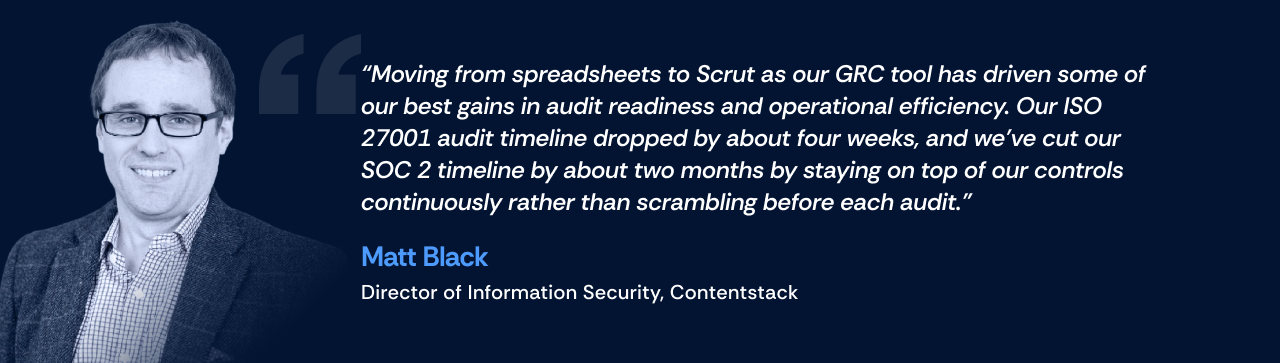\n\nRon Buell, CTO at Sounding Board, [put the day-to-day difference](https://youtu.be/-UsTx8lfm_U?si=Pl1-iAZY9ysBu8O8) plainly:\n\n\n\nKenneth Haugen, IT Manager at Athenium, [shares how it reduces delays](https://www.youtube.com/watch?v=ZfKjsQ3m8SU):\n\n\n\nIf you want to compress your own timeline, [see how Scrut accelerates your SOC 2 timeline](https://www.scrut.io/solutions/soc2), explore the [compliance automation platform](https://www.scrut.io/platform/compliance-automation), or look at the [live auditor dashboard](https://www.scrut.io/platform/audit-center) your auditor works inside.\n\n## **FAQs**\n\n**How can you avoid SOC 2 audit delays?**\n\nStart with a readiness assessment, automate evidence collection, align teams and vendors early, and maintain continuous monitoring to stay audit-ready year-round. The single most controllable factor is designating a compliance DRI before the audit begins.\n\n**How much does a SOC 2 audit cost?**\n\nCosts vary widely by firm type and scope. A Big 4 engagement for a mid-sized organization can run around $50,000 for the audit alone; boutique and small CPA firms are materially lower. Practitioner-cited ranges typically fall between $10,000 and $50,000 for Type I and $30,000 to $100,000 or more for Type II, depending on scope, observation period length, and firm tier. Organizations using a GRC automation platform generally receive lower auditor quotes, because fewer auditor hours are needed for evidence review.\n\n**Can the SOC 2 reporting window be changed?**\n\nYes, with your auditor's approval. It is often done when transitioning between audits or adjusting the observation period for a Type II report. Gaps between periods are visible to every enterprise buyer who reads the report. Avoid them.\n\n**What happens if I miss the last SOC 2 audit window?**\n\nA missed window creates a gap in coverage, which raises concerns for customers relying on your report. You can issue a bridge letter, a formal statement that your controls remain in place and effective until the next audit completes. A bridge letter is temporary and does not replace a valid SOC 2 report.\n\n**How many auditors are required to complete the SOC 2 audit?**\n\nA SOC 2 audit is conducted by a single CPA firm with one or more auditors assigned. Most small to mid-sized companies work with a team of 2 to 4 professionals from the firm. The exact number depends on your size, complexity, and scope.\n\n**What is the best time to start the SOC 2 audit?**\n\nAfter completing a readiness assessment to identify and fix control gaps. For Type II, align your start date with the desired observation period. Many organizations begin at the start of their fiscal year to simplify reporting. Starting early also secures auditor availability, since schedules fill quickly during peak seasons. When selecting a firm, check its AICPA peer review enrollment and status before engaging, particularly for boutique and small firms.\n\n**What is the minimum SOC 2 Type II observation period?**\n\nThe AICPA does not specify a formal minimum, but 3 months is the practical floor. Certain controls, particularly quarterly access reviews, must have at least one completed cycle within the period to be evidenced. Going shorter than 3 months risks gaps in operating effectiveness evidence that an auditor cannot test around.\n\n**Can I go directly to SOC 2 Type II without doing Type I first?**\n\nYes. In Scrut's experience, a large majority of organizations go directly to Type II, particularly when their controls have been operating for 3 or more months before the observation period starts. Type I remains valuable when controls are brand new and have not yet been practiced, or when there is commercial pressure to produce any report quickly while you work toward Type II.\n\n**What is a SOC 2 management assertion letter?**\n\nThe management assertion letter is a signed statement from senior management confirming that the system description in Section III accurately reflects the organization's controls and that the organization has been operating those controls as described. It is included in the final SOC 2 report and represents management's formal attestation to its security posture. Auditors require it before issuing the report.\n\n**How do I choose a SOC 2 auditor?**\n\nLook for a CPA firm enrolled in the AICPA's peer review program, a requirement the AICPA has reinforced in recent guidance for firms conducting SOC 2 attestation engagements (independent auditors cannot sign off attestation engagements). Check the firm's peer review status directly on the AICPA website: is the firm enrolled, has the review occurred, and was it a pass? Beyond credentials, evaluate whether the firm's auditors hold relevant information security certifications (CISA, CISSP, ISO 27001 Lead Auditor), whether they have experience with organizations at your size and stage, and whether they integrate with your GRC automation platform, which can reduce fieldwork hours and, accordingly, fees.\n\nLiked the post? Share on:\n\n\n\n[Megha Thakkar](https://www.scrut.io/author/megha-thakkar)\n\nTechnical Content Writer, CISA, ACPA (Australia), CA Intermediate (India)\n\nMegha Thakkar is a technical content writer with about a decade of experience in cybersecurity and compliance. She writes extensively on SOC 2, ISO 27001, GDPR, and security operations, helping organizations translate complex requirements into clear, audit-ready decisions. Her work, tailored for CISOs and executive leaders, is frequently cited in U.S. government and NIST publications.\n\nAuthored by\n\nTable of contents\n\n[Key takeaways](https://www.scrut.io/hub/soc-2/soc-2-compliance-timeline#key-takeaways)\n\n[SOC 2 Type I audit process and timeline](https://www.scrut.io/hub/soc-2/soc-2-compliance-timeline#soc-2-type-i-audit-process-and-timeline)\n\n[h3\\\\\n\\\\\nPhase 1: Pre-audit preparation (1 to 3 months)](https://www.scrut.io/hub/soc-2/soc-2-compliance-timeline#phase-1-pre-audit-preparation-1-to-3-months-2)\n\n[h3\\\\\n\\\\\nPhase 2: Audit fieldwork (2 to 5 weeks)](https://www.scrut.io/hub/soc-2/soc-2-compliance-timeline#phase-2-audit-fieldwork-2-to-5-weeks)\n\n[h3\\\\\n\\\\\nPhase 3: Report creation and delivery (2 to 6 weeks)](https://www.scrut.io/hub/soc-2/soc-2-compliance-timeline#phase-3-report-creation-and-delivery-2-to-6-weeks)\n\n[h3\\\\\n\\\\\nSOC 2 Type 1 audit timeline breakdown](https://www.scrut.io/hub/soc-2/soc-2-compliance-timeline#soc-2-type-1-audit-timeline-breakdown)\n\n[SOC 2 Type II audit process and timeline](https://www.scrut.io/hub/soc-2/soc-2-compliance-timeline#soc-2-type-ii-audit-process-and-timeline)\n\n[h3\\\\\n\\\\\nPhase 1: Pre-audit preparation (1 to 3 months)](https://www.scrut.io/hub/soc-2/soc-2-compliance-timeline#phase-1-pre-audit-preparation-1-to-3-months)\n\n[h3\\\\\n\\\\\nPhase 2: Observation period (3 to 12 months)](https://www.scrut.io/hub/soc-2/soc-2-compliance-timeline#phase-2-observation-period-3-to-12-months)\n\n[h3\\\\\n\\\\\nPhase 3: Audit fieldwork (2 to 5 weeks)](https://www.scrut.io/hub/soc-2/soc-2-compliance-timeline#phase-3-audit-fieldwork-2-to-5-weeks)\n\n[h3\\\\\n\\\\\nPhase 4: Report creation and delivery (2 to 6 weeks)](https://www.scrut.io/hub/soc-2/soc-2-compliance-timeline#phase-4-report-creation-and-delivery-2-to-6-weeks)\n\n[h3\\\\\n\\\\\nSOC 2 Type 2 timeline summary](https://www.scrut.io/hub/soc-2/soc-2-compliance-timeline#soc-2-type-2-timeline-summary)\n\n[h3\\\\\n\\\\\nChoosing your observation period](https://www.scrut.io/hub/soc-2/soc-2-compliance-timeline#choosing-your-observation-period)\n\n[Type I vs. Type II: Which should you start with?](https://www.scrut.io/hub/soc-2/soc-2-compliance-timeline#type-i-vs-type-ii-which-should-you-start-with)\n\n[h3\\\\\n\\\\\nWhen to start with Type 1 vs. go directly to Type 2](https://www.scrut.io/hub/soc-2/soc-2-compliance-timeline#when-to-start-with-type-1-vs-go-directly-to-type-2)\n\n[Factors affecting the SOC 2 audit timeline](https://www.scrut.io/hub/soc-2/soc-2-compliance-timeline#factors-affecting-the-soc-2-audit-timeline)\n\n[h3\\\\\n\\\\\n2\\. Maturity of your security program](https://www.scrut.io/hub/soc-2/soc-2-compliance-timeline#2-maturity-of-your-security-program)\n\n[h3\\\\\n\\\\\n3\\. Complexity of systems and infrastructure](https://www.scrut.io/hub/soc-2/soc-2-compliance-timeline#3-complexity-of-systems-and-infrastructure)\n\n[h3\\\\\n\\\\\n4\\. Organizational size and complexity](https://www.scrut.io/hub/soc-2/soc-2-compliance-timeline#4-organizational-size-and-complexity)\n\n[h3\\\\\n\\\\\n5\\. Auditor scheduling and communication](https://www.scrut.io/hub/soc-2/soc-2-compliance-timeline#5-auditor-scheduling-and-communication)\n\n[h3\\\\\n\\\\\n6\\. Availability of internal resources](https://www.scrut.io/hub/soc-2/soc-2-compliance-timeline#6-availability-of-internal-resources)\n\n[h3\\\\\n\\\\\n7\\. Third-party dependencies](https://www.scrut.io/hub/soc-2/soc-2-compliance-timeline#7-third-party-dependencies)\n\n[h3\\\\\n\\\\\n8\\. Use of compliance automation](https://www.scrut.io/hub/soc-2/soc-2-compliance-timeline#8-use-of-compliance-automation)\n\n[h3\\\\\n\\\\\n9\\. Industry-specific requirements](https://www.scrut.io/hub/soc-2/soc-2-compliance-timeline#9-industry-specific-requirements)\n\n[SOC 2 renewal audits: What the timeline looks like](https://www.scrut.io/hub/soc-2/soc-2-compliance-timeline#soc-2-renewal-audits-what-the-timeline-looks-like)\n\n[The SOC 2 audit process, step by step](https://www.scrut.io/hub/soc-2/soc-2-compliance-timeline#the-soc-2-audit-process-step-by-step)\n\n[h3\\\\\n\\\\\n1\\. Scoping and system description (client-led)](https://www.scrut.io/hub/soc-2/soc-2-compliance-timeline#1-scoping-and-system-description-client-led)\n\n[h3\\\\\n\\\\\n2\\. Auditor engagement and control definition](https://www.scrut.io/hub/soc-2/soc-2-compliance-timeline#2-auditor-engagement-and-control-definition)\n\n[h3\\\\\n\\\\\n3\\. Interim and design testing (Type II)](https://www.scrut.io/hub/soc-2/soc-2-compliance-timeline#3-interim-and-design-testing-type-ii)\n\n[h3\\\\\n\\\\\n4\\. Operating effectiveness sampling (Type II)](https://www.scrut.io/hub/soc-2/soc-2-compliance-timeline#4-operating-effectiveness-sampling-type-ii)\n\n[h3\\\\\n\\\\\n5\\. Fieldwork and auditor queries](https://www.scrut.io/hub/soc-2/soc-2-compliance-timeline#5-fieldwork-and-auditor-queries)\n\n[h3\\\\\n\\\\\n6\\. Draft report review](https://www.scrut.io/hub/soc-2/soc-2-compliance-timeline#6-draft-report-review)\n\n[h3\\\\\n\\\\\n7\\. Final report issuance](https://www.scrut.io/hub/soc-2/soc-2-compliance-timeline#7-final-report-issuance)\n\n[h3\\\\\n\\\\\n8\\. Where the process stalls](https://www.scrut.io/hub/soc-2/soc-2-compliance-timeline#8-where-the-process-stalls)\n\n[What happens between audit cycles](https://www.scrut.io/hub/soc-2/soc-2-compliance-timeline#what-happens-between-audit-cycles)\n\n[SOC 2 compliance challenges and how to overcome them](https://www.scrut.io/hub/soc-2/soc-2-compliance-timeline#soc-2-compliance-challenges-and-how-to-overcome-them)\n\n[h3\\\\\n\\\\\n1\\. Manual evidence collection](https://www.scrut.io/hub/soc-2/soc-2-compliance-timeline#1-manual-evidence-collection)\n\n[h3\\\\\n\\\\\n2\\. Overstretched internal teams](https://www.scrut.io/hub/soc-2/soc-2-compliance-timeline#2-overstretched-internal-teams)\n\n[h3\\\\\n\\\\\n3\\. Complex audit scope](https://www.scrut.io/hub/soc-2/soc-2-compliance-timeline#3-complex-audit-scope)\n\n[h3\\\\\n\\\\\n4\\. Coordination with auditors](https://www.scrut.io/hub/soc-2/soc-2-compliance-timeline#4-coordination-with-auditors)\n\n[h3\\\\\n\\\\\n5\\. Third-party vendor delays](https://www.scrut.io/hub/soc-2/soc-2-compliance-timeline#5-third-party-vendor-delays)\n\n[h3\\\\\n\\\\\n6\\. Budget constraints](https://www.scrut.io/hub/soc-2/soc-2-compliance-timeline#6-budget-constraints)\n\n[h3\\\\\n\\\\\n7\\. Maintaining year-round compliance](https://www.scrut.io/hub/soc-2/soc-2-compliance-timeline#7-maintaining-year-round-compliance)\n\n[h3\\\\\n\\\\\n8\\. Industry or regulatory overlays](https://www.scrut.io/hub/soc-2/soc-2-compliance-timeline#8-industry-or-regulatory-overlays)\n\n[h3\\\\\n\\\\\n9\\. Complexity in large environments](https://www.scrut.io/hub/soc-2/soc-2-compliance-timeline#9-complexity-in-large-environments)\n\n[h3\\\\\n\\\\\n10\\. Knowledge gaps](https://www.scrut.io/hub/soc-2/soc-2-compliance-timeline#10-knowledge-gaps)\n\n[How Scrut makes SOC 2 audits faster and simpler](https://www.scrut.io/hub/soc-2/soc-2-compliance-timeline#how-scrut-makes-soc-2-audits-faster-and-simpler)\n\n[FAQs](https://www.scrut.io/hub/soc-2/soc-2-compliance-timeline#faqs)\n\n%201.png)\n\nChoose risk-first compliance that\u2019s always on, built for you.\n\n[Book a Demo\\\\\n\\\\\nBook a Demo](https://www.scrut.io/book-a-demo)\n\n\n\n#### Join our community and be the first to know about updates!\n\nSubscribe\n\nI agree to receive marketing insights and other communications from Scrut Automation.\n\nThank you! Your submission has been received!\n\nOops! Something went wrong while submitting the form.\n\n- I agree to receive marketing insights and other communications from Scrut Automation.\n\n\n#### Related Posts\n\n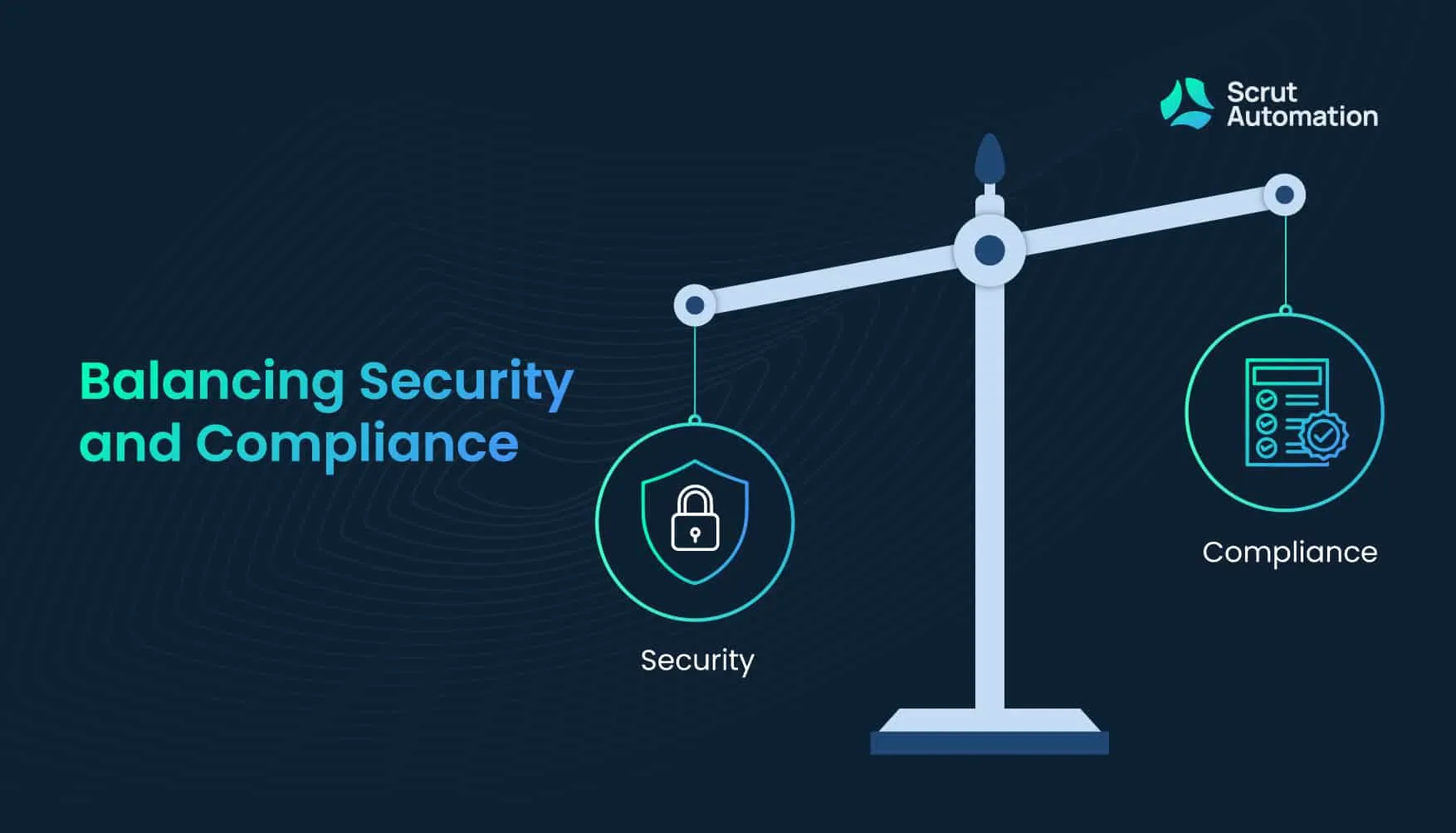\n\nAsset Management\n\nRisk Management\n\nHow to Prevent Cyberattacks by Balancing Security and Compliance?\n\n\n\nScrut Milestones\n\nScrut dazzles with 5 Momentum Leader Awards and 152 Badges in G2's Spring 2024 Report\n\n\n\nRisk Management\n\nCloud Security\n\nCompliance Essentials\n\nBiden's National Cybersecurity Strategy - a roadmap to prosperity through secure cyberspace\n\n### Experience security-first GRC powered by Scrut Teammates.\n\nScrut Automation\u2019s AI-powered platform helps you move fast, stay compliant, and build with confidence from day one.\n\n[Book a Demo\\\\\n\\\\\nBook a Demo](https://www.scrut.io/hub/soc-2/soc-2-compliance-timeline#demo_hero)\n\n\n\n[](https://www.scrut.io/)\n\n\n\nPlatform\n\n[Why Scrut](https://www.scrut.io/why-scrut) [Explore the Platform](https://www.scrut.io/platform/scrut-platform) [Simplify Compliance](https://www.scrut.io/platform/compliance-automation) [Streamline Audits](https://www.scrut.io/platform/audit-center) [Empower Your Employees](https://www.scrut.io/platform/security-training-and-device-monitoring) [Monitor Cyber Risk](https://www.scrut.io/platform/risk-management) [Assess Third-Party Risk](https://www.scrut.io/platform/vendor-risk-management) [Validate User Privileges](https://www.scrut.io/platform/access-reviews) [Manage Asset Inventory](https://www.scrut.io/platform/asset-management) [Demonstrate Trust](https://www.scrut.io/platform/trust-center) [AI-Powered GRC](https://www.scrut.io/platform/scrut-teammates) [Integrate Your Tech Stack](https://www.scrut.io/platform/integrations)\n\nFrameworks\n\n[SOC 2](https://www.scrut.io/solutions/soc2) [ISO 27001](https://www.scrut.io/solutions/iso-27001) [GDPR](https://www.scrut.io/solutions/gdpr) [PCI DSS](https://www.scrut.io/solutions/pci-dss) [HIPAA](https://www.scrut.io/solutions/hipaa) [NIST AI RMF](https://www.scrut.io/solutions/nist-ai-rmf) [Custom Frameworks](https://www.scrut.io/solutions/custom-frameworks) [All Frameworks](https://www.scrut.io/solutions/all-frameworks)\n\nCompany Stages\n\n[Startup](https://www.scrut.io/solutions/startup) [Growth](https://www.scrut.io/solutions/growth) [Enterprise](https://www.scrut.io/solutions/enterprise)\n\nIndustry\n\n[Enterprise Software](https://www.scrut.io/solutions/enterprise-software) [Financial Services](https://www.scrut.io/solutions/financial-services) [Healthcare](https://www.scrut.io/solutions/healthcare) [Travel and Tourism](https://www.scrut.io/solutions/travel) [Education](https://www.scrut.io/solutions/education)\n\nResources\n\n[Blog](https://www.scrut.io/blog) [Ebooks](https://www.scrut.io/ebooks) [Podcast](https://www.scrut.io/podcasts) [Success Stories](https://www.scrut.io/customer-stories) [Webinars](https://www.scrut.io/webinars) [Events](https://www.scrut.io/hub/soc-2/soc-2-compliance-timeline#) [Glossary](https://www.scrut.io/glossary) [Help Center](https://help.scrut.io/) [FAQs](https://www.scrut.io/faqs/general)\n\nHubs\n\n[SOC 2 Hub](https://www.scrut.io/hub/soc-2) [ISO 27001 Hub](https://www.scrut.io/hub/iso-27001) [HIPAA Hub](https://www.scrut.io/hub/hipaa) [Explore All Hubs](https://www.scrut.io/hub)\n\nPartners\n\n[Become a Partner](https://www.scrut.io/partners/program-overview) [Find a Partner](https://www.scrut.io/partners/partner-directory)\n\nCompany\n\n[Customers](https://www.scrut.io/customer-stories) [About](https://www.scrut.io/company/about-us) [Careers](https://www.scrut.io/company/careers) [Newsroom](https://www.scrut.io/company/newsroom) [Security](https://www.scrut.io/company/security)\n\n[social media links](https://www.linkedin.com/company/scrut-automation/)[social media link](https://x.com/i/flow/login?redirect_after_login=%2Fscrutsocial)[social media link](http://www.youtube.com/@scrutsocial)[social media link](https://www.facebook.com/people/Scrut-Automation/100083399827828/)[social media link](https://www.instagram.com/scrutsocial/?igshid=Y2ZmNzg0YzQ%3D)[social media link](https://www.g2.com/products/scrut-automation/reviews)\n\n[Trust](https://trust.scrut.io/) [Terms of Use](https://www.scrut.io/terms-of-use) [Privacy Policy](https://www.scrut.io/privacy-policy) [Cookies Policy](https://www.scrut.io/cookie-policy)\n\n\u00a92026 [Scrut Automation](https://www.scrut.io/staging/old-home). All Rights Reserved.",
"content_chars": 47240,
"published_date": null
},
{
"rank": 6,
"url": "https://www.reddit.com/r/soc2/comments/1lga0jq/soc_2_type_2_how_long_was_your_initial/",
"title": "SOC 2 Type 2 - How long was your initial implementation to get ... - Reddit",
"content": "Two (2) months for Implementation & Remediation ... CPAs will easily agree to audit you for SOC2 Type 2 after a 3 month observation period.What is a SOC 2 report, and why does every enterprise customer ask for it ...How Much Time Should I Allocate for SOC 2 Type II Compliance? - RedditMore results from www.reddit.com",
"content_chars": 318,
"published_date": null
},
{
"rank": 7,
"url": "https://compyl.com/blog/how-long-is-a-soc-2-report-valid-for/",
"title": "How Long Is a SOC 2 Report Valid For? - Compyl",
"content": "[Skip to the content](https://compyl.com/blog/how-long-is-a-soc-2-report-valid-for/#content)\n\n##### GRC Your Way\n\n# How Long Is a SOC 2 Report Valid For?\n\nSOC 2\n\nNearly every industry uses certifications and licenses to show that professionals are qualified for the task at hand. For example, no airline would hire a pilot that didn\u2019t have the appropriate license or aircraft rating, and no company would trust an IT service provider that couldn\u2019t prove they adhere to industry-standard data security protocols. For organizations that store or process client data, a SOC 2 report is the equivalent of compliance certification. To stay up-to-date, it\u2019s important to know how long SOC 2 reports remain valid.\n\n## How Long Is a SOC 2 Report Valid For Your Business?\n\n\n\nIn general, SOC 2 reports are valid for 12 months. There\u2019s technically no expiration date for SOC 2 certification, but industry best practices require businesses to schedule a new audit annually.\n\nThe idea is to show proof that your organization [meets SOC 2 requirements](https://compyl.com/blog/how-to-get-soc-2-certification-a-step-by-step-guide/) currently, not several years ago. Not renewing your certification could cause potential customers to choose a competitor\u2019s products instead.\n\nIn some circumstances, clients might request you to pass a SOC 2 audit every six months. This may be due to heightened security concerns or specific compliance requirements for sensitive data. This is rare, but it can happen if there\u2019s a particular area of compliance an enterprise customer wants to see assurances on. For example, a financial services client handling large volumes of customer data may want more frequent assurances of your compliance.\n\n## What Are SOC 2 Reports?\n\nSOC 2 compliance reports are official documents that outline audit results and state whether your organization meets SOC 2 guidelines. Only SOC 2 audits performed by a Certified Public Accountant or CPA auditing firm are valid, as CPA firms have the necessary expertise and are authorized to ensure compliance. These external auditors are approved by the [American Institute of Certified Public Accountants](https://www.aicpa-cima.com/topic/audit-assurance/audit-and-assurance-greater-than-soc-2).\n\n## What Do SOC 2 Reports Contain?\n\n\n\nSOC 2 attestations usually include the following sections.\n\n### Opinion Letter\n\nThe opinion letter provides a summary of the audit. It outlines the scope of the audit and assigns your business a score. Here\u2019s what the [different ratings](https://www.isaca.org/resources/news-and-trends/isaca-now-blog/2019/how-to-properly-review-an-soc-report) mean:\n\n- **Unqualified:** Your business passed the audit and complies fully with SOC 2 Trust Services Criteria. This is also known as a clean or unmodified opinion.\n- **Unqualified with issues:** Your business passed the audit, but there are some minor issues you need to pay more attention to.\n- **Qualified:** Your organization didn\u2019t pass the audit. You follow most SOC 2 guidelines well, but several TSC controls need better implementation.\n- **Adverse:** The organization failed the audit in serious ways. It does not comply with SOC 2 controls and the auditor does not recommend trusting its systems.\n- **Disclaimer of opinion:** The auditor can\u2019t issue a finding because there wasn\u2019t enough evidence to reach a conclusion.\n\nYour goal with SOC 2 compliance is to show customers an unqualified finding. Unqualified with issues is also acceptable, but you may need to show clients proof that you\u2019ve made the recommended changes.\n\n### Review Period\n\nEvery SOC 2 report states the review period the certification covers. For [Type I reports](https://compyl.com/blog/what-is-the-difference-between-soc-2-type-1-and-type-2/), this is a specific date, such as August 21, 2023. Type II reports list a date range like January 1 to December 31, 2023.\n\nIf your report covers January 1 to June 30, 2023, it would be valid until mid-2024. For annual reports, it\u2019s common for organizations to start the review period for the next audit as soon as they receive the current year\u2019s certification.\n\n### Management Assertion and System Description\n\nThese sections cover the audit from your team\u2019s point of view. You can explain the ways your business has followed [SOC 2 trust criteria](https://compyl.com/blog/soc-2-trust-principles/), describe system controls in more detail, and explain which controls are outside of your scope. This is also the place to emphasize changes you have already implemented to make your system more secure and compliant.\n\n### Test Results\n\nThis section contains the meat of the auditor\u2019s conclusions.\u00a0 It goes into great detail on your security policies, company processes, controls, and current implementation.\n\nClients are likely to carefully review your compliance in each area of TSC: security, privacy, confidentiality, availability, and processing integrity. This evidence review is why you need to pass a SOC 2 audit each year to build confidence in your organization\u2019s data security practices.\n\n## Are SOC 2 Reports Worth It?\n\n\n\nCPA audit firms usually charge by the hour, so the cost of a SOC 2 audit depends on how complex your system is, what type of readiness assessment you choose, and how many documents the auditor needs to look at. SOC 2 Type II audits that cover review periods of six months to a year can cost $10,000 to $50,000 (or more).\n\nIs it worth spending tens of thousands of dollars every year for SOC 2 certification? The answer depends heavily on your industry, services, and clients. Key factors include the sensitivity of the data you handle, client expectations, regulatory requirements, and the potential competitive advantage that certification can provide.\n\nIf you\u2019re a cloud services provider or SaaS developer, SOC 2 Type II certification ( [or ISO 27001](https://compyl.com/blog/iso-27001-vs-soc-2-key-differences-and-which-to-choose/)) is practically mandatory. All of your clients want assurances that you have robust cybersecurity protections and trustworthy organizational privacy policies in place for their data.\n\nThe same goes for FinTech, lending, and investment firms. Financial services businesses have customers who want to safeguard data, privacy, capital, and other assets. It\u2019s not surprising that SOC 2 compliance is high on their list of priorities. In this case, the cost of annual SOC 2 audits is nothing compared to the revenue gained.\n\nMany [healthcare organizations](https://compyl.com/blog/7-benefits-of-a-strong-compliance-program-in-healthcare/) pursue SOC 2 compliance alongside HIPAA compliance. Government contractors and DoD supply chain vendors benefit from up-to-date SOC 2 reports (or NIST) with CMMC, DFAR, and ITAR compliance.\n\n## How Long Does It Take To Get SOC 2 Certification?\n\nSOC 2 Type I reports only look at point-in-time compliance, which makes them faster but also less useful. Depending on your current compliance, the audit takes about two months. Type II reports include a review window that ranges from three months to a year. Besides this compliance observation period, the [audit often takes](https://compyl.com/blog/how-long-does-it-take-to-get-soc-2-compliance/) four to six months from start to finish.\n\n## Continual Compliance: The Solution to SOC 2 Report Validity Limits\n\nMany organizations are moving away from the old \u201cgetting ready for the auditor\u201d mindset. Instead, the goal is to meet data security standards [continually](https://compyl.com/blog/what-does-it-mean-to-have-continuous-compliance/) with ongoing compliance monitoring. This improves the efficiency, effectiveness, and organizational benefits of InfoSec controls, providing stronger cybersecurity for client data and business assets.\n\nCompliance software is key to a continual monitoring framework. With it, your organization can create secure workflows, track controls, verify compliance, and generate support documentation automatically. With Compyl, you don\u2019t have to ask how long a SOC 2 report is valid for because you have everything you need for your next certification audit. Learn more about Compyl\u2019s [SOC 2 compliance features](https://compyl.com/soc-2-certification/) right away.\n\n### Related Posts\n\n### [NIST AI RMF vs ISO 42001: Which One Do You Actually Need?](https://compyl.com/blog/nist-ai-rmf-vs-iso-42001/)\n\n### [NIST AI RMF Implementation Guide: A Step by Step Rollout](https://compyl.com/blog/nist-ai-rmf-implementation-guide/)\n\n### [NIST AI RMF Explained: What It Is and How the Four Functions Work](https://compyl.com/blog/nist-ai-rmf-explained/)\n\n[Close](https://compyl.com/blog/how-long-is-a-soc-2-report-valid-for/#)\n\n\n\nBy clicking \u201cAccept\u201d, you agree to the use of cookies on your device in accordance with our Privacy and Cookie policies\n\n[Accept](https://compyl.com/blog/how-long-is-a-soc-2-report-valid-for/#elementor-action%3Aaction%3Dpopup%3Aclose%26settings%3DeyJkb19ub3Rfc2hvd19hZ2FpbiI6InllcyJ9)",
"content_chars": 9640,
"published_date": null
},
{
"rank": 8,
"url": "https://www.everpuredata.com/knowledge/what-is-soc-2-type-ii.html",
"title": "What Is SOC 2 Type II Compliance? - Everpure",
"content": "[Skip to Content](https://www.everpuredata.com/knowledge/what-is-soc-2-type-ii.html#)\n\n3My Updates\nFind dismissed updates here\n\n\n[Edit My Preferences](https://www.everpuredata.com/knowledge/what-is-soc-2-type-ii.html#pathfinder)\n\n[Visit Pure.ai](https://www.pure.ai/) [Trust Center](https://www.everpuredata.com/trust-center.html) [Everpure Careers](https://www.everpuredata.com/company/careers.html)\n\nUS / EN\n\n[Visit Pure.ai](https://www.pure.ai/) [Trust Center](https://www.everpuredata.com/trust-center.html) [Everpure Careers](https://www.everpuredata.com/company/careers.html)\n\n[Everpure](https://www.everpuredata.com/ \"Everpure\")\n\n[Our Platform](https://www.everpuredata.com/platform.html)ProductsSolutionsSupportPartners [Resources](https://www.everpuredata.com/resources.html) [Built for AI](https://www.pure.ai/)\n\n[Contact Us](https://www.everpuredata.com/contact.html) [Start Here](https://www.everpuredata.com/knowledge/what-is-soc-2-type-ii.html#pathfinder)\n\n[Everpure](https://www.everpuredata.com/ \"Everpure\")\n\nSales 1-800-976-6494\n\n[Contact Us](https://www.everpuredata.com/contact.html)\n\nMain Menu\n\n\nOur Platform\n\n\nProducts\n\n\nSolutions\n\n\nSupport\n\n\nPartners\n\n\nResources\n\n\n[Built for AI](https://www.pure.ai/)\n\n[Contact Us](https://www.everpuredata.com/contact.html)\n\nChoose Your Region\n\nChoose Your Region\n\n[From Data Processing to Data Primacy\\\\\n\\\\\nHow sixty years of enterprise computing came full circle\u2014and what it means for enterprise architecture and designing work.](https://blog.everpuredata.com/perspectives/data-processing-to-data-primacy/)\n\n[\\\\\n\\\\\nHighest in Execution, Furthest in Vision\\\\\n\\\\\nEverpure is a Leader in the 2026 Gartner\u00ae Magic Quadrant\u2122 for Enterprise Storage Platforms.](https://www.everpuredata.com/resources/gartner-magic-quadrant-enterprise-storage-platforms.html)\n\n[Everpure Lands New Design Win with Second Top-Five Hyperscaler\\\\\n\\\\\nAgreement validates Everpure\u2019s technology advantage for hyperscale workloads.](https://www.everpuredata.com/company/newsroom/press-releases/everpure-lands-new-design-win-with-second-top-five-hyperscaler.html)\n\n# What Is SOC 2 Type II Compliance?\n\n\n\n### What Is SOC 2 Type II Compliance?\n\nSOC 2 Type II compliance is a framework for service organizations that demonstrates proper controls for data security criteria.\n\nIn today\u2019s service-driven landscape, an organization\u2019s data rarely exists only in its own IT environment. That data is often trusted with many vendors and service providers. A big part of choosing which vendor to trust that data with is made with the help of certifications, which can demonstrate adherence to certain standards for security and confidentiality.\n\nCompliance certifications fall under frameworks and are verified by third-party auditors. They can give customers a stamp of approval that a vendor has all of the necessary controls and protections in place to ensure their data is as safe as possible. One of these frameworks is called the Service Organization Control (SOC) framework.\n\nIf you\u2019re a vendor or service provider, you may be asked to provide SOC 2 data compliance reports. If you\u2019re a client, you may request SOC certification to verify that a vendor or provider has the proper controls in place for data compliance.\n\nHere\u2019s a closer look at this service provider-specific compliance standard, what it includes, and why it matters.\n\n### What Is SOC 2 Type II?\n\n#### Overview of SOC 2 Type II\n\nData compliance certifications are often required as a prerequisite or contractual obligation for an engagement. SOC 2 Type II compliance is specifically designed for service organizations. SOC 2 Type II includes principles for data security, availability, confidentiality, privacy, and transaction processing integrity. Type II indicates the audit was carried out over an extended period of time, often six months.\n\nThese standards are critical to ensuring top-notch information security (InfoSec) safeguards across vendors\u2019 IT systems and adhering to vendor-customer contracts.\n\n#### How Many SOC Criteria Are There?\n\nThere are five service criteria, or trust principles, in a SOC 2 compliance report. Security is mandatory, whereas the other criteria may be more industry- or business-specific. Each of these will trigger requirements for different types of controls.\n\n- **Security**: This is the most important, baseline service category required for SOC 2 compliance.\n- **Availability**: This is important for service providers who have strict SLAs to meet for software-as-a-service (SaaS), platform-as-a-service (PaaS), or infrastructure-as-a-service (IaaS) products. If the IT service is considered mission-critical to customers, data availability is key.\n- **Processing integrity**: This is applicable to services that process transactions for finance or e-commerce customers.\n- **Confidentiality**: When the data you\u2019re processing for customers is sensitive (e.g., intellectual property), this is a key pillar of your SOC 2 Type II compliance.\n- **Privacy**: Not to be confused with confidentiality above, this principle is specific to personally identifiable information (PII) such as health records.\n\n### Trust Service Criteria\n\n| | |\n| --- | --- |\n| Principles | Categories |\n| **Security**
**Availability**
**Processing Integrity**
**Confidentiality**
**Privacy** | - Organization
- Communication
- Risk assessment & management of controls
- Monitoring of controls
- Logical and physical access control to sensitive data and systems (e.g., key cards or login credentials)
- System operations and procedures (daily, weekly, monthly)
- Change management |\n\nSlide\n\n#### What Is Evaluated in a SOC 2 Type II?\n\nIn a SOC 2 Type II compliance audit, policies and controls designed to meet the above service criteria are evaluated for their effectiveness, usually over a period of six months. Are the controls suitable for the criteria? Is your organization consistent in carrying them out?\n\n#### What Is a SOC 2 Type II Certification?\n\nThe SOC 2 Type II Certification is proof from a third-party auditor that an organization\u2019s policies passed the audit for SOC 2 Type II compliance.\n\n### What Are the Benefits of SOC 2 Type II Compliance?\n\nThe benefits of SOC 2 Type II are in improving the overall health of data security and protections within an organization and across its vendors. For service providers, SOC 2 Type II certification can help improve the odds of earning a partnership or client over the competition. For clients, it\u2019s demonstrable proof your data will be in good hands with proper controls and safeguards.\n\n#### Who Needs to Have SOC 2 Type II Compliance?\n\nAny vendor who handles customer data or sensitive information that is looking to meet contractual obligations with a customer for SOC 2 Type II compliance can benefit from certification.\n\n### SOC 2 vs. Other Compliance Certifications\n\n#### Differences Between SOC 1 and SOC 2\n\nWhat is the difference between SOC 1 and SOC 2? SOC 1 is not focused on security criteria but on financial reporting criteria. SOC 1 was designed for service organizations as well, but specifically those to which certain financial functions have been outsourced. Note that SOC 1 audits typically align with fiscal years and include five service criteria, including control environment, risk assessment, control activities, communication and information, and monitoring.\n\n#### Differences Between SOC 2 and ISO-27001\n\nBoth SOC 2 Type II and ISO-27001 are frameworks that focus on management of InfoSec. While SOC 2 Type II assesses the overall effectiveness of security controls, ISO-27001 is a very prescriptive, systematic approach to information security management systems. ISO-27001\u2019s primary focus is on internal systems and controls and is a standard, whereas SOC 2 Type II is a framework for conducting an audit.\n\n#### SOC 2 Type II vs. PCI DSS, HIPAA, GDPR\n\nThere are a number of compliance frameworks\u2014how are they different, and which organizations need them?\n\nSOC 2 Type II and Payment Card Industry Data Security Standard (PCI DSS) are two very different compliance frameworks with little to no overlap. PCI DSS is specifically related to controls for how credit card information and transactions are handled. PCI DSS is also only applicable to financial services providers, whereas SOC 2 Type II covers a more broad range of industries. Finally, PCI DSS is conducted annually, and not by a CPA firm.\n\nSOC 2 Type II and the Health Insurance Portability and Accountability Act (HIPAA) are also different in the focus area of the data being protected. HIPAA applies only to healthcare organizations and service providers handling patient data (and is required by law), while SOC 2 Type II can include healthcare organizations but is not mandatory for them. Also, whereas SOC 2 Type II is not as prescriptive in how the service criteria are met, HIPAA is, with very specific standards that must be met for compliance.\n\nSOC 2 Type II and the General Data Protection Regulation (GDPR) are both frameworks that address data security and privacy. The GDPR framework is only applicable to organizations handling personal data of residents within the European Union and is focused on data privacy and protection rights. This requires controls around transparency of how data is used, the \u201cright to be forgotten\u201d and data minimization, and consent. While SOC 2 Type II is not mandatory, GDPR is and failure to comply can come with legal ramifications and fines.\n\n### Preparing for SOC 2 Type II Assessment\n\nPreparing for a SOC 2 Type II audit is a team effort and can require quite a few staff hours to get off the ground. Deciding to implement SOC 2 Type II compliance can also require a fair amount of buy-in and support internally to get things underway and incorporate it into processes for the long term.\n\n#### Steps to Help Prepare for SOC 2 Type II Assessment\n\n1. **Know the \u201cwhy\u201d behind your request for SOC 2 compliance**. Whether it\u2019s a customer request or other reason, this will help you understand your deadlines for compliance certification, the scope of work involved, and more. This will also help you identify existing policies you have that may help and also provide the auditor with context and scope.\n2. **Gather the right team of individuals** within your organization to onboard them to SOC 2 Type II. Depending on your timeframe to get SOC 2 Type II underway, you may need more people to pitch in on certain tasks, evidence gathering, and development. This group may include:\n\n\n - Leadership, such as the CEO, CTO, CISO, and other C-suite executives\n - DevOps\n - Human resources, as employees may come into scope for audits\n - InfoSec\n3. InfoSecPrepare to provide scope. Be prepared to answer data-specific questions such as where your service is hosted (public cloud, on-prem), capacity forecasting, office locations (is it a zero-trust environment or will servers need to be white-listed?), whether you store sensitive data, etc.\n\n#### Working with Third-party Auditors for SOC 2 Type II Compliance\n\nThe SOC 2 framework was developed by the American Institute of Certified Public Accountants (AICPA) and an audit must be completed by a CPA firm.\n\nWhen you\u2019re evaluating a firm to audit you for SOC 2 Type II compliance, consider quality and experience along with cost, and if they\u2019re a good fit to work alongside your team day to day for weeks or months\u2014and become a long-term advisor and partner for your organization.\n\n**Questions to ask**: Do they have a great track record of successful audits? Does the firm have audit experience specific to your industry? Feel free to ask for peer reviews, required third-party review of documents for auditors, and referrals.\n\nAlso, consider engaging an auditor as early in the process as possible, as they can be valuable in helping you to scope the project and align the right resources internally to meet your deadline (if you have one).\n\n- Once you\u2019ve chosen the auditor, you\u2019ll go through:\n- A scoping and discovery exercise to set expectations\n- A readiness assessment, for a top-down look at gaps, what you\u2019ll need to get started, what policies are already in place, etc.\n- Check-ins, leading up to the final test\n- The certification exam\n\nDuring the audit, you\u2019ll be asked to provide the policies, controls, and evidence for each.\n\n### How to Maintain SOC 2 Type II Certification\n\nIt\u2019s important to note that SOC 2 Type II compliance is not one and done. It requires diligence and ongoing effort. Maintaining SOC 2 Type II certification requires constant monitoring, documentation, incident disclosure and response, employee training, and periodic assessments. This is to show that an organization has an ongoing commitment to compliance and is making the necessary policy changes and upgrades.\n\nAs an [ISO 27001-certified](https://blog.everpuredata.com/news-events/pure-storage-is-now-iso-27001-certified-what-does-it-mean-for-you/) organization, Everpure provides a number of products and services designed to give our customers comprehensive monitoring and control over their data. Check out our suite of [modern data protection solutions](https://www.everpuredata.com/solutions/cyber-resilience/data-protection.html) to see how we can help you meet your data security compliance goals.\n\n### Browse key resources and events\n\n[Watch Demos](https://www.everpuredata.com/demos.html)\n\n\n\nPURE360 DEMOS\n\nExplore, learn, and experience Everpure.\n\nAccess on-demand videos and demos to see what Everpure can do.\n\n[Watch Demos](https://www.everpuredata.com/demos.html)\n\n[Register Now](https://www.everpuredata.com/events/webinars/ask-us-everything-about-accelerate-announcements.html)\n\n\n\nWEBINAR\n\nAsk Us Everything about Accelerate Announcements\n\nGot questions about what\u2019s new in your Everpure platform? Get answers.\n\n[Register Now](https://www.everpuredata.com/events/webinars/ask-us-everything-about-accelerate-announcements.html)\n\n[Watch Now](https://www.everpuredata.com/enterprise-data-cloud.html#edc-video)\n\n\n\nVIDEO\n\nWatch: The value of an Enterprise Data Cloud\n\nCharlie Giancarlo on why managing data\u2014not storage\u2014is the future. Discover how a unified approach transforms enterprise IT operations.\n\n[Watch Now](https://www.everpuredata.com/enterprise-data-cloud.html#edc-video)\n\n[Get the Report](https://www.everpuredata.com/resources/gartner-magic-quadrant-enterprise-storage-platforms.html)\n\n\n\n2025 GARTNER\u00ae MAGIC QUADRANT\u2122 REPORT\n\nHighest in Execution, Furthest in Vision\n\n2025 Gartner\u00ae Magic Quadrant\u2122 for Enterprise Storage Platforms.\n\n[Get the Report](https://www.everpuredata.com/resources/gartner-magic-quadrant-enterprise-storage-platforms.html)\n\nCurrently reading\n\nBack to top\n\nYour Browser Is No Longer Supported!\n\nOlder browsers often represent security risks. In order to deliver the best possible experience when using our site, please update to any of these latest browsers.\n\n[safari](https://www.apple.com/ua/safari/) [chrome](https://www.google.com/chrome/) [firefox](https://www.mozilla.org/en-US/) [edge](https://www.microsoft.com/en-us/edge?r=1)\n\n[Close](https://www.everpuredata.com/knowledge/what-is-soc-2-type-ii.html#)\n\nPersonalize for Me\n\nStepsComplete!\n\n1\n\n2\n\n3\n\nEdit My Preferences\n\n[Start a Chat](https://www.everpuredata.com/knowledge/what-is-soc-2-type-ii.html#chat-now)\n\nContinue where you left off\n\n\nPersonalize your Everpure experience\n\n\nSelect a challenge, or skip and build your own use case.\n\n\nFuture-proof virtualization strategies\n\nStorage options for all your needs\n\nEnable AI projects at any scale\n\nHigh-performance storage for data pipelines, training, and inferencing\n\nProtect against data loss\n\nCyber resilience solutions that defend your data\n\nReduce cost of cloud operations\n\nCost-efficient storage for Azure, AWS, and private clouds\n\nAccelerate applications and database performance\n\nLow-latency storage for application performance\n\nReduce data center power and space usage\n\nResource-efficient storage to improve data center utilization\n\nBuild My Use Case\n\n\nConfirm your outcome priorities\n\n\nYour scenario prioritizes the selected outcomes. You can modify or choose next to confirm.\n\n\nPrimary\n\nReduce My Storage Costs\n\nLower hardware and operational spend.\n\nPrimary\n\nStrengthen Cyber Resilience\n\nDetect, protect against, and recover from ransomware.\n\nPrimary\n\nSimplify Governance and Compliance\n\nEasy-to-use policy rules, settings, and templates.\n\nPrimary\n\nDeliver Workflow Automation\n\nEliminate error-prone manual tasks.\n\nPrimary\n\nUse Less Power and Space\n\nSmaller footprint, lower power consumption.\n\nPrimary\n\nBoost Performance and Scale\n\nPredictability and low latency at any size.\n\nStart Over\n\n\nSelect an outcome priority\n\nSelect an outcome priority\n\nNext\n\n\nWhat\u2019s your role and industry?\n\n\nWe've inferred your role based on your scenario. Modify or confirm and select your industry.\n\n\nSelect your industry\n\nFinancial services\n\nGovernment\n\nHealthcare\n\nEducation\n\nTelecommunications\n\nAutomotive\n\nHyperscaler\n\nElectronic design automation\n\nRetail\n\nService provider\n\nTransportation\n\nShow MoreShow Less\n\nWhich team are you on?\n\nTechnical leadership team\n\nDefines the strategy and the decision making process\n\nInfrastructure and Ops team\n\nManages IT infrastructure operations and the technical evaluations\n\nBusiness leadership team\n\nResponsible for achieving business outcomes\n\nSecurity team\n\nOwns the policies for security, incident management, and recovery\n\nApplication team\n\nOwns the business applications and application SLAs\n\nBack\n\n\nSelect an industry\n\nSelect a team\n\nSelect an industry\n\nSelect a team\n\nNext\n\n\nDescribe your ideal environment\n\n\nTell us about your infrastructure and workload needs. We chose a few based on your scenario.\n\n\nSelect your preferred deployment\n\nHosted\n\nDedicated off-prem\n\nOn-prem\n\nYour data center + edge\n\nPublic cloud\n\nPublic cloud only\n\nHybrid\n\nMix of on-prem and cloud\n\nSelect the workloads you need\n\nDatabases\n\nOracle, SQL Server, SAP HANA, open-source\n\nKey benefits:\n\n- Instant, space-efficient snapshots\n- Near-zero-RPO protection and rapid restore\n- Consistent, low-latency performance\n\nAI/ML and analytics\n\nTraining, inference, data lakes, HPC\n\nKey benefits:\n\n- Predictable throughput for faster training and ingest\n- One data layer for pipelines from ingest to serve\n- Optimized GPU utilization and scale\n\nData protection and recovery\n\nBackups, disaster recovery, and ransomware-safe restore\n\nKey benefits:\n\n- Immutable snapshots and isolated recovery points\n- Clean, rapid restore with SafeMode\u2122\n- Detection and policy-driven response\n\nContainers and Kubernetes\n\nKubernetes, containers, microservices\n\nKey benefits:\n\n- Reliable, persistent volumes for stateful apps\n- Fast, space-efficient clones for CI/CD\n- Multi-cloud portability and consistent ops\n\nCloud\n\nAWS, Azure\n\nKey benefits:\n\n- Consistent data services across clouds\n- Simple mobility for apps and datasets\n- Flexible, pay-as-you-use economics\n\nVirtualization\n\nVMs, vSphere, VCF, vSAN replacement\n\nKey benefits:\n\n- Higher VM density with predictable latency\n- Non-disruptive, always-on upgrades\n- Fast ransomware recovery with SafeMode\u2122\n\nData storage\n\nBlock, file, and object\n\nKey benefits:\n\n- Consolidate workloads on one platform\n- Unified services, policy, and governance\n- Eliminate silos and redundant copies\n\nWhat other vendors are you considering or using?\n\nNetApp\n\nHPE\n\nDell\n\nNutanix\n\nVMware\n\nGoogle Cloud\n\nMicrosoft Azure\n\nAWS\n\nIBM\n\nHitachi Vantara\n\nWEKA\n\nHuawei\n\nBack\n\n\nSelect a deployment\n\nSelect a workload\n\nSelect a deployment\n\nSelect a workload\n\nFinish\n\n\nThinking...\n\nYour personalized, guided path\n\n\nGet started with resources based on your selections.\n\n\n[Start a Chat](https://www.everpuredata.com/knowledge/what-is-soc-2-type-ii.html#chat-now)\n\n3My Updates\n\n[From Data Processing to Data Primacy\\\\\n\\\\\nHow sixty years of enterprise computing came full circle\u2014and what it means for enterprise architecture and designing work.](https://blog.everpuredata.com/perspectives/data-processing-to-data-primacy/) [\\\\\n\\\\\nHighest in Execution, Furthest in Vision\\\\\n\\\\\nEverpure is a Leader in the 2026 Gartner\u00ae Magic Quadrant\u2122 for Enterprise Storage Platforms.](https://www.everpuredata.com/resources/gartner-magic-quadrant-enterprise-storage-platforms.html) [Everpure Lands New Design Win with Second Top-Five Hyperscaler\\\\\n\\\\\nAgreement validates Everpure\u2019s technology advantage for hyperscale workloads.](https://www.everpuredata.com/company/newsroom/press-releases/everpure-lands-new-design-win-with-second-top-five-hyperscaler.html)\n\nNo updates at this time.\n\n\n[\\\\\n\\\\\nThe Everpure Platform\\\\\n\\\\\nUnify your data, from storage to management to the intelligence behind it.\\\\\n\\\\\n- Universal Data Intelligence\\\\\n- Delivered as a Service\\\\\n- Intelligent Control Plane\\\\\n- Unified Data Plane\\\\\n- Evergreen Architecture\\\\\n\\\\\nExplore Our Platform](https://www.everpuredata.com/platform.html)\n\nWhat a Unified Platform Delivers\n\n[Power Innovation with an Enterprise Data Cloud\\\\\n\\\\\nIntelligent data management across on-prem, cloud, and edge](https://www.everpuredata.com/enterprise-data-cloud.html)\n\n[See How Storage as a Service Benefits You\\\\\n\\\\\nGuaranteed availability and performance, backed by clear SLAs](https://www.everpuredata.com/products/evergreen-staas.html)\n\n[Customer Stories\\\\\n\\\\\nSee what customers say and why you're in good company](https://www.everpuredata.com/customers.html)\n\n[\\\\\n\\\\\nGet the outcomes you need\\\\\n\\\\\nEvergreen//One turns business commitments into guaranteed infrastructure SLAs.\\\\\n\\\\\nExplore Storage as a Service](https://www.everpuredata.com/products/evergreen-staas.html)\n\nPlatform Storage\n\nEverpure Unified Data Plane\n\n[High Performance AI and HPC Storage\\\\\n\\\\\nMassive performance and scale for AI and HPC with **FlashBlade//EXA**](https://www.pure.ai/flashblade-exa.html)\n\n[Scale-up Block, File, and Object Storage\\\\\n\\\\\nEnterprise scale-up and performance with **FlashArray**](https://www.everpuredata.com/products/block-file-object-storage.html)\n\n[Scale-out Unstructured Data Storage\\\\\n\\\\\nHigh-throughput file and object performance with **FlashBlade**](https://www.everpuredata.com/products/unstructured-data-storage.html)\n\n[Archive\\\\\n\\\\\nLow-cost, scalable archive with the **Everpure//E Family**](https://www.everpuredata.com/products/archive-storage.html)\n\n[Public Cloud Storage\\\\\n\\\\\nCloud native storage solutions through **Everpure Cloud**](https://www.everpuredata.com/products/cloud.html)\n\nPlatform Capabilities\n\nEverpure Intelligent Control Plane\n\n[Automation and Orchestration\\\\\n\\\\\nGlobal storage automation and workflow orchestration](https://www.everpuredata.com/products/automation-orchestration.html)\n\n[Monitoring and Fleet Management\\\\\n\\\\\nIntelligent planning and monitoring for your entire fleet](https://www.everpuredata.com/products/monitoring-fleet-management.html)\n\n[Purity Array Management\\\\\n\\\\\nStore, protect, and manage with the same consistent experience](https://www.everpuredata.com/products/array-management.html)\n\nAdditional Platform Software & Services\n\n[Universal Data Intelligence\\\\\n\\\\\nDiscover, classify and contextualize enterprise data with **Everpure Data Intelligence**](https://www.everpuredata.com/products/data-intelligence.html)\n\n[Kubernetes Data Management\\\\\n\\\\\nAutomate, protect, and unify container data with **Portworx**](https://www.everpuredata.com/products/kubernetes-data-management.html)\n\n[Cyber Recovery\\\\\n\\\\\nReliable, managed cyber recovery with **Everpure Resilience**](https://www.everpuredata.com/products/cyber-recovery.html)\n\nSolutions\n\n[AI](https://www.everpuredata.com/solutions/ai.html)\n\n[Cloud](https://www.everpuredata.com/solutions/cloud.html)\n\n[Cyber Resilience](https://www.everpuredata.com/solutions/cyber-resilience.html)\n\n[Databases](https://www.everpuredata.com/solutions/databases.html)\n\n[High-Performance Computing](https://www.everpuredata.com/solutions/hpc.html)\n\n[Virtualization](https://www.everpuredata.com/solutions/virtualization.html)\n\nIndustries\n\n[Automotive](https://www.everpuredata.com/solutions/industries/automotive.html)\n\n[Education](https://www.everpuredata.com/solutions/industries/education.html)\n\n[Electronic Design Automation](https://www.everpuredata.com/solutions/industries/eda.html)\n\n[Financial Services](https://www.everpuredata.com/solutions/industries/financial-services.html)\n\n[Government](https://www.everpuredata.com/solutions/industries/government.html)\n\n[Healthcare](https://www.everpuredata.com/solutions/industries/healthcare.html)\n\n[Hyperscale](https://www.everpuredata.com/solutions/industries/hyperscale.html)\n\n[Retail](https://www.everpuredata.com/solutions/industries/retail.html)\n\n[Service Providers](https://www.everpuredata.com/solutions/industries/managed-service-providers.html)\n\n[Telecom](https://www.everpuredata.com/solutions/industries/telecom.html)\n\n[Transportation](https://www.everpuredata.com/solutions/industries/transportation.html)\n\n[Services](https://www.everpuredata.com/services.html)\n\n[Technical Services](https://www.everpuredata.com/services/technical.html)\n\n[Advanced Services](https://www.everpuredata.com/services/advanced.html)\n\n[Customer Success](https://www.everpuredata.com/services/customer-success.html)\n\n[Training and Education](https://academy.purestorage.com/student/catalog)\n\n[IT Professional Certifications](https://academy.purestorage.com/student/activity/2133577-it-certifications)\n\n[Support](https://support.purestorage.com/)\n\n[Contact Support](https://support.purestorage.com/)\n\n[Everpure Community](https://community.purestorage.com/)\n\n[Product Security](https://support.purestorage.com/Pure_Security)\n\n[Vulnerability Disclosure Policy](https://support.purestorage.com/bundle/m_product_security_policy/page/Employee_Handbooks/Technical_Services/PSIRT/topics/concept/c_pure_storage_vulnerability_reporting_and_disclosure_policy.html)\n\n[Everpure Partners](https://www.everpuredata.com/partners.html)\n\n[Find a Partner](https://www.everpuredata.com/partners/partner-finder.html)\n\n[Become a Partner](https://www.everpuredata.com/partners/become-a-partner.html)\n\n[Partner Certifications](https://www.everpuredata.com/partners/certifications.html)\n\n[Partner Ecosystem](https://www.everpuredata.com/partners.html)\n\n[Resellers](https://www.everpuredata.com/partners/resellers.html)\n\n[Global System Integrators](https://www.everpuredata.com/partners/global-system-integrators.html)\n\n[Managed Service Providers](https://www.everpuredata.com/partners/managed-service-providers.html)\n\n[Technology Alliance Partners](https://www.everpuredata.com/partners/technology-alliance-partners.html)\n\n[Service Specialization Partners](https://www.everpuredata.com/partners/service-specializations-partner.html)\n\nExplore\n\n[Browse All Resources](https://www.everpuredata.com/resources.html)\n\n[Browse All Demos](https://www.everpuredata.com/demos.html)\n\n[Blog](https://blog.everpuredata.com/)\n\n[Events and Webinars](https://www.everpuredata.com/events.html)\n\n[Customer Stories](https://www.everpuredata.com/customers.html)\n\n[What's New](https://www.everpuredata.com/pure-launch-updates-releases.html)\n\n[Newsroom](https://www.everpuredata.com/company/newsroom.html)\n\n[Thought Leadership](https://blog.everpuredata.com/perspectives/)\n\n[Knowledge Articles](https://www.everpuredata.com/knowledge.html)\n\nConnect with Everpure\n\n[Schedule a Demo](https://www.everpuredata.com/contact/sales.html)\n\n[Chat with Us](https://www.everpuredata.com/knowledge/what-is-soc-2-type-ii.html#chat-now)\n\n[Careers](https://www.everpuredata.com/company/careers.html)\n\n[Customer Community](https://purecommunity.purestorage.com/)\n\n[User Groups](https://purecommunity.purestorage.com/category/pure-user-groups)\n\nQualified",
"content_chars": 28652,
"published_date": null
},
{
"rank": 9,
"url": "https://blog.rsisecurity.com/what-is-the-soc-2-certification-validity-period/",
"title": "What is the SOC 2 Certification Validity Period? - RSI Security",
"content": "[Skip to content](https://blog.rsisecurity.com/what-is-the-soc-2-certification-validity-period/#wp--skip-link--target)\n\n[SOC 2](https://blog.rsisecurity.com/compliance-standards/soc-2/)\n\n# What is the SOC 2 Certification Validity Period?\n\n\n\nBy\n\n[RSI Security](https://blog.rsisecurity.com/author/rsi-security/)\n\n\\| Topics:\n\nOverseen by the **American Institute of Certified Public Accountants (AICPA)**, SOC 2 evaluates the implementation of effective standards and controls for organizations outside the financial sector, including software-as-a-service (SaaS) providers. Since the SOC 2 certification validity period only lasts for a limited amount of time, those pursuing certification on a long-term basis will need to dedicate themselves to learning and maintaining these rules.\n\n## **SOC 2 At a Glance**\n\nThe rules and guidelines of SOC 2 provide a clear framework for service organization audits assessing the implemented controls that safeguard consumer data and relevant IT systems. SOC 1 is reserved for organizations specifically in the financial industry; those outside the sector primarily use SOC 2.\n\nDepending on your current status, [SOC 2 certification](https://www.rsisecurity.com/soc2/) could take up to 12 months to obtain. However, because of a strict SOC 2 certification validity period, those pursuing long-term SOC 2 certification must recertify every year.\n\nTo streamline the process as much as possible, you\u2019ll want to be familiar with:\n\n- The purpose of SOC certification and reporting\n- The SOC 2 certification timeline\n- The SOC 2 reporting timeline\n- The SOC 2 auditing process\n\n## **Understanding the** **SOC 2 Certification Validity Period**\n\nSome professional certifications and accreditations last a lifetime. College diplomas and trade school degrees never have to be renewed. Others\u2014like SOC 2 certification\u2014only last for a period of 12 months.\n\nAfter the 12-month period has passed, those who wish to maintain their status must retake the certification process. But before your organization can recertify, it must navigate the initial stage of the SOC 2 certification timeline.\n\nOrganizations that have yet to obtain [SOC 2 certification](https://blog.rsisecurity.com/10-common-questions-about-soc-2-compliance/) for the first time will need to pass the lengthy certification process, which can last for up to 12 months in some of the most prolonged cases. However, the average certification process length is closer to six months. Those seeking recertification can complete the process much quicker, but it\u2019s still a continuous commitment for any organization.\n\n[Request a Free Consultation](https://www.rsisecurity.com/request-demo/)\n\n## **Understanding SOC 2 Reports**\n\nCoinciding with the SOC 2 certification validity period, SOC 2 reports are also valid for 12 months. This timeline begins on the report\u2019s original issue date. After 12 months have elapsed, these outdated reports are considered stale. That\u2019s why most [SOC 2 audits](https://blog.rsisecurity.com/why-you-should-conduct-a-soc-2-audit/) are scheduled annually.\n\nThere are two different [SOC 2 reports](https://blog.rsisecurity.com/what-is-a-soc-2-report-and-do-you-need-one/) to consider:\n\n- **SOC 2 Type 1** \u2013 Though the report focuses on security controls and system stability at a given moment, your first SOC 2 Type 1 report could take a few months.\n- **SOC 2 Type 2** \u2013 Far more complex than Type 1 reports, SOC 2 Type 2 reports are only generated after long-term audits. In some cases, these audits might last as long as 12 months. These audits focus on infrastructure, software, personnel, data security, and automation.\n\nWhile SOC 2 Type 1 reports require less time and financial investment, they lack the comprehensiveness of SOC 2 Type 2 reports. SOC 2 Type 1 audits only provide a snapshot of your organization\u2019s security framework, but SOC 2 Type 2 audits take it much further in assessing ongoing effectiveness. Incidentally, many organizations pursue Type 1 on their way to pursuing Type 2. Although the latter is more demanding, they will help ensure your clients\u2019 confidence in your cybersecurity and internal controls.\n\n\n\n## **Understanding the SOC 2 Auditing Process**\n\nRegardless of the Type, current [SOC 2 audits](https://blog.rsisecurity.com/how-long-does-a-soc-2-audit-take/) generally follow a similar, standardized process. Understanding these steps will help your organization prepare for SOC 2 auditing or certification. These steps include:\n\n- **Establishing scope** \u2013 A critical first step, this defines the most important controls and benchmarks for auditing. This stage is sometimes used for readiness assessment, too.\n- **Performing gap analysis** \u2013 Comprehensive gap analysis helps you detect potential issues before undergoing an audit. If gaps still remain, most auditors can provide guidance for remediation. Persistent gaps will extend your certification timeline.\n- **Attestation** \u2013 This is where the audit actually takes place. Auditors take care to follow the AICPA attestation standards and perform an evaluation against the Trust Services Criteria (TSC) when performing SOC 2 audits of either type.\n- **Report finalization** \u2013 The entire process is finalized in this phase. When everything\u2019s complete, the auditor delivers their final report for review.\n\nNote that a **SOC 2 Type 1 audit** can feed into a **SOC 2 Type 2 audit** down the line. Then, if your organization is also considering generating a SOC 3 later on, the SOC 2 Type 2 will facilitate it.\n\n## **Making the Most of SOC 2**\n\nThe brief SOC 2 certification validity period ensures that the assessment of your organization\u2019s internal controls and systems security remains robust and effective. However, the year-long duration places an increased burden on many organizations.\n\nRSI Security\u2019s [SOC 2 certification and advisory services](https://www.rsisecurity.com/soc2/)\u2014such as gap assessment\u2014will help streamline the process, regardless of which Type you choose to pursue.\n\nFor more information on SOC 2 certification or to begin your SOC 2 audit right away, [contact RSI Security today](https://www.rsisecurity.com/contact/).\n\n[Request a Free Consultation](https://www.rsisecurity.com/request-demo/)\n\n* * *\n\n## **Want to know more about SOC 2 Compliance? Talk to Our Expert**\n\ncontact.rsisecurity.com\n\n# This site can\u2019t provide a secure connection\n\n**contact.rsisecurity.com** uses an unsupported protocol.\n\nERR\\_SSL\\_VERSION\\_OR\\_CIPHER\\_MISMATCH\n\nDetails\n\n\nUnsupported protocol\n\nThe client and server don't support a common SSL protocol version or cipher suite.\n\n**contact.rsisecurity.com** uses an unsupported protocol.\n\n![]()![]()\n\n* * *\n\nExplore other Topics\n\n**AI-powered Insight, Human-led Protection**\n\n**Get the latest update on cybersecurity and compliance.**\n\nRSI Security uses the information you provide to contact you about our products and services. You may unsubscribe at any time. To learn more, see our Privacy Policy.\n\nSUBSCRIBE\n\n**Check out more of our posts**\n\n- ### [CMMC Phase 2 Paused: What It Means for Defense Contractors and What to Do Now](https://blog.rsisecurity.com/cmmc-phase-2-paused-what-it-means-for-defense-contractors-and-what-to-do-now/)\n\n\n\n[July 15, 2026](https://blog.rsisecurity.com/cmmc-phase-2-paused-what-it-means-for-defense-contractors-and-what-to-do-now/)\n\n- ### [SOC 2 vs. HITRUST: Which Framework Is Right for your Organization?](https://blog.rsisecurity.com/soc-2-vs-hitrust-which-framework-is-right-for-your-organizatiion/)\n\n\n\n[June 14, 2026](https://blog.rsisecurity.com/soc-2-vs-hitrust-which-framework-is-right-for-your-organizatiion/)\n\n- ### [Preparing for DoD Compliance with the CMMC Framework](https://blog.rsisecurity.com/preparing-for-dod-compliance-with-the-cmmc-framework/)\n\n\n\n[March 26, 2026](https://blog.rsisecurity.com/preparing-for-dod-compliance-with-the-cmmc-framework/)\n\n- ### [PCI Requirement Changes: What You Need to Know in 2026](https://blog.rsisecurity.com/pci-requirement-changes-in-2018/)\n\n\n\n[March 24, 2026](https://blog.rsisecurity.com/pci-requirement-changes-in-2018/)",
"content_chars": 8288,
"published_date": null
},
{
"rank": 10,
"url": "https://www.vanta.com/collection/soc-2/soc-2-audit-timeline",
"title": "How long does a SOC 2 audit take? | Vanta",
"content": "[](https://www.vanta.com/)\n\n\n\n\n\n[SOC 2](https://www.vanta.com/collection/soc-2)\n\n>\n\n[Preparing for a SOC 2 audit](https://www.vanta.com/collection/soc-2/soc-2-audit-timeline#)\n\nThere are many factors in your [SOC 2](https://www.vanta.com/collection/soc-2/what-is-soc-2) compliance journey that can influence the time it takes for you to get your final [SOC 2 report](https://www.vanta.com/collection/soc-2/what-is-a-soc-report). How long it takes for you to get your SOC 2 will depend on how many of the SOC 2 controls you need to implement, the type of audit you choose, and how well you\u2019ve prepared for your audit.\n\n\u200d\n\nIn this article, we\u2019ll go over the factors that will impact your [SOC 2 audit](https://www.vanta.com/collection/soc-2/what-is-a-soc-2-audit) timeline, break down the time frame for each of the steps, and give some tips for accelerating your SOC 2 timeline.\n\n\u200d\n\n| Key takeaways |\n| --- |\n| - SOC 2 compliance timelines vary depending on control readiness, audit type, organization size, as well as auditor and customer responsiveness.
- SOC 2 Type 1 duration: Includes one to three months of pre-audit preparation, two to five weeks for official audit, and two to six weeks for report creation and delivery.
- SOC 2 Type 2 duration: Includes a three- to twelve-month compliance observation window, followed by two to five weeks for the actual audit (this may occur during the compliance observation window, depending on the audit firm), and two to six weeks for the report creation and delivery.
- Pre-audit prep: Both audit types require variable prep time to implement controls, assess risk, monitor systems, and hire an auditor.
- Audit phase: The audit itself includes reviewing evidence, investigating controls, live calls (if requested by the auditor), and fielding auditor requests.
- Post-audit phase: This includes finalizing evidence review, preparing the draft report (you are responsible for preparing the system description for the report and responding to comments on the report by the audit firm), and receiving the final report.
- Compliance observation window (Type 2 only): Auditors test control effectiveness during a three- to twelve-month window. Best practice is to start with a three-month audit window and then move to continuous, year-long Type 2 audit periods so there are no gaps in compliance. Some audit firms require this, so it is best to speak to your auditor about observation windows. Type 2 audits typically occur after a Type 1 audit has taken place.
- Automation with Vanta: Compliance platforms like Vanta help reduce SOC 2 audit timelines through integrations, evidence automation, and built-in auditor access. |\n\n\u200d\n\n## SOC 2 audit timelines\n\nThere are two types of SOC 2 reports: [SOC 2 Type 1 or SOC 2 Type 2](https://www.vanta.com/collection/soc-2/soc-2-type-1-vs-type-2).\n\n\u200d\n\nA [**SOC 2 Type 1** report](https://www.vanta.com/collection/soc-2/soc-2-type-1) evaluates the design of your controls (which are used to meet the SOC 2 criteria) at a single point in time. It answers the question: \u201cAre the controls suitably designed to meet the trust service criteria as of a particular date?\u201d This audit date is agreed upon between you and the auditor. A Type 1 report typically takes less time than a Type 2 report.\n\n\u200d\n\n**Vanta tip:** The auditor may request and review evidence prior to the audit date to test a control.\n\n\u200d\n\nA [**SOC 2 Type 2** report](https://www.vanta.com/collection/soc-2/soc-2-type-2) evaluates both the design and operating effectiveness of your controls over a period of time. It answers the question: \u201cWere these controls suitably designed and operated effectively throughout the review period?\u201d The audit window for a SOC 2 Type 2 is between three months to a year, depending on the length you choose.\n\n\u200d\n\nDuring or after your audit window (depending on your auditor), evidence is reviewed by the auditor firm to show proof of design (Types 1 and 2) and operating effectiveness (Type 2) of your controls. Once all evidence is reviewed, the audit firm works with you to finalize the SOC 2 report.\n\n\u200d\n\n{{cta\\_withimage1=\"/cta-blocks\"}}\n\n\u200d\n\n### \u200dSOC 2 Type 1 audit timeline\n\nIn most cases, a SOC 2 Type 1 audit will take between five weeks and two months to complete. [The auditor you choose](https://www.vanta.com/resources/the-importance-of-choosing-the-right-auditor) and how well you prepare for your audit will impact your SOC 2 Type 1 audit timeline. Here are some additional factors that will also impact your timeline:\n\n\u200d\n\n- How easily your auditor can access your evidence\n- The size of your organization\n- The complexity of your infrastructure\n- How quickly you follow up on requests and questions from your auditor\n\n\u200d\n\nA SOC 2 Type 1 provides a [point-in-time](https://www.vanta.com/resources/point-in-time-vs-continuous-monitoring-for-security) look at your controls as of a certain date. A SOC 2 Type 1 is the most [cost-effective](https://www.vanta.com/resources/what-does-a-soc-2-audit-cost) option because it is less time-intensive than a SOC 2 Type 2.\n\n\u200d\n\n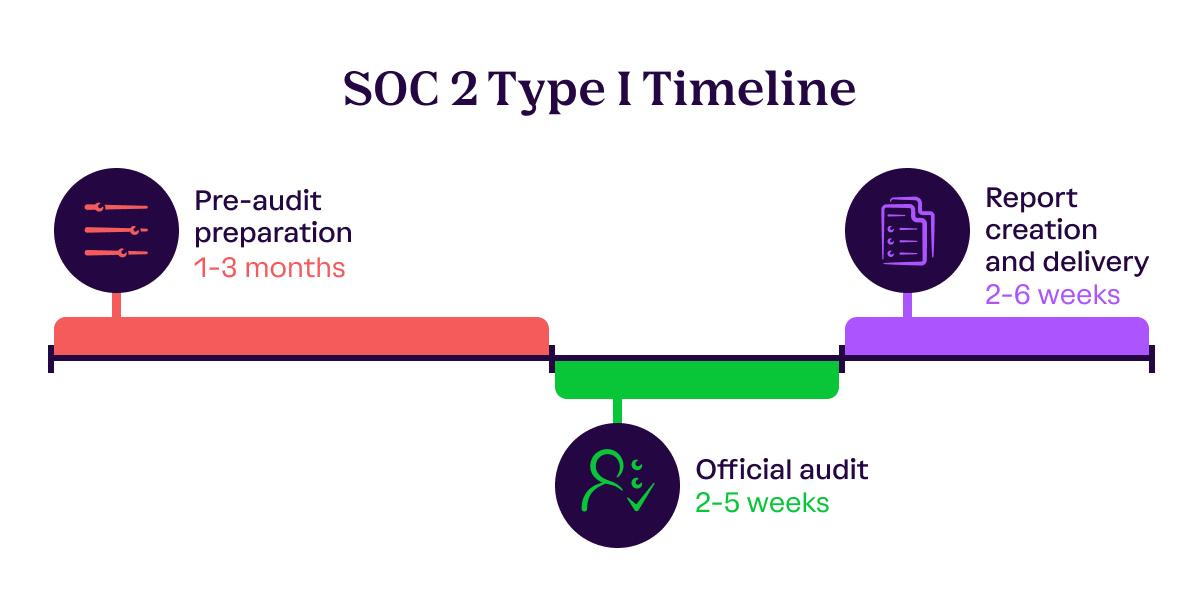\n\n\u200d\n\n#### Pre-audit preparation \\| 1-3 months\n\nBefore your audit, you\u2019ll need to determine which systems will be in scope for the audit, as well as which trust services criteria you want your auditor to review. Every SOC 2 report must have the security trust services criteria in scope.\n\n\u200d\n\nYou can add availability, confidentiality, processing integrity, and privacy as well. Adding these additional criteria is often driven by customer demand and usually incurs an additional fee.\n\n\u200d\n\nNext, make sure you have controls in place to meet the SOC 2 criteria. Think of a control as a safeguard or check that enforces how your organization protects systems and data, and mitigates security risks. These often include controls around access management and data encryption, creating business-wide security policies, monitoring for software vulnerabilities, screening vendors, and conducting risk assessments.\n\n\u200d\n\nOnce you\u2019ve prepared your controls, [hire an accredited auditor](https://www.vanta.com/resources/5-key-questions-to-ask-your-auditor). Ask your auditor what tests, documents, and policies they will need to start the audit.\n\n\u200d\n\nThe time this phase takes will depend on how many of the relevant SOC 2 controls you already have in place and how many you still need to implement.\n\n\u200d\n\n#### Official audit \\| 2-5 weeks\n\nAfter you\u2019ve hired an auditor, reviewed your in-scope systems and controls, agreed upon timelines, and made sure that all evidence is ready, your auditor will start their audit review.\n\n\u200d\n\nThe auditor will spend time reviewing evidence, asking follow-up questions, and investigating controls to see if they were suitably designed to meet trust service criteria. Respond promptly to your auditor\u2019s questions and requests during this period to accelerate the audit process.\n\n\u200d\n\n#### Report creation and delivery \\| 2-6 weeks\n\nOnce your auditor has completed their evidence review, they\u2019ll let you know if they found any exceptions (i.e., issues) with controls they reviewed. Depending on the nature of the exception, your auditor will let you know the impact on the SOC 2 trust services criteria.\n\n\u200d\n\nYour auditor will then work with you to create your SOC 2 report. Make sure the system description in the report is accurate and reply to all auditor comments about the report promptly.\n\n\u200d\n\nYour auditor will first present you with a draft report to review. Next, they\u2019ll generate your final SOC 2 Type 1 report. The report details your information security practices and controls, and includes your auditor\u2019s determination of whether they meet SOC 2 criteria. You can present this report to prospects, customers, and partners to show what measures you have in place to protect data.\n\n\u200d\n\n### SOC 2 Type 2 audit timeline\n\nSOC 2 Type 2 audits evaluate your compliance over a period of time. You can choose the length of this audit window, which is typically between three months to a year. The added detail provided by a SOC 2 Type 2 reassures stakeholders that you\u2019ll protect their data.\n\n\u200d\n\n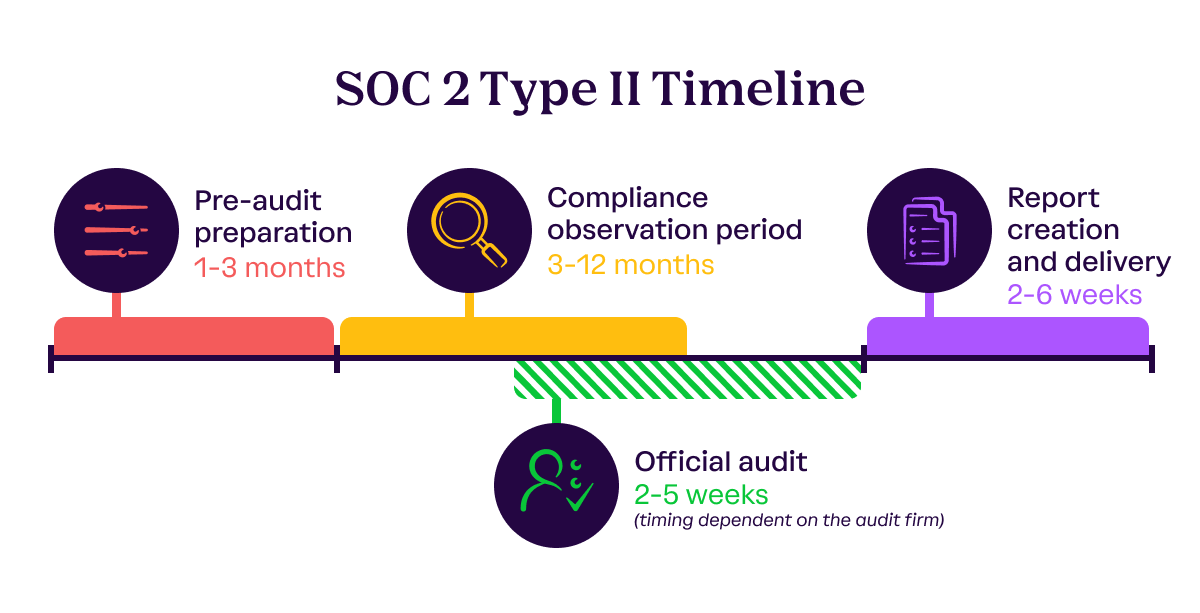\n\n#### Pre-audit preparation \\| 1-3 months\n\nMuch like a SOC 2 Type 1, you\u2019ll also need to implement the appropriate SOC 2 controls to address areas of non-compliance for a SOC 2 Type 2 report.\n\n\u200d\n\nOften, a SOC 2 Type 2 report occurs after a Type 1 report. Track any areas of improvement or exceptions from your Type 1 report to resolution as you prepare for a Type 2.\n\n\u200d\n\nThe length of your preparation phase will depend on how many of the applicable controls you already have in place and how many you still need to add. Once your controls are ready, you\u2019ll need to hire an AICPA-accredited auditor to conduct your SOC 2 Type 2 audit.\n\n\u200d\n\n#### Compliance observation period \\| 3-12 months\n\nThe biggest difference between a SOC 2 Type 1 and SOC 2 Type 2 audit is the length of the audit window. During your observation period, your auditor will review whether controls were designed appropriately and are operating effectively.\n\n\u200d\n\nYou get to choose how long your observation period is, commonly ranging anywhere from three to six, nine, or twelve months. Early-stage organizations often opt for their first observation window to be shorter so they can get their SOC 2 report back faster. Larger and more established organizations tend to choose a one-year audit window. After companies finish their first SOC 2 Type 2, the following review periods are typically set to 12-month windows.\n\n\u200d\n\n#### Official audit \\| 2-5 weeks\n\nFor a SOC 2 Type 2 audit, your auditor will review the documentation used to meet your controls to determine if you meet the SOC 2 criteria in scope. Depending on the audit firm, this review can occur during the observation window or shortly thereafter.\n\n\u200d\n\nUpload evidence and complete any required activities that must be done before the end of the observation window in a timely manner. Your auditor will have months of information to review, so their audit period will take longer depending on the length of your observation window. During this period, it\u2019s important to respond promptly to the auditor\u2019s requests and questions to accelerate the audit process.\n\n\u200d\n\n#### Report creation and delivery \\| 2-6 weeks\n\nOnce your auditor has completed their audit, they will compile their findings into a SOC 2 Type 2 report. Make sure the system description in the report is accurate and reply to all auditor comments about the report promptly.\n\n\u200d\n\nThe auditor will present you with a draft to review before issuing the final report. This report will detail your information security posture, the SOC 2 controls you have in place, and if they were designed appropriately and were operating effectively over the period of time to meet the SOC 2 criteria in scope. You can show this report to prospects, customers, or other stakeholders when they ask for your SOC 2 Type 2.\n\n\u200d\n\n## How long does it take to get a SOC 2 report?\n\nFrom scoping your report to implementing the controls to undergoing a SOC 2 audit, the entire SOC 2 compliance process can vary greatly. Your SOC 2 timeline will vary based on the structure and size of your organization, the type of data you process or manage for your customers, the type of SOC 2 report you pursue, and whether you use [compliance automation](https://www.vanta.com/collection/soc-2/what-is-soc-2-compliance-automation) to streamline the process.\u00a0We highly recommend speaking to your auditor about timelines, the estimated report issuance date, and expectations for response times.\n\n\u200d\n\n## Speed up your SOC 2 timeline with automated compliance\n\nGetting a SOC 2 tends to be a long and complicated process, but it doesn\u2019t have to be. With compliance automation, you can get your SOC 2 faster. [Vanta\u2019s trust management platform](https://www.vanta.com/vanta-platform) with compliance automation capabilities can help you streamline your SOC 2 and get your completed report in half the time.\n\n\u200d\n\nHere\u2019s what an [automated SOC 2 process](https://www.vanta.com/integrations) can look like with Vanta:\n\n\u200d\n\n- Connect your infrastructure to the Vanta platform with our 200+ built-in integrations.\n- Assess your risk holistically from one unified view.\n- Identify areas of non-compliance with in-platform notifications.\n- Get a checklist of actions to help you make the needed changes.\n- Automate evidence collection and centralize all your documents in one place.\n- Find a Vanta-vetted auditor within the platform.\n- Streamline reviews by giving your auditor the information in your [Trust Center](https://www.vanta.com/products/trust-reports).\n- Complete your SOC 2 in half the time.\n\n\u200d\n\nBy using Vanta, you can save your business valuable time and money during your SOC 2 audit process. Learn how you can get your SOC 2 faster by [requesting a demo](https://www.vanta.com/products/soc-2).\n\n\u200d\n\n**A note for Vanta customers:** These timelines are rough estimates. You should speak with your auditor to confirm all timelines before making commitments to external parties about report issuance dates. Delays in timelines and report issuance will occur if you do not:\n\n- Respond to audit firm follow-ups on time\n- Make payments on time\n- Have a majority of Vanta tests ready by the time of review by the audit firm\n- Complete all evidence submissions within agreed-upon timelines\n- Utilize the Vanta tool\n- Integrate all of the in-scope systems for the audit with Vanta\n\n\u200d\n\n{{cta\\_simple1=\"/cta-blocks\"}}\n\n\u200d\n\n[**How long does a SOC 2 audit take?** \\\\\n\\\\\nRead now](https://www.vanta.com/collection/soc-2/soc-2-audit-timeline)\n\n[**How much does a SOC 2 audit cost?** \\\\\n\\\\\nRead now](https://www.vanta.com/collection/soc-2/soc-2-audit-cost)\n\n[**SOC 2 compliance requirements: What does SOC 2 compliance involve?** \\\\\n\\\\\nRead now](https://www.vanta.com/collection/soc-2/soc-2-compliance-requirements)\n\n[**SOC 2 compliance checklist: 15 essential tasks** \\\\\n\\\\\nRead now](https://www.vanta.com/collection/soc-2/soc-2-compliance-checklist)\n\n[**SOC 2 readiness assessment checklist** \\\\\n\\\\\nRead now](https://www.vanta.com/collection/soc-2/soc-2-readiness-assessment-checklist)\n\n[**Who can perform a SOC 2 audit?** \\\\\n\\\\\nRead now](https://www.vanta.com/collection/soc-2/who-can-perform-soc-2-audit)\n\n[**How to prepare your SOC 2 compliance documentation** \\\\\n\\\\\nRead now](https://www.vanta.com/collection/soc-2/soc-2-compliance-documentation)\n\n##### Preparing for a SOC 2 audit\n\n# How long does a SOC 2 audit take?\n\nWritten by\n\nWritten by\n\nReviewed by\n\n\n\n##### Preparing for a SOC 2 audit\n\n# How long does a SOC 2 audit take?\n\n\n\n### Download the checklist\n\n#### Preparing for a SOC 2 audit\n\nHow long does a SOC 2 audit take?\n\n[SOC 2 audit timelines](https://www.vanta.com/collection/soc-2/soc-2-audit-timeline#soc-2-audit-timelines)\n\n[How long does it take to get a SOC 2 report?](https://www.vanta.com/collection/soc-2/soc-2-audit-timeline#how-long-does-it-take-to-get-a-soc-2-report)\n\n[Speed up your SOC 2 timeline with automated compliance](https://www.vanta.com/collection/soc-2/soc-2-audit-timeline#speed-up-your-soc-2-timeline-with-automated-compliance)\n\nExpand table of contents\n\n[How much does a SOC 2 audit cost?](https://www.vanta.com/collection/soc-2/soc-2-audit-cost)\n\n[SOC 2 compliance requirements: What does SOC 2 compliance involve?](https://www.vanta.com/collection/soc-2/soc-2-compliance-requirements)\n\n[SOC 2 compliance checklist: 15 essential tasks](https://www.vanta.com/collection/soc-2/soc-2-compliance-checklist)\n\n[SOC 2 readiness assessment checklist](https://www.vanta.com/collection/soc-2/soc-2-readiness-assessment-checklist)\n\n[Who can perform a SOC 2 audit?](https://www.vanta.com/collection/soc-2/who-can-perform-soc-2-audit)\n\n[How to prepare your SOC 2 compliance documentation](https://www.vanta.com/collection/soc-2/soc-2-compliance-documentation)\n\n### Looking to automate SOC 2 audit prep?\n\n[Request a demo](https://www.vanta.com/products/soc-2)\n\n[SOC 2](https://www.vanta.com/collection/soc-2)\n\n\u203a\n\n[Preparing for a SOC 2 audit](https://www.vanta.com/collection/soc-2/audit)\n\n\u203a\n\n[How long does a SOC 2 audit take?](https://www.vanta.com/collection/soc-2/soc-2-audit-timeline#)\n\nThere are many factors in your [SOC 2](https://www.vanta.com/collection/soc-2/what-is-soc-2) compliance journey that can influence the time it takes for you to get your final [SOC 2 report](https://www.vanta.com/collection/soc-2/what-is-a-soc-report). How long it takes for you to get your SOC 2 will depend on how many of the SOC 2 controls you need to implement, the type of audit you choose, and how well you\u2019ve prepared for your audit.\n\n\u200d\n\nIn this article, we\u2019ll go over the factors that will impact your [SOC 2 audit](https://www.vanta.com/collection/soc-2/what-is-a-soc-2-audit) timeline, break down the time frame for each of the steps, and give some tips for accelerating your SOC 2 timeline.\n\n\u200d\n\n| Key takeaways |\n| --- |\n| - SOC 2 compliance timelines vary depending on control readiness, audit type, organization size, as well as auditor and customer responsiveness.
- SOC 2 Type 1 duration: Includes one to three months of pre-audit preparation, two to five weeks for official audit, and two to six weeks for report creation and delivery.
- SOC 2 Type 2 duration: Includes a three- to twelve-month compliance observation window, followed by two to five weeks for the actual audit (this may occur during the compliance observation window, depending on the audit firm), and two to six weeks for the report creation and delivery.
- Pre-audit prep: Both audit types require variable prep time to implement controls, assess risk, monitor systems, and hire an auditor.
- Audit phase: The audit itself includes reviewing evidence, investigating controls, live calls (if requested by the auditor), and fielding auditor requests.
- Post-audit phase: This includes finalizing evidence review, preparing the draft report (you are responsible for preparing the system description for the report and responding to comments on the report by the audit firm), and receiving the final report.
- Compliance observation window (Type 2 only): Auditors test control effectiveness during a three- to twelve-month window. Best practice is to start with a three-month audit window and then move to continuous, year-long Type 2 audit periods so there are no gaps in compliance. Some audit firms require this, so it is best to speak to your auditor about observation windows. Type 2 audits typically occur after a Type 1 audit has taken place.
- Automation with Vanta: Compliance platforms like Vanta help reduce SOC 2 audit timelines through integrations, evidence automation, and built-in auditor access. |\n\n\u200d\n\n## SOC 2 audit timelines\n\nThere are two types of SOC 2 reports: [SOC 2 Type 1 or SOC 2 Type 2](https://www.vanta.com/collection/soc-2/soc-2-type-1-vs-type-2).\n\n\u200d\n\nA [**SOC 2 Type 1** report](https://www.vanta.com/collection/soc-2/soc-2-type-1) evaluates the design of your controls (which are used to meet the SOC 2 criteria) at a single point in time. It answers the question: \u201cAre the controls suitably designed to meet the trust service criteria as of a particular date?\u201d This audit date is agreed upon between you and the auditor. A Type 1 report typically takes less time than a Type 2 report.\n\n\u200d\n\n**Vanta tip:** The auditor may request and review evidence prior to the audit date to test a control.\n\n\u200d\n\nA [**SOC 2 Type 2** report](https://www.vanta.com/collection/soc-2/soc-2-type-2) evaluates both the design and operating effectiveness of your controls over a period of time. It answers the question: \u201cWere these controls suitably designed and operated effectively throughout the review period?\u201d The audit window for a SOC 2 Type 2 is between three months to a year, depending on the length you choose.\n\n\u200d\n\nDuring or after your audit window (depending on your auditor), evidence is reviewed by the auditor firm to show proof of design (Types 1 and 2) and operating effectiveness (Type 2) of your controls. Once all evidence is reviewed, the audit firm works with you to finalize the SOC 2 report.\n\n\u200d\n\nCHECKLIST\n\nYour checklist to\u00a0**SOC 2 compliance**\n\nNeed to get your SOC 2 report but not sure where to start? This guide walks you through the steps to attain your SOC 2.\n\n[Download now](https://www.vanta.com/downloads/the-soc-2-compliance-checklist)\n\nCHECKLIST\n\nYour checklist to\u00a0**SOC 2 compliance**\n\nNeed to get your SOC 2 report but not sure where to start? This guide walks you through the steps to attain your SOC 2.\n\n[Download now](https://www.vanta.com/downloads/the-soc-2-compliance-checklist)\n\n\n\nCHECKLIST\n\nYour checklist to\u00a0**SOC 2 compliance**\n\n[Download now](https://www.vanta.com/downloads/the-soc-2-compliance-checklist)\n\n\n\n\n\nNeed to get your SOC 2 report but not sure where to start? This guide walks you through the steps to attain your SOC 2.\n\n[Download now](https://www.vanta.com/downloads/the-soc-2-compliance-checklist)\n\n\u200d\n\n### \u200dSOC 2 Type 1 audit timeline\n\nIn most cases, a SOC 2 Type 1 audit will take between five weeks and two months to complete. [The auditor you choose](https://www.vanta.com/resources/the-importance-of-choosing-the-right-auditor) and how well you prepare for your audit will impact your SOC 2 Type 1 audit timeline. Here are some additional factors that will also impact your timeline:\n\n\u200d\n\n- How easily your auditor can access your evidence\n- The size of your organization\n- The complexity of your infrastructure\n- How quickly you follow up on requests and questions from your auditor\n\n\u200d\n\nA SOC 2 Type 1 provides a [point-in-time](https://www.vanta.com/resources/point-in-time-vs-continuous-monitoring-for-security) look at your controls as of a certain date. A SOC 2 Type 1 is the most [cost-effective](https://www.vanta.com/resources/what-does-a-soc-2-audit-cost) option because it is less time-intensive than a SOC 2 Type 2.\n\n\u200d\n\n\n\n\u200d\n\n#### Pre-audit preparation \\| 1-3 months\n\nBefore your audit, you\u2019ll need to determine which systems will be in scope for the audit, as well as which trust services criteria you want your auditor to review. Every SOC 2 report must have the security trust services criteria in scope.\n\n\u200d\n\nYou can add availability, confidentiality, processing integrity, and privacy as well. Adding these additional criteria is often driven by customer demand and usually incurs an additional fee.\n\n\u200d\n\nNext, make sure you have controls in place to meet the SOC 2 criteria. Think of a control as a safeguard or check that enforces how your organization protects systems and data, and mitigates security risks. These often include controls around access management and data encryption, creating business-wide security policies, monitoring for software vulnerabilities, screening vendors, and conducting risk assessments.\n\n\u200d\n\nOnce you\u2019ve prepared your controls, [hire an accredited auditor](https://www.vanta.com/resources/5-key-questions-to-ask-your-auditor). Ask your auditor what tests, documents, and policies they will need to start the audit.\n\n\u200d\n\nThe time this phase takes will depend on how many of the relevant SOC 2 controls you already have in place and how many you still need to implement.\n\n\u200d\n\n#### Official audit \\| 2-5 weeks\n\nAfter you\u2019ve hired an auditor, reviewed your in-scope systems and controls, agreed upon timelines, and made sure that all evidence is ready, your auditor will start their audit review.\n\n\u200d\n\nThe auditor will spend time reviewing evidence, asking follow-up questions, and investigating controls to see if they were suitably designed to meet trust service criteria. Respond promptly to your auditor\u2019s questions and requests during this period to accelerate the audit process.\n\n\u200d\n\n#### Report creation and delivery \\| 2-6 weeks\n\nOnce your auditor has completed their evidence review, they\u2019ll let you know if they found any exceptions (i.e., issues) with controls they reviewed. Depending on the nature of the exception, your auditor will let you know the impact on the SOC 2 trust services criteria.\n\n\u200d\n\nYour auditor will then work with you to create your SOC 2 report. Make sure the system description in the report is accurate and reply to all auditor comments about the report promptly.\n\n\u200d\n\nYour auditor will first present you with a draft report to review. Next, they\u2019ll generate your final SOC 2 Type 1 report. The report details your information security practices and controls, and includes your auditor\u2019s determination of whether they meet SOC 2 criteria. You can present this report to prospects, customers, and partners to show what measures you have in place to protect data.\n\n\u200d\n\n### SOC 2 Type 2 audit timeline\n\nSOC 2 Type 2 audits evaluate your compliance over a period of time. You can choose the length of this audit window, which is typically between three months to a year. The added detail provided by a SOC 2 Type 2 reassures stakeholders that you\u2019ll protect their data.\n\n\u200d\n\n\n\n#### Pre-audit preparation \\| 1-3 months\n\nMuch like a SOC 2 Type 1, you\u2019ll also need to implement the appropriate SOC 2 controls to address areas of non-compliance for a SOC 2 Type 2 report.\n\n\u200d\n\nOften, a SOC 2 Type 2 report occurs after a Type 1 report. Track any areas of improvement or exceptions from your Type 1 report to resolution as you prepare for a Type 2.\n\n\u200d\n\nThe length of your preparation phase will depend on how many of the applicable controls you already have in place and how many you still need to add. Once your controls are ready, you\u2019ll need to hire an AICPA-accredited auditor to conduct your SOC 2 Type 2 audit.\n\n\u200d\n\n#### Compliance observation period \\| 3-12 months\n\nThe biggest difference between a SOC 2 Type 1 and SOC 2 Type 2 audit is the length of the audit window. During your observation period, your auditor will review whether controls were designed appropriately and are operating effectively.\n\n\u200d\n\nYou get to choose how long your observation period is, commonly ranging anywhere from three to six, nine, or twelve months. Early-stage organizations often opt for their first observation window to be shorter so they can get their SOC 2 report back faster. Larger and more established organizations tend to choose a one-year audit window. After companies finish their first SOC 2 Type 2, the following review periods are typically set to 12-month windows.\n\n\u200d\n\n#### Official audit \\| 2-5 weeks\n\nFor a SOC 2 Type 2 audit, your auditor will review the documentation used to meet your controls to determine if you meet the SOC 2 criteria in scope. Depending on the audit firm, this review can occur during the observation window or shortly thereafter.\n\n\u200d\n\nUpload evidence and complete any required activities that must be done before the end of the observation window in a timely manner. Your auditor will have months of information to review, so their audit period will take longer depending on the length of your observation window. During this period, it\u2019s important to respond promptly to the auditor\u2019s requests and questions to accelerate the audit process.\n\n\u200d\n\n#### Report creation and delivery \\| 2-6 weeks\n\nOnce your auditor has completed their audit, they will compile their findings into a SOC 2 Type 2 report. Make sure the system description in the report is accurate and reply to all auditor comments about the report promptly.\n\n\u200d\n\nThe auditor will present you with a draft to review before issuing the final report. This report will detail your information security posture, the SOC 2 controls you have in place, and if they were designed appropriately and were operating effectively over the period of time to meet the SOC 2 criteria in scope. You can show this report to prospects, customers, or other stakeholders when they ask for your SOC 2 Type 2.\n\n\u200d\n\n## How long does it take to get a SOC 2 report?\n\nFrom scoping your report to implementing the controls to undergoing a SOC 2 audit, the entire SOC 2 compliance process can vary greatly. Your SOC 2 timeline will vary based on the structure and size of your organization, the type of data you process or manage for your customers, the type of SOC 2 report you pursue, and whether you use [compliance automation](https://www.vanta.com/collection/soc-2/what-is-soc-2-compliance-automation) to streamline the process.\u00a0We highly recommend speaking to your auditor about timelines, the estimated report issuance date, and expectations for response times.\n\n\u200d\n\n## Speed up your SOC 2 timeline with automated compliance\n\nGetting a SOC 2 tends to be a long and complicated process, but it doesn\u2019t have to be. With compliance automation, you can get your SOC 2 faster. [Vanta\u2019s trust management platform](https://www.vanta.com/vanta-platform) with compliance automation capabilities can help you streamline your SOC 2 and get your completed report in half the time.\n\n\u200d\n\nHere\u2019s what an [automated SOC 2 process](https://www.vanta.com/integrations) can look like with Vanta:\n\n\u200d\n\n- Connect your infrastructure to the Vanta platform with our 200+ built-in integrations.\n- Assess your risk holistically from one unified view.\n- Identify areas of non-compliance with in-platform notifications.\n- Get a checklist of actions to help you make the needed changes.\n- Automate evidence collection and centralize all your documents in one place.\n- Find a Vanta-vetted auditor within the platform.\n- Streamline reviews by giving your auditor the information in your [Trust Center](https://www.vanta.com/products/trust-reports).\n- Complete your SOC 2 in half the time.\n\n\u200d\n\nBy using Vanta, you can save your business valuable time and money during your SOC 2 audit process. Learn how you can get your SOC 2 faster by [requesting a demo](https://www.vanta.com/products/soc-2).\n\n\u200d\n\n**A note for Vanta customers:** These timelines are rough estimates. You should speak with your auditor to confirm all timelines before making commitments to external parties about report issuance dates. Delays in timelines and report issuance will occur if you do not:\n\n- Respond to audit firm follow-ups on time\n- Make payments on time\n- Have a majority of Vanta tests ready by the time of review by the audit firm\n- Complete all evidence submissions within agreed-upon timelines\n- Utilize the Vanta tool\n- Integrate all of the in-scope systems for the audit with Vanta\n\n\u200d\n\nSee how our\u00a0**SOC 2 automation works**\n\nRequest a demo to see how Vanta can help you automate audit prep with real evidence and 400+ continuously monitored integrations.\n\n[Request a demo](https://www.vanta.com/products/soc-2)\n\nSee how our\u00a0**SOC 2 automation works**\n\nRequest a demo to see how Vanta can help you automate audit prep with real evidence and 400+ continuously monitored integrations.\n\n[Request a demo](https://www.vanta.com/products/soc-2)\n\n\n\nSee how our\u00a0**SOC 2 automation works**\n\n[Request a demo](https://www.vanta.com/products/soc-2)\n\n\n\n\n\nRequest a demo to see how Vanta can help you automate audit prep with real evidence and 400+ continuously monitored integrations.\n\n[Request a demo](https://www.vanta.com/products/soc-2)\n\n\u200d\n\n[Arrow Right](https://www.vanta.com/collection/soc-2/soc-2-audit-timeline#)\n\n[Arrow Right](https://www.vanta.com/collection/soc-2/soc-2-audit-timeline#)\n\n[Arrow Right](https://www.vanta.com/collection/soc-2/soc-2-audit-timeline#)\n\n\n\n[Arrow Right](https://www.vanta.com/collection/soc-2/soc-2-audit-timeline#)\n\n\n\n\n\n\n\n[Arrow Right](https://www.vanta.com/collection/soc-2/soc-2-audit-timeline#)\n\n\u201c\n\n[Arrow Right](https://www.vanta.com/collection/soc-2/soc-2-audit-timeline#)\n\n\u201c\n\n## Explore more SOC 2 articles\n\n#### Introduction to SOC 2\n\n[What is SOC 2? A modern guide to compliance](https://www.vanta.com/collection/soc-2/what-is-soc-2)\n\n[Why is SOC 2 compliance important?](https://www.vanta.com/collection/soc-2/why-is-soc-2-important)\n\n[What is a SOC 2 audit?](https://www.vanta.com/collection/soc-2/what-is-a-soc-2-audit)\n\n[Is SOC 2 a certification or attestation? Why it's important to get right](https://www.vanta.com/collection/soc-2/is-soc-2-a-certification-or-attestation)\n\n[The guide to SOC 2 Trust Services Criteria](https://www.vanta.com/collection/soc-2/soc-2-trust-service-criteria)\n\n[SOC 2 Trust Principles: Everything you need to know](https://www.vanta.com/collection/soc-2/soc-2-trust-principles)\n\n[Why SOC 2 is the most accepted security framework](https://www.vanta.com/collection/soc-2/soc-2-most-accepted-compliance-standard)\n\n#### Preparing for a SOC 2 audit\n\n[How long does a SOC 2 audit take?](https://www.vanta.com/collection/soc-2/soc-2-audit-timeline)\n\n[How much does a SOC 2 audit cost?](https://www.vanta.com/collection/soc-2/soc-2-audit-cost)\n\n[SOC 2 compliance requirements: What does SOC 2 compliance involve?](https://www.vanta.com/collection/soc-2/soc-2-compliance-requirements)\n\n[SOC 2 compliance checklist: 15 essential tasks](https://www.vanta.com/collection/soc-2/soc-2-compliance-checklist)\n\n[SOC 2 readiness assessment checklist](https://www.vanta.com/collection/soc-2/soc-2-readiness-assessment-checklist)\n\n[Who can perform a SOC 2 audit?](https://www.vanta.com/collection/soc-2/who-can-perform-soc-2-audit)\n\n[How to prepare your SOC 2 compliance documentation](https://www.vanta.com/collection/soc-2/soc-2-compliance-documentation)\n\n#### SOC 2 reporting and documentation\n\n[What is a SOC report?](https://www.vanta.com/collection/soc-2/what-is-a-soc-report)\n\n[What is SOC 2 Type 1? A complete guide to the report and audit](https://www.vanta.com/collection/soc-2/soc-2-type-1)\n\n[SOC 2 Type 2 compliance: What it is and who needs this report](https://www.vanta.com/collection/soc-2/soc-2-type-2)\n\n[SOC 2 reports 101: A complete breakdown](https://www.vanta.com/collection/soc-2/soc-2-report-example)\n\n[What is a SOC 2 bridge letter?\u200d](https://www.vanta.com/collection/soc-2/what-is-a-soc-2-bridge-letter)\n\n[SOC 2 background check requirements: What are they and why are they important?](https://www.vanta.com/collection/soc-2/soc-2-background-check-requirements)\n\n#### Streamlining SOC 2 compliance\n\n[How to create a SOC 2 project plan](https://www.vanta.com/collection/soc-2/soc-2-project-plan)\n\n[Who is responsible for SOC 2?](https://www.vanta.com/collection/soc-2/who-is-responsible-for-soc-2)\n\n[What is SOC 2 automation? How to automate your SOC 2 compliance](https://www.vanta.com/collection/soc-2/what-is-soc-2-compliance-automation)\n\n[How SOC 2 automation empowers auditors and organizations](https://www.vanta.com/collection/soc-2/automation-for-auditors-and-organizations)\n\n[5 tips for evaluating SOC 2 security monitoring platforms](https://www.vanta.com/collection/soc-2/evaluating-soc-2-security-monitoring-platforms)\n\n[How to maintain your SOC 2 attestation](https://www.vanta.com/collection/soc-2/maintain-soc-2-compliance)\n\n[An actionable guide to SOC 2 compliance for startups](https://www.vanta.com/collection/soc-2/soc-2-for-startups)\n\n#### SOC differences and similarities\n\n[\u200dWhat is a SOC 1 report and who needs one?](https://www.vanta.com/collection/soc-2/what-is-soc-1)\n\n[What is SOC 3?](https://www.vanta.com/collection/soc-2/what-is-soc-3)\n\n[SOC 1 vs. SOC 2: Which one do you need?](https://www.vanta.com/collection/soc-2/soc-1-vs-soc-2-which-one-do-you-need)\n\n[SOC 1 vs. SOC 2 vs. SOC 3 comparison guide](https://www.vanta.com/collection/soc-2/soc-1-vs-soc-2-vs-soc-3)\n\n[SOC 2 vs. SOC 3: What's the difference?](https://www.vanta.com/collection/soc-2/soc-2-vs-soc-3-whats-the-difference)\n\n[SOC 2 Type 1 vs. Type 2: What's the difference?](https://www.vanta.com/collection/soc-2/soc-2-type-1-vs-type-2)\n\n#### Additional SOC 2 resources\n\n[Why you need SOC 2 policy templates](https://www.vanta.com/collection/soc-2/soc-2-policy-templates)\n\n[Does your team need SOC 2 training?](https://www.vanta.com/collection/soc-2/soc-2-training)\n\n[\u200dHow to take advantage of your SOC 2 badge](https://www.vanta.com/collection/soc-2/soc-2-badge)\n\n[SSAE 16 vs. SSAE18 attestations](https://www.vanta.com/collection/soc-2/ssae-16-vs-ssae18)\n\n[ISO 27001 vs. SOC 2: What is the difference?](https://www.vanta.com/collection/soc-2/iso-27001-vs-soc-2)\n\n[Mapping common criteria for SOC 2 and ISO 27001 compliance](https://www.vanta.com/collection/soc-2/iso-27001-vs-soc-2-mapping)\n\n[How to identify and close gaps in SOC 2 compliance](https://www.vanta.com/collection/soc-2/soc-2-compliance-gap-analysis)\n\n## Get started with SOC 2\n\nStart your SOC 2 journey with these related resources.\n\n\n\n### The SOC 2 Compliance Checklist\n\nSpeed up SOC 2 audit prep with automation. This checklist shows how to simplify compliance, reduce audit friction, and unlock enterprise deals.\n\n[Read more](https://www.vanta.com/collection/soc-2/soc-2-audit-timeline#)\n\n[The SOC 2 Compliance Checklist](https://www.vanta.com/resources/the-soc-2-compliance-checklist) [The SOC 2 Compliance Checklist](https://www.vanta.com/collection/soc-2/soc-2-audit-timeline#)\n\n\n\n### Vanta in Action: Compliance Automation\n\nDemonstrating security compliance with a framework like SOC 2, ISO 27001, HIPAA, etc. is not only essential for scaling your business and raising capital, it also builds an important foundation of trust.\n\n[Read more](https://www.vanta.com/collection/soc-2/soc-2-audit-timeline#)\n\n[Vanta in Action: Compliance Automation](https://www.vanta.com/resources/vanta-in-action-compliance-automation) [Vanta in Action: Compliance Automation](https://www.vanta.com/webinars/vanta-in-action-compliance-automation)\n\n## Get compliant and build trust\u2014fast\n\n[Request a demo](https://www.vanta.com/demo)\n\n\n\nQualified\n\n**Welcome to Vanta** \ud83d\udc4b\n\nVanta is the first ever enterprise-ready trust management platform \u2013 one place to automate compliance workflows, centralize and scale your security program, and build and manage trust with customers and partners.\n\n**How can we help you today?**\n\nWhat product is best for me?Content ResourcesGet in touch with our team \u2709\ufe0f",
"content_chars": 40910,
"published_date": null
}
],
"answer_text": null,
"citations": [],
"raw_response": {
"success": true,
"data": {
"web": [
{
"url": "https://security.gallagher.com/en/Blog/SOC-2-Type-2-certification-what-it-is-and-why-it-matters",
"title": "SOC 2 Type 2 certification: what it is and why it matters",
"description": "Type II reports assess control effectiveness over time, typically six to twelve months, unlike Type I at a point. SOC 2 uses five trust ...",
"position": 1,
"markdown": "# SOC 2 Type 2 certification: what it is and why it matters\n\nWritten by\n\n[Gallagher Content Team](https://security.gallagher.com/en/Blog/Authors/Gallagher-Content-Team \"Gallagher Content Team\")\n\nTuesday, 17 Feb, 2026\n\n- Created with Fabric.js 1.7.22\n\n\n\nData security is essential in the digital age. With cyber threats just a few clicks away, businesses need stringent protocols in place to protect customers\u2019 data. Fortunately, there are many reports, standards, and certifications to help you identify businesses committed to the protection and privacy of your personal data.\n\nOne such report is the SOC2 Type 2 attestation report. This is an important tool for a business with cloud-hosted solutions that are serious about their data protection and privacy measures. At Gallagher Security, we are proud that our cloud-hosted solutions for Command Centre are SOC 2 Type 2 certified, providing you with peace of mind that we care about the privacy of your information.\n\n## Key takeaways\n\n- SOC 2 is a voluntary AICPA standard auditing service organizations' controls for information security and privacy.\n- Type II reports assess control effectiveness over time, typically six to twelve months, unlike Type I at a point.\n- SOC 2 uses five trust principles, security, availability, processing integrity, confidentiality, and privacy, audited by a third party.\n- Gallagher\u2019s Command Centre cloud services are SOC 2 Type 2 certified, first achieved early 2023, recertified 16th December 2024.\n\n## What is a SOC 2 Type 2 Certification?\n\nThe System and Organization Controls 2 (referred to as SOC2) is a voluntary compliance standard for service organizations. SOC 2 is maintained by the [American Institute of Certified Public Accountants](http://www.aicpa-cima.com/) (AICPA) and audits are completed by accredited businesses.\n\n## What is the Purpose of a SOC 2 Type 2 Certification?\n\nThe purpose of a SOC 2 audit is to test an organization\u2019s internal controls for information security and privacy.\u00a0 It ensures that the organization processes and stores client data securely and aligns with established best practices outlined in the American Institute of Certified Public Accountants (AICPA) Trust Service Criteria (TSC).\n\nBeyond mere compliance, a SOC 2 Type 2 certification serves as a symbol of trust and transparency for organizations handling sensitive data in the constantly changing world of digital technology. The resulting report demonstrates that a business\u2019s security and confidentiality controls, meet or exceed the requirements established by the AICPA.\n\n## SOC 2 Type 2 Principles\n\nThere are five principles in the SOC 2 framework:\n\n1. Security\n2. Availability\n3. Processing Integrity\n4. Confidentiality\n5. Privacy\n\nA business can be audited against any combination of these principles. During the audit process, all systems are reviewed by a trusted external third party to ensure they comply with the AICPA trust principles. This audit captures how a company safeguards customer data and how well the controls are operating.\n\n## What are the Types of SOC 2 Reports?\n\nThere are two main types of SOC 2 reports, each offering distinct insights:\n\n1. **Type I Report:** This report examines the design of a vendor's system. Specifically, it assesses whether the system is suitably designed to meet the relevant trust principles at a particular fixed point in time. It essentially answers the question, \"Is the system structured to ensure security, availability, processing integrity, confidentiality, and privacy?\"\n2. **Type II Report:** This goes a step further by evaluating the operational effectiveness of these systems over a certain period, usually a six to twelve-month time frame. It provides details on whether the controls in place are functioning as intended and effectively maintain the trust principles throughout the stated timeframe.\n\n## Benefits of SOC 2 Type 2 Certification\n\nSOC 2 Type 2 certification is a must-have for organizations serious about their data protection measures. With data breaches increasing at an alarming rate, businesses are under constant pressure to provide their clients and customers with assurance that their information remains secure. By conducting a SOC2 Type 2 audit, companies demonstrate their commitment to data security and privacy.\n\nAdditionally, achieving SOC 2 Type 2 complements existing ISO 27001 standards and can be used to verify that businesses prioritize the security of their customer\u2019s information and data through an independent validation audit. Both certifications determine that proper procedures are in place to ensure customers data is secure, private, and confidential while looking at a business\u2019s service availability and processing integrity.\n\nA SOC 2 Type 2 attestation report not only demonstrates that you have robust controls in place to protect your business and customers from data breaches, but it\u2019s also a great competitive advantage when tendering for new projects and retaining customers.\n\n## How Often Should Organizations Undergo Audits to Ensure SOC 2 Compliance?\n\nOrganizations aiming to maintain SOC 2 compliance must undergo regular audits. Industry standard of the frequency of these audits is annually, this helps businesses identify and address gaps before they become significant concerns.\n\nAlthough the formal audit occurs annually, continuous monitoring and internal reviews should be in place to quickly identify and mitigate risks between audits.\n\nEngaging third-party auditors can provide an objective assessment, ensuring that the organization meets all requirements.\n\nAnnual audits combined with continuous monitoring are essential for organizations to ensure they remain SOC 2-compliant year-round.\n\n## What Does SOC 2 Ensure for Service Providers?\n\nSOC 2 focuses on ensuring that service providers maintain rigorous standards for data security and privacy. This auditing procedure shows that your service providers implement comprehensive measures to protect your organization's data and safeguard client information.\n\nKey points that SOC 2 covers include:\n\n- **Data Security:** Ensures that service providers have robust controls in place to prevent unauthorized access and data breaches of systems and information.\n- **Privacy Protection:** Verifies that client data is handled with the highest level of confidentiality and used solely for its intended purpose.\n- **Availability:** Confirms that systems are operational and accessible as needed, maintaining consistent performance levels.\n- **Processing Integrity:** Ensures that data processing is accurate, timely, and authorized to achieve the intended objective.\n- **Confidentiality:** Ensures that sensitive information is protected from unauthorized disclosure.\n\nBy adhering to SOC 2 standards, service providers demonstrate their commitment to safeguarding your organization's data and upholding the trust and privacy of your clients.\n\n## Why Choosing a SOC 2 Certified Solution is Important for your Organization?\n\nCompanies in many industries, such as financial services and healthcare, are expected to have SOC 2 certification by their clients. Depending on the complexity and sensitivity of data handled by the organization, some government agencies also demand SOC 2 Type 2 compliance.\n\nSOC 2 Type 2 empowers businesses to comprehensively evaluate their existing controls against established market benchmarks regularly. This proactive audit is important for businesses looking to continuously improve their internal data security controls and identify any gaps or issues that may not have been otherwise identified. By embracing this leap towards transparency, businesses enable robust security measures that safeguard sensitive information while fostering a culture of accountability. A SOC 2 Type 2 is an invaluable tool for any businesses looking to actively demonstrate their commitment to the on-going protection of customer data.\n\n## What is Included the Gallagher Security SOC 2 Type 2 Report?\n\nGallagher Security has conducted a SOC 2 Type 2 audit via an accredited third-party. The report covers applications that are grouped under the following Command Centre cloud-hosted services:\n\n- Mobile Connect\n- Command Centre Web\n- API Gateway, enabling access to Command Centre Mobile\n\nFirst achieved in early 2023, the report outlines our internal controls for the development processes of these products and confirms that they adequately safeguard data internally within Gallagher as well as customer data in accordance with the trust services criteria. We have since\u00a0[achieved SOC 2 Type 2 recertification](https://security.gallagher.com/en/News/Gallagher-Security-boosts-customer-trust-with-renewed-SOC2-Type-2-recertification)\u00a0twice, most recently after a fresh audit of our cloud-hosted services on December 16, 2024.\n\nAt Gallagher, we believe that data security is of the utmost importance and conducting this audit is one way we can show our dedication to protecting our clients\u2019 data. We are proud of the many regulations, standards, accreditations, and awards we\u2019ve earned by being an industry-leading, cybersecurity responsible vendor. The SOC 2 Type 2 certification further demonstrates our commitment to being the most cyber secure physical security manufacturer.\n\nIs data security important to you? Choose the only physical access control manufacturer, worldwide, with this set of certifications: ISO27001, CAPSS CPNI 2021, AACS 2022,\u00a0EN50131-4, SOC 2 Type 2.\n\n**What if security is capable of so much more?**\n\nBy challenging what's possible, Gallagher empowers businesses to be more connected with their people, their goals, and their potential.\n\n[Unlock More](https://security.gallagher.com/en/Unlock-More)\n\n* * *\n\n**Do you have a question?**\n\nLet us put you in contact with one of our team members.\n\n[CONTACT US](https://security.gallagher.com/en/Contact-Us)\n\n* * *\n\n**Want to hear more from Gallagher?**\n\nGet the latest Gallagher news, updates, and event information delivered straight to your inbox.\n\n[SUBSCRIBE](https://security.gallagher.com/en/Subscribe)\n\n[Talk to us](https://security.gallagher.com/Contact-Us) [Back to blogs](https://security.gallagher.com/Blog)\n\n## Stay up to date with Gallagher\n\n**Get the latest Gallagher news, updates, and event information delivered straight to your inbox.**\n\n[Subscribe](https://security.gallagher.com/en/Subscribe)",
"metadata": {
"description": "SOC 2 Type 2 explained. What the audit covers, why it matters, and how to assess vendor claims. See Gallagher\u2019s certification scope.",
"og:description": "Data security is essential in the digital age. With cyber threats just a few clicks away, businesses need stringent protocols in place to protect customers\u2019 data. Fortunately, there are many reports, standards, and certifications, such as the SOC 2 Type 2 attestation report, to help you identify businesses committed to the protection and privacy of your personal data.",
"title": "SOC 2 Type 2 Certification | What It Proves & Why It Matters",
"og:image": "https://security.gallagher.com/-/media/Bynder/Security/Image/Blog/2023/SOC-2-Type-2-blog-hero-image-General-Purpose.jpeg",
"viewport": "width=device-width, initial-scale=1",
"ogImage": "https://security.gallagher.com/-/media/Bynder/Security/Image/Blog/2023/SOC-2-Type-2-blog-hero-image-General-Purpose.jpeg",
"ogUrl": "https://security.gallagher.com/en/Blog/SOC-2-Type-2-certification-what-it-is-and-why-it-matters",
"VIcurrentDateTime": "639241108027176386",
"twitter:title": "SOC 2 Type 2 Certification | What It Proves & Why It Matters",
"language": "en",
"twitter:card": "summary_large_image",
"og:url": "https://security.gallagher.com/en/Blog/SOC-2-Type-2-certification-what-it-is-and-why-it-matters",
"ogDescription": "Data security is essential in the digital age. With cyber threats just a few clicks away, businesses need stringent protocols in place to protect customers\u2019 data. Fortunately, there are many reports, standards, and certifications, such as the SOC 2 Type 2 attestation report, to help you identify businesses committed to the protection and privacy of your personal data.",
"og:title": "SOC 2 Type 2 certification: what it is and why it matters",
"VirtualFolder": "/",
"ogTitle": "SOC 2 Type 2 certification: what it is and why it matters",
"robots": "index, follow",
"favicon": "https://security.gallagher.com/-/media/Project/Security-Business/Security-Public-Site/favicon.png",
"scrapeId": "01a06bbd-e291-7231-b579-66297ff35af0",
"sourceURL": "https://security.gallagher.com/en/Blog/SOC-2-Type-2-certification-what-it-is-and-why-it-matters",
"url": "https://security.gallagher.com/en/Blog/SOC-2-Type-2-certification-what-it-is-and-why-it-matters",
"statusCode": 200,
"contentType": "text/html; charset=utf-8",
"timezone": "America/New_York",
"proxyUsed": "basic",
"cacheState": "miss",
"indexId": "b8e6eb12-33ca-4d8e-8923-e87438f5caa7",
"creditsUsed": 1
}
},
{
"url": "https://cloud.google.com/security/compliance/soc-2",
"title": "SOC 2: compliance - Google Cloud",
"description": "The core Google Cloud and Google Workspace SOC 2 Type II reports are issued quarterly and can be downloaded via the Compliance Reports Manager. The coverage ...",
"position": 2,
"markdown": "# SOC 2\n\nThe [Service and Organization Controls](https://www.aicpa-cima.com/topic/audit-assurance/audit-and-assurance-greater-than-soc-2) (SOC) 2 is a report based on the [Auditing Standards Board of the American Institute of Certified Public Accountants](https://www.aicpa-cima.com/home) (AICPA) SSAE 18, which evaluates the service organization\u2019s controls relevant to the Trust Services Criteria of security, availability, processing integrity, confidentiality, or privacy.\n\nLooking for Google Cloud and Google Workspace SOC 2reports? Customers can request the reports at their convenience via [Compliance Reports Manager](https://cloud.google.com/security/compliance/compliance-reports-manager#/ReportType=Audit_Report,Vendor_Risk_Assessment).\n\n### Reference\n\n- [AICPA](https://www.aicpa-cima.com/home)\n- [SOC 2](https://www.aicpa-cima.com/topic/audit-assurance/audit-and-assurance-greater-than-soc-2)\n- [SSAE 16](https://www.aicpa-cima.com/resources/download/aicpa-ssaes-currently-effective)\n- [ISAE 3402](https://www.iaasb.org/)\n- [SOC Toolkit for Service Organizations](https://www.aicpa-cima.com/resources/download/soc-for-service-organizations-toolkit)\n\n## Google Cloud and SOC 2 compliance\n\n### Accessing Google Cloud\u2019s SOC 2 reports\n\nGoogle Cloud regularly undergoes third-party audits for our products, systems, and infrastructure related to this standard. The SOC 2 reports are generated by an objective third party attesting to a set of assertions made by Google Cloud about its controls that are in place to protect customer data. The audit firm\u2019s evaluation includes comprehensive testing of the design and operating effectiveness of the controls within the audit period.\n\nCustomers may use the SOC 2 report to assess the risks arising from interactions with the assessed Google Cloud and Google Workspace systems throughout the period.\n\n## Google Cloud\u2019s SOC 2 timelines\n\n### Core Google Cloud and Google Workspace SOC 2 reports\n\nThe core Google Cloud and Google Workspace SOC 2 Type II reports are issued quarterly and can be downloaded via the [Compliance Reports Manager](https://cloud.google.com/security/compliance/compliance-reports-manager#/ReportType=Audit_Report,Vendor_Risk_Assessment). The coverage periods and issuance dates for these reports are:\n\n- **First quarter of the year**\n- Coverage period: February 1 XX - January 31 X1\n- Estimated issuance: late March\n- **Second quarter of the year**\n- Coverage period: May 1 XX - April 30 X1\n- Estimated issuance: late June\n- **Third quarter of the year**\n- Coverage period: August 1 XX - July 31 X1\n- Estimated issuance: late September\n- **Fourth quarter of the year**\n- Coverage period: November 1 XX - October 31 X1\n- Estimated issuance: late December\n\n### Additional Google Cloud SOC 2 reports\n\nWe issue separate SOC 2 Type II reports for a small subset of Google Cloud products, including Actifio Heritage, Apigee Edge, AppSheet, Bare Metal Solution, Bare Metal HSM, BigQuery Omni, Google Cloud NetApp Volumes, Google Cloud VMware Engine, Google Distributed Cloud connected, StratoZone, and Mandiant. These reports are issued semi-annually or annually and customers can obtain these reports by contacting [sales](https://cloud.google.com/contact) or [support](https://cloud.google.com/support-hub).\n\n### Bridge letters\n\nBridge letters are attestations made by the management of the service provider, in this case, Google Cloud, and are intended to \u201cbridge\u201d the gap from the end date of the SOC report to the customer\u2019s period end date. Bridge letters summarize material changes or issues identified within the internal control environment beyond the period end date of the most recent SOC report. Bridge letters are available for SOC 1 and SOC 2 reports.\n\nGoogle Cloud creates monthly bridge letters with each letter designed to cover the period since the most recent SOC report. For example, Google Cloud issues a bridge letter in early January to cover the look-back period of November 1 to December 31, which extends the coverage period of the previously issued SOC report with a period end date of October 31.\n\nSOC bridge letters for the core Google Cloud and Google Workspace SOC 2 reports are made available on [Compliance Reports Manager](https://cloud.google.com/security/compliance/compliance-reports-manager#/ReportType=Audit_Report,Vendor_Risk_Assessment) for the periods ending March 31, June 30, September 30, and December 31 and can be downloaded directly. If a bridge letter covering a different period end date or product scope is required, please contact [sales](https://cloud.google.com/contact) or [support](https://cloud.google.com/support-hub).\n\n### FAQs\n\nExpand all\n\n#### Who performs the independent third-party audit?\n\nGoogle Cloud\u2019s independent auditors are Ernst & Young LLP and Coalfire.\n\n#### How does a SOC 2 Type II report differ from a SOC 2 Type I report?\n\nA SOC 2 Type I report covers the design of the service organization's controls at a specific point in time. A SOC 2 Type II report covers the design and operating effectiveness of the service organization's controls over a period of time. For example, a SOC 2 Type I may assess the service organization\u2019s controls as of today, but a SOC 2 Type II assesses the service organization\u2019s controls within the past six months. Google Cloud only issues SOC 2 Type II reports.\n\n### Services in scope\n\nBelow are Google Cloud services that are in scope for SOC 2.\n\nExpand all\n\n#### Google Cloud\n\nWhere we are simplifying the name of our service, we have also included its former name in parentheses.\n\n**Artificial Intelligence (AI) and Machine Learning (ML)**\n\n[**Agent Assist**](https://cloud.google.com/agent-assist)\n\n[**Agent Conversation on Gemini Enterprise Agent Platform (Formerly Vertex AI Conversation)**](https://docs.cloud.google.com/gemini/enterprise/docs)\n\n[**Agent Search on Gemini Enterprise Agent Platform (Formerly Vertex AI Search)**](https://cloud.google.com/enterprise-search)\n\n[**AI Platform Deep Learning Container**](https://cloud.google.com/deep-learning-containers)\n\n[**Anti-Money Laundering AI**](https://cloud.google.com/anti-money-laundering-ai)\n\n[**AutoML Tables**](https://cloud.google.com/automl-tables)\n\n[**Cloud Natural Language API**](https://cloud.google.com/natural-language)\n\n[**Cloud Speaker ID**](https://cloud.google.com/speaker-id)\n\n[**Cloud Translation**](https://cloud.google.com/translate)\n\n[**Cloud Vision**](https://cloud.google.com/vision/docs)\n\n[**Contact Center as a Service (CCaaS)**](https://cloud.google.com/solutions/contact-center-ai-platform)\n\n[**Conversational Agents (formerly\u00a0Dialogflow**](https://cloud.google.com/dialogflow/) **)**\n\n[**CX Agent Studio**](https://docs.cloud.google.com/gemini-enterprise-cx/cx-agent-studio)\n\n[**CX Insights (formerly Conversational Insights**](https://cloud.google.com/solutions/ccai-insights) **)**\n\n[**Database Center**](https://docs.cloud.google.com/database-center/docs/overview)\n\n[**Document AI**](https://cloud.google.com/solutions/document-ai)\n\n[**Document AI Warehouse**](https://cloud.google.com/document-ai-warehouse)\n\n[**Food Ordering AI Agent**](https://docs.cloud.google.com/food-ai)\n\n[**Gemini Code Assist**](https://codeassist.google/products/business?hl=en)\n\n[**Gemini Enterprise (including Agentspace)**](https://docs.cloud.google.com/gemini/enterprise/docs)\n\n[**Gemini Enterprise Agent Platform Colab Enterprise (Vertex AI Colab Enterprise)**](https://cloud.google.com/colab/docs)\n\n[**Gemini Enterprise Agent Platform (formerly Vertex AI Platform)**](https://cloud.google.com/vertex-ai/docs)\n\n[**Gemini Enterprise Agent Platform Workbench Instances (formerly Vertex AI Workbench Instances)**](https://cloud.google.com/vertex-ai/docs/workbench/introduction)\n\n[**Gemini Enterprise for Customer Experience (GECX)** **(formerly Conversational AI and Contact Center AI)**](https://cloud.google.com/solutions/contact-center)\n\n[**Gemini for Google Cloud**](https://cloud.google.com/products/gemini?hl=en)\n\n[**Gemini in BigQuery**](https://cloud.google.com/gemini/docs/bigquery/overview)\n\n[**Generative AI on Gemini Enterprise Agent Platform (formerly Generative AI on Vertex AI)**](https://cloud.google.com/products/gemini-enterprise-agent-platform)\n\n[**NotebookLM for enterprise**](https://docs.cloud.google.com/gemini/enterprise/notebooklm-enterprise/docs/overview)\n\n[**Ray on Gemini Enterprise Agent Platform (formerly Ray on Vertex)**](https://cloud.google.com/vertex-ai/docs/open-source/ray-on-vertex-ai/overview)\n\n[**Recommendations AI**](https://cloud.google.com/recommendations)\n\n[**Retail Search**](https://cloud.google.com/retail/docs/search-basic)\n\n[**Speech-to-Text**](https://cloud.google.com/speech-to-text/)\n\n[**Talent Solution**](https://cloud.google.com/solutions/talent-solution)\n\n[**Text-to-Speech**](https://cloud.google.com/text-to-speech)\n\n[**Video Intelligence API**](https://cloud.google.com/video-intelligence)\n\n**Application Programming Interface (API) Management**\n\n[**Advanced API Security**](https://cloud.google.com/apigee/docs/api-security)\n\n[**Apigee**](https://cloud.google.com/apigee)\n\n[**API Gateway**](https://cloud.google.com/api-gateway)\n\n[**Application Integration**](https://cloud.google.com/application-integration/docs/overview)\n\n[**Cloud Endpoints**](https://cloud.google.com/endpoints)\n\n[**Integration Connectors**](https://cloud.google.com/integration-connectors/docs/overview)\n\n**Compute**\n\n[**App Engine**](https://cloud.google.com/appengine)\n\n[**Batch**](https://cloud.google.com/batch/docs/get-started)\n\n[**Compute Engine**](https://cloud.google.com/compute)\n\n[**Managed Lustre**](https://cloud.google.com/products/managed-lustre)\n\n[**Workload Manager**](https://cloud.google.com/workload-manager/docs)\n\n**Data Analytics**\n\n[**BigQuery**](https://cloud.google.com/bigquery)\n\n[**BigQuery Omni**](https://cloud.google.com/bigquery/docs/omni-introduction)\n\n[**Cloud Data Fusion**](https://cloud.google.com/data-fusion)\n\n[**Data Catalog**](https://cloud.google.com/data-catalog/docs/concepts/overview)\n\n[**Dataflow**](https://cloud.google.com/dataflow)\n\n[**Dataform**](https://cloud.google.com/dataform)\n\n[**Dataproc Metastore**](https://cloud.google.com/dataproc-metastore/docs)\n\n[**Data Studio (formerly Looker Studio)**](https://lookerstudio.google.com/)\n\n[**Google Cloud Managed Service for Apache Kafka**](https://cloud.google.com/products/managed-service-for-apache-kafka?hl=en&e=0)\n\n[**Knowledge Catalog (formerly Dataplex)**](https://cloud.google.com/dataplex)\n\n[**Looker (Google Cloud core)**](https://docs.cloud.google.com/looker/docs/looker-core-overview)\n\n[**Managed Service for Apache Airflow (formerly Cloud Composer)**](https://cloud.google.com/composer)\n\n[**Managed Service for Apache Spark (formerly Dataproc)**](https://cloud.google.com/dataproc)\n\n[**Pub/Sub**](https://cloud.google.com/pubsub)\n\n**Databases**\n\n[**AlloyDB**](https://cloud.google.com/alloydb)\n\n[**Bigtable**](https://cloud.google.com/bigtable)\n\n[**Cloud SQL**](https://cloud.google.com/sql)\n\n[**Datastore**](https://cloud.google.com/datastore)\n\n[**Firestore**](https://cloud.google.com/firestore)\n\n[**Memorystore**](https://cloud.google.com/memorystore)\n\n[**Spanner**](https://cloud.google.com/spanner)\n\n**Developer Tools**\n\n[**Artifact Analysis**](https://cloud.google.com/artifact-analysis/docs)\n\n[**Artifact Registry**](https://cloud.google.com/artifact-registry)\n\n[**Cloud Build**](https://cloud.google.com/cloud-build)\n\n[**Cloud Source Repositories**](https://cloud.google.com/source-repositories)\n\n[**Cloud Workstations**](https://cloud.google.com/workstations)\n\n[**Developer Connect**](https://docs.cloud.google.com/developer-connect/docs/overview)\n\n[**Firebase Test Lab**](https://firebase.google.com/products/test-lab)\n\n[**Google Cloud Deploy**](https://cloud.google.com/deploy)\n\n[**Google Cloud SDK**](https://cloud.google.com/sdk)\n\n[**Infrastructure Manager**](https://cloud.google.com/infrastructure-manager/docs)\n\n[**Secure Source Manager**](https://cloud.google.com/secure-source-manager/docs)\n\n**Healthcare and Life Sciences**\n\n[**Cloud Healthcare API (formerly Cloud Healthcare)**](https://cloud.google.com/healthcare)\n\n[**Healthcare Data Engine (HDE)**](https://cloud.google.com/blog/topics/healthcare-life-sciences/introducing-healthcare-data-engine-accelerators)\n\n**Hybrid and Multi-cloud**\n\n[**Config Connector**](https://docs.cloud.google.com/config-connector/docs/overview)\n\n[**Config Controller**](https://docs.cloud.google.com/kubernetes-engine/config-controller/docs/overview)\n\n[**Connect**](https://cloud.google.com/anthos/multicluster-management/connect/)\n\n[**Google Kubernetes Engine** **(GKE)**](https://cloud.google.com/kubernetes-engine)\n\n[**GKE Config Sync (formerly Config Sync)**](https://docs.cloud.google.com/kubernetes-engine/config-sync/docs/overview)\n\n[**GKE Identity Service**](https://cloud.google.com/anthos/identity#:~:text=Anthos%20Identity%20Service%20is%20an,using%20your%20existing%20identity%20provider.)\n\n[**Hub**](https://cloud.google.com/anthos/multicluster-management/connect)\n\n[**Knative serving**](https://docs.cloud.google.com/kubernetes-engine/enterprise/knative-serving/docs)\n\n[**Policy Controller**](https://docs.cloud.google.com/kubernetes-engine/policy-controller/docs/overview)\n\n[**Service Mesh**](https://cloud.google.com/anthos/service-mesh)\n\n**Management Tools**\n\n[**App Hub**](https://cloud.google.com/products/app-hub)\n\n[**Cloud Console App**](https://cloud.google.com/console-app)\n\n[**Cloud Console Platform**](https://cloud.google.com/cloud-console)\n\n[**Cloud Deployment Manager**](https://cloud.google.com/deployment-manager)\n\n[**Cloud Shell**](https://cloud.google.com/shell)\n\n[**Recommender**](https://cloud.google.com/recommender/docs/overview)\n\n[**Service Infrastructure**](https://cloud.google.com/service-infrastructure/docs/overview)\n\n**Media and Gaming**\n\n[**Media CDN**](https://cloud.google.com/media-cdn/docs/overview)\n\n[**Transcoder API**](https://cloud.google.com/transcoder/docs)\n\n[**Video Stitcher API**](https://docs.cloud.google.com/video-stitcher/docs)\n\n**Migration**\n\n[**BigQuery Data Transfer Service**](https://docs.cloud.google.com/bigquery/docs/dts-introduction)\n\n[**Database Migration Service**](https://cloud.google.com/database-migration)\n\n[**Migration Center**](https://cloud.google.com/migration-center/docs)\n\n[**Migrate to Virtual Machines**](https://cloud.google.com/migrate/compute-engine)\n\n[**Storage Transfer Service**](https://cloud.google.com/storage-transfer/docs/overview)\n\n**Networking**\n\n[**Cloud CDN**](https://cloud.google.com/cdn)\n\n[**Cloud DNS**](https://cloud.google.com/dns)\n\n[**Cloud Intrusion Detection System (Cloud IDS)**](https://cloud.google.com/security/products/intrusion-detection-system)\n\n[**Cloud Interconnect**](https://cloud.google.com/interconnect)\n\n[**Cloud Load Balancing**](https://cloud.google.com/load-balancing)\n\n[**Cloud NAT (Network Address Translation)**](https://cloud.google.com/nat?hl=en)\n\n[**Cloud Next Generation Firewall (Cloud NGFW)**](https://cloud.google.com/security/products/firewall)\n\n[**Cloud Router**](https://cloud.google.com/router/docs)\n\n[**Cloud Service Mesh**](https://cloud.google.com/products/service-mesh?hl=en)\n\n[**Cloud VPN**](https://docs.cloud.google.com/network-connectivity/docs/vpn/concepts/overview)\n\n[**Firebase App Hosting**](https://firebase.google.com/docs/app-hosting)\n\n[**Google Cloud Armor**](https://cloud.google.com/armor)\n\n[**Network Connectivity Center**](https://cloud.google.com/network-connectivity-center)\n\n[**Network Intelligence Center**](https://cloud.google.com/network-intelligence-center)\n\n[**Network Security Integration**](https://docs.cloud.google.com/network-security-integration/docs/nsi-overview)\n\n[**Network Service Tiers**](https://cloud.google.com/network-tiers)\n\n[**Secure Web Proxy (Cloud SWP)**](https://cloud.google.com/security/products/secure-web-proxy?hl=en)\n\n[**Service Directory**](https://cloud.google.com/service-directory)\n\n[**Spectrum Access System**](https://cloud.google.com/spectrum-access-system/docs)\n\n[**Traffic Director**](https://cloud.google.com/traffic-director/)\n\n[**Virtual Private Cloud (VPC)**](https://cloud.google.com/vpc)\n\n**Operations**\n\n[**Backup and DR Service**](https://cloud.google.com/backup-disaster-recovery)\n\n[**Cloud Logging**](https://cloud.google.com/logging/docs)\n\n[**Cloud Monitoring**](https://cloud.google.com/monitoring)\n\n[**Cloud Profiler**](https://cloud.google.com/profiler)\n\n[**Cloud Trace**](https://cloud.google.com/trace)\n\n[**Personalized Service Health**](https://cloud.google.com/service-health)\n\n**Security and Identity**\n\n[**Access Approval**](https://cloud.google.com/access-approval/docs/)\n\n[**Access Context Manager**](https://cloud.google.com/access-context-manager/docs)\n\n[**Access Transparency**](https://cloud.google.com/access-transparency)\n\n[**Assured Workloads**](https://cloud.google.com/assured-workloads)\n\n[**Audit Manager**](https://cloud.google.com/products/audit-manager?hl=en)\n\n[**Binary Authorization**](https://cloud.google.com/binary-authorization)\n\n[**Certificate Authority Service**](https://cloud.google.com/certificate-authority-service/docs/request-and-view-certificates?hl=en)\n\n[**Certificate Manager**](https://cloud.google.com/certificate-manager/docs)\n\n[**Chrome Enterprise Premium**](https://chromeenterprise.google/products/chrome-enterprise-premium/)\n\n[**Cloud Asset Inventory**](https://docs.cloud.google.com/asset-inventory/docs)\n\n[**Cloud Domains**](https://docs.cloud.google.com/domains/docs/overview)\n\n[**Cloud External Key Manager (Cloud EKM)**](https://cloud.google.com/kms/docs/ekm)\n\n[**Cloud HSM (Hardware Security Module)**](https://docs.cloud.google.com/kms/docs/hsm)\n\n[**Cloud Key Management Service (KMS)**](https://cloud.google.com/security-key-management)\n\n[**Cloud Quotas**](https://docs.cloud.google.com/docs/quotas/overview)\n\n[**Cyber Insurance Hub (formerly RIsk Manager)**](https://cloud.google.com/risk-protection-program)\n\n[**Firebase App Check**](https://cloud.google.com/identity-platform/docs/admin/app-check-integration)\n\n[**Firebase Authentication**](https://firebase.google.com/docs/auth)\n\n[**Google Security Operations (SIEM)**](https://cloud.google.com/security/products/security-operations)\n\n[**Google Security Operations (SOAR)**](https://docs.cloud.google.com/chronicle/docs/soar/overview-and-introduction/soar-overview)\n\n[**Google Threat Intelligence**](https://cloud.google.com/security/products/threat-intelligence?hl=en)\n\n[**GTI for Google Security Operations**](https://cloud.google.com/chronicle/docs/reference)\n\n[**Identity & Access Management (IAM)**](https://cloud.google.com/iam)\n\n[**Identity Platform**](https://cloud.google.com/identity-platform)\n\n[**Identity-Aware Proxy (IAP)**](https://cloud.google.com/iap)\n\n[**Key Access Justifications (KAJ)**](https://cloud.google.com/security-key-management#section-8)\n\n[**Managed Service for Microsoft Active Directory (AD)**](https://cloud.google.com/managed-microsoft-ad/)\n\n[**Model Armor**](https://cloud.google.com/security/products/model-armor)\n\n[**Organization Policy Service (formerly Cloud Org Policy)**](https://cloud.google.com/resource-manager/docs/organization-policy/overview)\n\n[**Privileged Access Manager**](https://cloud.google.com/iam/docs/pam-overview)\n\n[**reCAPTCHA Enterprise**](https://cloud.google.com/recaptcha-enterprise)\n\n[**Resource Manager (formerly Resource Manager API)**](https://cloud.google.com/resource-manager)\n\n[**SecLM**](https://cloud.google.com/chronicle/docs/secops/gemini-chronicle)\n\n[**Secret Manager**](https://cloud.google.com/secret-manager)\n\n[**Security Command Center**](https://cloud.google.com/security-command-center/)\n\n[**Sensitive Data Protection (including Cloud Data Loss Prevention)**](https://cloud.google.com/security/products/sensitive-data-protection?hl=en)\n\n[**VirusTotal**](https://cloud.google.com/chronicle/docs/investigation/view-virustotal-information)\n\n[**VPC Service Controls**](https://cloud.google.com/vpc-service-controls)\n\n[**Web Risk API**](https://docs.cloud.google.com/web-risk/docs/reference/rest)\n\n**Serverless Computing**\n\n[**Cloud Functions for Firebase**](https://firebase.google.com/docs/functions)\n\n[**Cloud Run**](https://cloud.google.com/run)\n\n[**Cloud Run Functions (formerly Cloud Functions)**](https://cloud.google.com/functions)\n\n[**Cloud Scheduler**](https://cloud.google.com/scheduler)\n\n[**Cloud Tasks**](https://cloud.google.com/tasks)\n\n[**DataStream**](https://cloud.google.com/datastream/docs)\n\n[**Eventarc**](https://cloud.google.com/eventarc/docs)\n\n[**Workflows**](https://cloud.google.com/workflows)\n\n**Storage**\n\n[**Backup for GKE**](https://cloud.google.com/kubernetes-engine/docs/add-on/backup-for-gke)\n\n[**Cloud Storage**](https://cloud.google.com/storage)\n\n[**Cloud Storage for Firebase**](https://firebase.google.com/products/storage)\n\n[**Filestore**](https://cloud.google.com/filestore?hl=en)\n\n[**Google Cloud NetApp Volumes (GCNV)**](https://cloud.google.com/netapp/volumes/docs/discover/overview)\n\n[**Parallelstore**](https://cloud.google.com/parallelstore?hl=en&e=0)\n\n[**Persistent Disk**](https://cloud.google.com/persistent-disk)\n\n**Firebase**\n\n[**Firebase A/B Testing**](https://firebase.google.com/docs/ab-testing)\n\n[**Firebase AI logic**](https://firebase.google.com/products/firebase-ai-logic)\n\n[**Firebase App Distribution**](https://firebase.google.com/docs/app-distribution)\n\n[**Firebase Cloud Messaging**](https://firebase.google.com/docs/cloud-messaging)\n\n[**Firebase Console**](https://firebase.google.com/docs)\n\n[**Firebase Crashlytics**](https://firebase.google.com/docs/crashlytics)\n\n[**Firebase Data Connect**](https://firebase.google.com/docs/data-connect)\n\n[**Firebase Dynamic Links**](https://firebase.google.com/docs/dynamic-links)\n\n[**Firebase Hosting**](https://firebase.google.com/docs/hosting)\n\n[**Firebase In-App Messaging**](https://firebase.google.com/docs/in-app-messaging)\n\n[**Firebase Machine Learning (ML)**](https://firebase.google.com/docs/ml)\n\n[**Firebase Performance Monitoring**](https://firebase.google.com/docs/perf-mon)\n\n[**Firebase Realtime Database**](https://firebase.google.com/docs/database)\n\n[**Firebase Registry**](https://firebase.google.com/docs/functions)\n\n[**Firebase Remote Config**](https://firebase.google.com/docs/remote-config)\n\n[**Firebase Rules**](https://firebase.google.com/docs/rules)\n\n[**Gemini in Firebase**](https://firebase.google.com/docs/ai-assistance/gemini-in-firebase)\n\n**Other**\n\n[**Cloud Billing**](https://cloud.google.com/billing/docs)\n\n[**Earth Engine**](https://earthengine.google.com/)\n\n[**Google Cloud Marketplace**](https://cloud.google.com/marketplace)\n\n[**Google Cloud Skills Boost**](https://cloud.google.com/resources/boost-your-cloud-skills-with-google)\n\n[**Google Cloud VMware Engine (GCVE)**](https://cloud.google.com/vmware-engine)\n\n[**SaaS Runtime**](https://cloud.google.com/products/saas-runtime)\n\n[**Tables**](https://support.google.com/area120-tables#topic=9904105)\n\n#### Google Workspace\n\n[**Admin Console**](https://gsuite.google.com/products/admin/)\n\n[**Appsheet**](https://cloud.google.com/appsheet?hl=en&e=0)\n\n[**Assignments**](https://edu.google.com/intl/ALL_us/assignments/)\n\n[**Classroom**](https://edu.google.com/products/classroom/?modal_active=none)\n\n[**Cloud Identity**](https://storage.googleapis.com/gfw-touched-accounts-pdfs/google-identity-takeaway.pdf)\n\n[**Cloud Search**](https://developers.google.com/workspace/cloud-search)\n\n[**Gemini app (formerly Gemini)**](https://gemini.google.com/corp/app?enterprise_mode=true)\n\n[**Gemini in Workspace apps (formerly Gemini for Google Workspace)**](https://workspace.google.com/solutions/ai/)\n\n[**Gmail**](https://gsuite.google.com/products/gmail/)\n\n[**Google Beam**](https://beam.google/)\n\n[**Google Calendar**](https://workspace.google.com/products/calendar/)\n\n[**Google Chat**](https://workspace.google.com/products/chat/)\n\n[**Google Contacts**](https://support.google.com/a/users/answer/9310148)\n\n[**Google Docs**](https://workspace.google.com/products/docs/)\n\n[**Google Drive**](https://workspace.google.com/products/drive/)\n\n[**Google Forms**](https://workspace.google.com/products/forms/)\n\n[**Google Groups**](https://support.google.com/a/users/answer/9304805)\n\n[**Google Keep**](https://workspace.google.com/products/keep/)\n\n[**Google Meet**](https://workspace.google.com/products/meet/)\n\n[**Google Sheets**](https://workspace.google.com/products/sheets/)\n\n[**Google Sites**](https://workspace.google.com/products/sites/)\n\n[**Google Slides**](https://workspace.google.com/products/slides/)\n\n[**Google Tasks**](https://support.google.com/a/users/answer/9308887)\n\n[**Google Vault**](https://workspace.google.com/products/vault/)\n\n[**Google Vids**](https://workspace.google.com/products/vids/)\n\n[**Google Voice**](https://workspace.google.com/products/voice)\n\n[**Google Workspace Migrate**](https://support.google.com/workspacemigrate#topic=9223062)\n\n[**Google Workspace Studio**](https://workspace.google.com/studio/)\n\n[**Mobile Device Management**](https://gsuite.google.com/products/admin/endpoint/)\n\n[**NotebookLM**](https://workspace.google.com/products/notebooklm/)\n\n[**Read Along**](https://support.google.com/readalong/answer/12279471?hl=en&co=GENIE.Platform%3DDesktop)\n\n[**Workspace LTI (formerly Assignments)**](https://edu.google.com/intl/ALL_us/workspace-lti/)\n\n#### Application Programming Interfaces and Developer Offerings\n\n[**Apps Script**](https://developers.google.com/apps-script)\n\n[**Gmail Rest API**](https://developers.google.com/gmail/)\n\n[**Google Calendar API**](https://developers.google.com/calendar/)\n\n[**Google Drive Activity API**](https://developers.google.com/drive/activity/)\n\n[**Google Drive Rest API**](https://developers.google.com/drive/api/v3/about-sdk/)\n\n[**Google Sheets API**](https://developers.google.com/sheets/api/)\n\n[**Google Tasks API**](https://developers.google.com/tasks/)\n\n[**People API**](https://developers.google.com/people)\n\n#### Google Workspace Admin SDK\n\n[**Alert Center API**](https://developers.google.com/admin-sdk/alertcenter/guides/)\n\n[**Data Transfer API**](https://developers.google.com/admin-sdk/data-transfer/)\n\n[**Directory API**](https://developers.google.com/admin-sdk/directory/)\n\n[**Domain Shared Contacts API**](https://developers.google.com/admin-sdk/domain-shared-contacts/)\n\n[**Email Audit API**](https://developers.google.com/admin-sdk/email-audit/)\n\n[**Enterprise License Manager API**](https://developers.google.com/admin-sdk/licensing/v1/get-start/getting-started/)\n\n[**Groups Migration API**](https://developers.google.com/admin-sdk/groups-migration/v1/get-start/getting-started/)\n\n[**Groups Settings API**](https://developers.google.com/admin-sdk/groups-settings/get_started)\n\n[**Reports API**](https://developers.google.com/admin-sdk/reports/v1/get-start/getting-started/)\n\n[**Reseller API**](https://developers.google.com/admin-sdk/reseller/v1/get-start/getting-started/)\n\n[**SAML-based SSO API**](https://developers.google.com/admin-sdk/admin-settings/#managing_single_sign-on_settings)\n\n### Relevant products and services\n\n### \\#\\#\\#\\# Access Transparency\n\nWhen Google Cloud administrators access your content, Access Transparency gives you near real-time logs of their actions.\n\n[Learn more](https://cloud.google.com/security/products/access-transparency)\n\n### \\#\\#\\#\\# Cloud Key Management Service\n\nManage cryptographic keys for your cloud services the same way you do on-premises, to protect secrets and other sensitive data that you store in Google Cloud.\n\n[Learn more](https://cloud.google.com/security/products/security-key-management)\n\n### \\#\\#\\#\\# Google Cloud Armor\n\nDelivers defense at scale against infrastructure and application DDoS attacks using Google\u2019s global infrastructure and security systems.\n\n[Learn more](https://cloud.google.com/security/products/armor)\n\n### \\#\\#\\#\\# Security Command Center\n\nPrevent and detect threats in virtual machines, networks, applications, and storage from one location, and act on them before they cause damage or loss.\n\n[Learn more](https://cloud.google.com/security/products/security-command-center)\n\n### **Sensitive Data Protection (including Cloud Data Loss Prevention)**\n\nProvides fast, scalable classification and redaction for sensitive data elements like names, credit card numbers, Google Cloud credentials, and more.\n\n[Learn more](https://cloud.google.com/security/products/dlp?hl=en)\n\n### \\#\\#\\#\\# VPC Service Controls\n\nKeeps sensitive data private by defining a security perimeter around Google Cloud resources like Cloud Storage buckets, Bigtable instances, and BigQuery datasets.\n\n[Learn more](https://cloud.google.com/security/vpc-service-controls)\n\n## Related documentation\n\nSOC 2 reports may be requested via the [Compliance Reports Manager](https://cloud.google.com/security/compliance/compliance-reports-manager/). Potential customers can contact [sales](https://cloud.google.com/contact) for more information.\n\n## Related offerings\n\n- [\\\\\n\\\\\nSOC 1\\\\\n\\\\\nGoogle Cloud undergoes a regular third-party audit to certify individual products against SOC 2 standards.](https://cloud.google.com/security/compliance/soc-1/)\n- [\\\\\n\\\\\nSOC 3\\\\\n\\\\\nGoogle Cloud and Google Workspace undergo a regular third-party audit to certify individual products against SOC 3 standards.](https://cloud.google.com/security/compliance/soc-3/)\n\n#### Take the next step\n\nStart building on Google Cloud with $300 in free credits and 20+ always free products.\n\nGet started for free [Get started for free](https://console.cloud.google.com/freetrial)\n\n- ##### Learn security best practices\n\n[See our best practices](https://cloud.google.com/security/best-practices/)\n- ##### Solve common problems\n\n[Watch security use-case videos](https://cloud.google.com/security/showcase/)\n- ##### Work with a partner\n\n[See our security partners](https://cloud.google.com/security/partners/)",
"metadata": {
"title": "SOC 2: compliance | Google Cloud",
"track-metadata-page_publishing_platform": "bricks",
"language": "en-US",
"ogSiteName": "Google Cloud",
"ogImage": "https://cloud.google.com/_static/cloud/images/social-icon-google-cloud-1200-630.png",
"ogTitle": "SOC 2: compliance ",
"theme-color": "#039be5",
"viewport": "initial-scale=1, width=device-width",
"description": "Google Cloud undergoes a regular third-party audit to certify individual products against SOC 2 standards.",
"ogUrl": "/security/compliance/soc-2",
"og:title": "SOC 2: compliance ",
"og:type": "website",
"referrer": "strict-origin-when-cross-origin",
"og:image": "https://cloud.google.com/_static/cloud/images/social-icon-google-cloud-1200-630.png",
"og:site_name": "Google Cloud",
"og:url": "/security/compliance/soc-2",
"twitter:title": "SOC 2: compliance ",
"twitter:url": "/security/compliance/soc-2",
"twitter:description": "Google Cloud undergoes a regular third-party audit to certify individual products against SOC 2 standards.",
"twitter:site": "@googlecloud",
"track-metadata-page_template": "PAGE_TEMPLATE_TYPE_SEO_TOPIC",
"ogDescription": "Google Cloud undergoes a regular third-party audit to certify individual products against SOC 2 standards.",
"twitter:card": "summary_large_image",
"track-metadata-page_hosting_platform": "cgc_boq",
"og:description": "Google Cloud undergoes a regular third-party audit to certify individual products against SOC 2 standards.",
"twitter:image": "https://cloud.google.com/_static/cloud/images/social-icon-google-cloud-1200-630.png",
"robots": "max-image-preview:large",
"favicon": "https://www.gstatic.com/cgc/supercloud_favicon.ico",
"scrapeId": "01a06bbd-e291-7231-b579-6a8dfb1375ac",
"sourceURL": "https://cloud.google.com/security/compliance/soc-2",
"url": "https://cloud.google.com/security/compliance/soc-2",
"statusCode": 200,
"contentType": "text/html; charset=utf-8",
"proxyUsed": "basic",
"cacheState": "hit",
"cachedAt": "2026-09-03T17:50:14.580Z",
"creditsUsed": 1
}
},
{
"url": "https://sprinto.com/soc-2/type-2-report/",
"title": "SOC 2 Type II Report: Timelines, Cost, Components, Steps - Sprinto",
"description": "SOC 2 Type II reports are generally valid for 12 months from the end of the audit period. After that, customers may start asking for an updated report to ...",
"position": 3,
"markdown": "\n\n[Skip to content](https://sprinto.com/soc-2/type-2-report/#main)\n\n[Blog](https://sprinto.com/blog/) [SOC 2](https://sprinto.com/blog/category/soc-2/) SOC 2 Type II Report: Timelines, Cost, Components, Steps\n\nUpdated on:Aug 11, 2026\n\n15 minutes\n\n# SOC 2 Type II Report: Timelines, Cost, Components, Steps\n\nWRITTEN BY\n\n\n\nPansy[](https://www.linkedin.com/in/pansythakuria/)\n\nSenior Content Marketer\n\n[Talk to an expert](https://sprinto.com/get-a-demo/?utm_source=blog&utm_medium=cta-button&utm_campaign=talk-to-an-expert)\n\n\n\nDo you know that [29% of organizations](https://go.a-lign.com/benchmarkreport2023?_ga=2.54619182.406184446.1709584867-1681479690.1709584867) have lost at least one new business deal simply because they lacked the required compliance certification? This should alert you if you\u2019re selling software or services in today\u2019s environment. B2B buyers have become more selective; they expect clear, verifiable proof that their data is safe with you.\n\nA SOC 2 Type II report does precisely that, and it\u2019s quickly becoming a minimum standard requirement rather than a competitive bonus.\n\nHere\u2019s everything you need to know about SOC 2 Type II.\n\n## TL;DR\n\n| |\n| --- |\n| A SOC 2 Type II report is a third-party audit that assesses whether your security controls are correctly designed and functioning, typically conducted over 3\u201312 months.
**Key Characteristics of a SOC 2 Type 2 Report:**
1\\. Issued by an independent CPA
2\\. Based on AICPA Trust Services Criteria
3\\. Evaluates control design AND operating effectiveness
4\\. Covers a monitoring period (typically 3\u201312 months)
5\\. Provides higher assurance than Type 1 |\n\n## **What\u2019s a SOC 2 Type II report?**\n\nA SOC 2 Type 2 report is an independent, third-party attestation that measures the design and effectiveness of your company\u2019s security controls over an observation period, typically spanning between 3 and 12 months.\n\nA SOC 2 attestation is issued by a licensed CPA firm based on criteria set by the [American Institute of Certified Public Accountants](https://www.aicpa-cima.com/) (AICPA). It\u2019s a rigorous test of how your systems, policies, and processes perform in practice.\n\n\n\nEvery SOC 2 report is based on five Trust Services Criteria (TSC) developed by the AICPA. These are:\n\n1. **Security**: Mandatory. Covers protection against unauthorized access.\n2. **Availability**: Uptime, disaster recovery, and incident response.\n3. **Processing integrity**: Accuracy and reliability of your system\u2019s operations.\n4. **Confidentiality**: Handling of sensitive information like IP, contracts, or business data.\n5. **Privacy**: Focused on personal information and how it\u2019s collected, used, and retained.\n\n\n\nMost companies start with Security and optionally include one or more of the others, depending on their industry or client needs.\n\nExpect the SOC 2 Type 2 report to be anywhere from 50 to even 100+ pages.\n\n## **SOC 2 Type 1 vs Type 2 reports: What\u2019s the difference?**\n\nBefore diving into what a SOC 2 Type 2 report includes, it\u2019s essential to understand the different types of SOC 2 reports and their purposes.\n\nWhile a\u00a0**SOC 2 Type 1 report**\u00a0evaluates the design of controls at a single point in time, a\u00a0**SOC 2 Type 2 report**\u00a0assesses how those controls operate over an extended period, typically\u00a0**3 to 12 months**.\n\n- **SOC 2 Type 1:** A SOC 2 Type 1 report is a snapshot of an organization\u2019s operational controls at a given point in time. It\u2019s useful if you\u2019re new to compliance. It\u2019s also faster to complete, but carries less weight with the security-conscious buyer.\n- **SOC 2 Type 2:** A SOC 2 type 2 report observes an organization\u2019s operational controls over a defined period, known as the observation period, and assesses both the design and effectiveness of controls. Procurement and security teams consider it more credible and thorough.\n\nHere\u2019s are the key difference between\u00a0[SOC 2 Type I vs Type 2](https://sprinto.com/soc-2/type-1-vs-type-2/)\n\n| | | |\n| --- | --- | --- |\n| **Feature** | **SOC 2 Type 1** | **SOC 2 Type 2** |\n| **Scope** | Point-in-time assessment | Ongoing assessment over a period |\n| **Focus** | Control design | Control design and operating effectiveness |\n| **Audit timeline** | Shorter (a few weeks) | Longer (3+ months) |\n| **Report frequency** | Typically once, or prior to Type 2 | Renewed annually (or biannually) |\n\n**Ready to move from Type I to Type II\u2014fast?**\n\nSee a mapped plan for your scope, gaps, and audit timeline.\n\n\ud83d\udc49 **[Get a tailored demo \u2192](https://sprinto.com/get-a-demo/)**\n\n## **Why is having a SOC 2 Type 2 report important?**\n\nA\u00a0[SOC 2 Type 2](https://sprinto.com/soc-2/type-2/)\u00a0report provides third-party validation that a service organization\u2019s controls are not only suitably designed (Type 1) but also operating effectively over a sustained period (at least 6 months), giving customers and partners assurance of reliable data security, availability, integrity, confidentiality, and/or privacy.\n\nThere\u2019s also the cost of not having it. Companies now spend up to [25% of their annual revenue](https://www.northrow.com/blog/compliance-in-2023-report) on compliance activities. Without a framework like SOC 2, those efforts become duplicated, manual, and reactive.\n\nA proper SOC 2 Type II process brings structure and repeatability to [risk management](https://sprinto.com/blog/risk-management-process/). Over time, this reduces audit fatigue and compliance overhead.\n\nAccording to Gartner,\u00a0[78% of buyers](https://www.gartner.com/en/newsroom/press-releases/2024-02-22-gartner-identifies-top-cybersecurity-trends-for-2024)\u00a0now ask for SOC 2 compliance before signing a contract. For companies in SaaS, healthtech, and fintech, not having a SOC 2 Type 2 report means you\u2019re out of the running before the first call.\n\nIn Sprinto\u2019s [Pulse of Cyber GRC 2025](https://sprinto.com/report-pulse-of-cyber-grc-2025/) survey, 40% of GRC experts said enhancing customer trust is one of the most important outcomes for GRC programs. That\u2019s exactly what a SOC 2 Type II report delivers: a recognizable, third-party trust artifact.\n\n## **Benefits of having a SOC 2 Type 2 report**\n\nA SOC 2-compliant organization indicates that the organization has the infrastructure, tools, and processes to safeguard its data from threats from the firm and externally. Here are some benefits of getting a SOC 2 Type 2 report:\n\n### **1\\. Increases trust**\n\nArguably, the biggest benefit of achieving SOC 2 Type 2 compliance is trust. When you\u2019re selling to larger organizations or handling sensitive customer data, buyers want assurance that you\u2019re not approaching it without a proper strategy and processes. A clean SOC 2 Type 2 report reduces uncertainty and builds\u00a0[confidence with stakeholders](https://sprinto.com/blog/stakeholder-alignment-in-cybersecurity/)\u00a0at every level.\n\n### **2\\. Accelerates operations**\n\n[SOC 2 compliance](https://sprinto.com/soc-2/)\u00a0helps you move faster. If you\u2019ve ever filled a 200-question security questionnaire, you already know how tedious and time-consuming that process can be. But when you have a SOC 2 Type 2 report, you can bypass much of that red tape.\n\nMany procurement teams will skip large portions of due diligence if you\u2019ve already passed a third-party audit. That can shave weeks, sometimes months, off the sales cycle.\n\n### **3\\. Operationalizes your security posture**\n\nWith SOC 2, you have systems in place to monitor access controls, encryption,\u00a0[change management](https://sprinto.com/blog/grc/regulatory-change-management/), incident response, and evidence that they\u2019re working. This pushes maturity across your organization. You\u2019ll be better prepared for security incidents and more capable of handling risk.\n\n### **4\\. Makes you stand out**\n\nWhile many peers are still scrambling to meet basic security requirements, showing up with a recent SOC 2 Type 2 report instantly sets your organization apart. It proves your systems, processes, and controls have been independently verified over time.\n\nIn fact,\u00a0[29% of organizations](https://go.a-lign.com/benchmarkreport2023?_ga=2.54619182.406184446.1709584867-1681479690.1709584867)\u00a0have lost potential new business due to the absence of a required compliance certification, like SOC 2 Type 2.\n\n## **Who needs a SOC 2 Type 2 report?**\n\n\n\nIf your business stores, processes, or transmits customer data, in the cloud or otherwise, you need a SOC 2 Type 2 report. No, it\u2019s not only for publicly traded companies or enterprise vendors. It\u2019s becoming the baseline for trust across data-driven service providers.\n\n**A simple way to think about it**: If your customers are asking about data security during onboarding or procurement, a SOC 2 Type 2 report answers that question in a way they\u2019ll recognize and respect.\n\nTypical companies that benefit from SOC 2 Type 2:\n\n- **B2B SaaS providers**, especially those that work with sensitive client or user data\n- **Fintech companies**\u00a0working with financial information or third-party integrations\n- **Healthtech platforms**\u00a0dealing with\u00a0[PHI](https://sprinto.com/blog/hipaa/what-is-phi-in-hipaa/)\u00a0or regulated health data (often alongside HIPAA)\n- **AI and analytics platforms**\u00a0that ingest customer datasets for training or insights\n- **Managed service providers (MSPs**) offering cloud, IT, or infrastructure services\n\nAs SMBs move upstream or enter more regulated markets, SOC 2 Type 2 becomes less optional and more expected.\n\n## **What must your SOC 2 Type 2 report contain?**\n\nThe [SOC 2 report](https://sprinto.com/soc-2/report-example/) itself usually has many components, including:\n\n### **1\\. Management assertion**\n\nThis is your official statement signed by leadership, asserting that the controls you\u2019ve implemented to meet the relevant Trust Services Criteria (TSC) are designed and operating effectively. It shows that your organization takes ownership and responsibility before the auditor weighs in.\n\n### **2\\. Independent auditor\u2019s opinion**\n\nThe independent auditor\u2019s opinion section contains the final verdict from the CPA firm. Based on their testing, they\u2019ll state whether your controls met the required criteria over the audit period. A clean, or \u201cunqualified,\u201d opinion means the auditor found no significant issues.\n\n### **3\\. System description**\n\nThe system description contains a detailed overview of the systems, services, and boundaries covered by the audit. This includes everything from infrastructure and software to people and processes, giving context for how your environment supports security, availability, processing integrity, confidentiality, and privacy.\n\n### **4\\. Control activities**\n\nThe control activities section includes a full list of your implemented controls for each applicable TSC. It outlines what each control is intended to do (e.g., restrict access, monitor activity, respond to incidents) and how it relates to the TSC. This section often maps each control directly to specific risks and requirements.\n\n### **5\\. Testing results**\n\nFinally, the testing results is where the auditor shares what they did to evaluate each control\u2014what evidence they reviewed, what tests they ran, and whether each control passed or failed. This section gives readers a transparent view into the rigor of the audit and how your organization performed under scrutiny.\n\n**Organize your audit pack in one click**.\n\nPolicies, controls, tests, and artifacts\u2014centralized and audit-ready.\n\n\ud83d\udc49 **[See Sprinto in action \u2192](https://sprinto.com/get-a-demo/)**\n\n## **How much does a SOC 2 Type 2 audit cost?**\n\n[SOC 2 audits](https://sprinto.com/soc-2/audit/) don\u2019t come cheap, but the investment is lower than the cost of not being compliant. Although not written in stone, here\u2019s what you need to expect:\n\n- **Audit firm fees range from** [**$7,000 to $50,000,**](https://sprinto.com/soc-2/certification-cost/) **depending on the complexity of your systems, the number of controls, and whether** you\u2019ll be including criteria beyond Security.\n- **Preparation and tooling:** [Compliance automation tools](https://sprinto.com/blog/compliance-automation-tools/) help automate evidence collection and manage controls. These alone cost $5,000 to $20,000 a year.\n- **Internal resource time:** Expect anywhere between [100 to 300 hours](https://sprinto.com/soc-2/type-2-timeline/) from your team over the course of preparation and audit, if you\u2019re starting from zero.\n- **Remediation work:** If your environment isn\u2019t ready, you will need to invest in infrastructure upgrades, documentation, access control policies, or incident response plans.\n\nThe total cost can easily exceed $75K for a mid-size team. Many startups and smaller companies can do it for far less by narrowing the scope and using automation to lighten the load.\n\nHowever, the time and cost of SOC 2 prep can quickly add up for growing teams. Consider compliance automation tools like Sprinto that allow you to pay for what you use.\n\n[Sprinto](https://sprinto.com/) offers you a personalized dashboard with specific features and workflows to minimize manual effort and maximize efficiency, reducing the time and cost to achieve the SOC 2 Type 2 report marginally.\n\n[Sprinto helped Ripl](https://sprinto.com/customers/ripl/) achieve SOC 2 readiness in just **25 days** and complete their Type 2 audit in **14 days** after surveillance. With Sprinto\u2019s automation in place, Ripl now manages ongoing compliance with just 10 minutes of oversight per week.\n\n## **When should you conduct a SOC 2 Type 2 audit?**\n\nYou should conduct a SOC 2 Type II audit once your security controls are fully implemented and once you have reasonable confidence and evidence that they have functioned consistently (through monitoring) over a period of the observation period.\n\nThis audit is especially important when customers or partners require proof of sustained compliance and operational reliability.\n\nA common path is to begin with a SOC 2 Type I to validate your control design, then transition to a Type II once your systems have stabilized, as this Redditor exemplifies.\n\n\n\nVia [Reddit](https://www.reddit.com/r/cybersecurity/comments/1gnzdzf/cheapest_ideally_quickest_way_to_get_soc2_for_a/)\n\nFor many high-growth SaaS companies, on the other hand, the right time to kick off a Type II audit is just after raising a seed or Series A round, when you\u2019re scaling, building trust with enterprise prospects, and trying to close larger deals.\n\n**Also, read:** What Is a [Trust Center](https://sprinto.com/blog/what-is-a-trust-center/)?\n\nWith all that said, let\u2019s see how you have to prepare for a SOC Type II audit.\n\n## **How to prepare for a SOC 2 Type 2 audit?**\n\nFollow these proven preparation steps, which have been used by companies with successful audits, to complete the audit without disrupting your team\u2019s workflow.\n\n### **Step 1: Define your scope early on**\n\nSOC 2 scope defines the boundaries for assessing internal controls during a SOC 2 audit. It clarifies which service providers control and which systems must be evaluated to ensure the protection of customer data.\n\nTo define your SOC 2 Type 2 scope, typically involves the following steps:\n\n- **Identify key services**: Focus on the services that handle sensitive customer data.\n- **Map supporting systems**: List the apps, infrastructure, and workflows behind those services.\n- **Document policies**: Include the security and availability policies that guide your operations.\n- **List involved personnel**: Call out the teams and roles directly managing in-scope services.\n- **Align with trust criteria**: Ensure your scope matches relevant Trust Services Criteria like security or availability.\n\n### **Step 2: Document your policies and procedures**\n\nAuditors want to see written, approved, and distributed policies. That means access control policies, vendor risk management, change management, incident response, encryption standards, and more. It doesn\u2019t count if it\u2019s not documented,\n\nDon\u2019t just download templates and call it done. Review and adapt them to reflect how your team works. Auditors are quick to catch on when policy and reality don\u2019t match.\n\n### **Step 3: Implement the technical controls**\n\nTechnical controls depend on your SOC 2 scope and the Trust Services Criteria (TSC) selected by your organization. These controls must be precisely mapped to the specific SOC 2 requirements, as SOC 2 does not mandate any particular controls by default.\n\nAt a minimum, make sure you have:\n\n- SSO and MFA are enabled for all critical systems\n- Role-based access control with provisioning and deprovisioning processes\n- Logging and monitoring on production systems\n- Secure development and deployment practices like code reviews, CI/CD controls\n- Regular backups and disaster recovery testing\n\nThe tools we mentioned earlier can automate much of this, but they don\u2019t replace the need for operational discipline.\n\nGetting ready for a SOC 2 Type II audit can feel overwhelming, especially when you\u2019re juggling documentation, tooling, and team coordination. This is where a platform like [Sprinto](https://go.sprinto.com/lp-soc-2-india-pmax) can make a big difference.\n\nIt maps controls to the SOC 2 framework out of the box, automates evidence collection, and guides you through what needs to happen next.\n\nInstead of duct-taping your way through spreadsheets and screenshots, Sprinto plugs into your existing systems and helps you stay audit-ready without the heavy lift.\n\n### **Step 4: Carry out a readiness assessment**\n\nA [SOC 2 readiness assessment](https://sprinto.com/soc-2/readiness-assessment/) is a pre-audit evaluation that helps your organization determine how prepared it is to undergo a formal SOC 2 audit.\n\nEither self-led or conducted with a consultant, before you invite an auditor, it helps point out gaps and broken processes before they become official audit findings.\n\nAfter the assessment, your next steps are to review the findings, fix any gaps, update your policies, and make sure your security practices are clearly documented.\n\nOnce everything\u2019s in place, you\u2019re ready to bring in a certified auditor to start the official SOC 2 process.\n\n### **Step 5: Choose an audit partner**\n\nYou\u2019ll work with this firm for at least a few months, possibly years. Choose a CPA firm with evidential SOC 2 experience; ideally, one that\u2019s worked with companies your size and in your industry.\n\nHere are some more things to keep in mind:\n\n- **Must be a licensed CPA firm**: If they\u2019re not licensed, the SOC 2 report won\u2019t be valid.\n- **Relevant industry experience**: Choose an auditor who understands your specific industry (e.g., SaaS vs. healthcare).\n- **Pre-audit support:** Some firms offer readiness assessments to help you prepare before the formal audit.\n- **Clear pricing and timelines:** Make sure you know what you\u2019re paying for and how long the process will take.\n- **Strong security knowledge**: Auditors should be familiar with modern DevOps, cloud environments, and compliance tools.\n\nAlso, consider whether they work well with your tech stack. Misalignment here creates unnecessary friction.\n\n### **Step 6: Train your team**\n\nEveryone should understand their role in compliance, from engineers and IT to HR and support. Even a 10-minute security awareness session does a lot.\n\nSOC 2 Type 2 auditors often speak with team members during virtual or onsite walkthroughs to see if policies are being followed in practice. These are usually casual interviews or quick chats with people across IT, HR, support, or engineering.\n\nThe goal isn\u2019t to quiz anyone deeply, but to confirm that basic processes like access control or incident response are understood and followed. It can raise red flags if someone seems unaware of key security steps relevant to their role.\n\nSo while not everyone will be interviewed, it\u2019s best to prepare your team as if they might be.\n\n## **Expedite your SOC 2 Type 2 report with Sprinto**\n\nGetting SOC 2 Type II compliant is a big step, but it doesn\u2019t have to drain your time or budget. [Sprinto](https://sprinto.com/) makes it easier.\n\nSprinto handles up to 90% of the heavy lifting while getting you a SOC 2 Type 2 report. From pre-mapped [SOC 2 controls](https://sprinto.com/soc-2/controls/) and real-time evidence collection to built-in security training and expert guidance, it helps you get audit-ready without burning out your team.\n\nBecause compliance isn\u2019t a one-time event, Sprinto keeps you on track year-round with smart alerts, continuous monitoring, and support for other frameworks like ISO 27001 and GDPR.\n\n\n\nSOC 2 draining effort and time?\n\nAutomate and Fastrack with Sprinto.\n\n[Let\u2019s talk](https://sprinto.com/get-a-demo/?utm_source=organic&utm_medium=inline_cta-1&utm_campaign=blog) [Learn more >](https://sprinto.com/frameworks/iso-27001/?utm_source=organic&utm_medium=inline_cta-2&utm_campaign=blog)\n\n## **FAQs**\n\n**How long is a SOC 2 Type II report valid?**\n\nSOC 2 Type II reports are generally valid for 12 months from the end of the audit period. After that, customers may start asking for an updated report to confirm that your controls are still working.\n\n**What\u2019s the difference between SOC 2 Type I and SOC 2 Type II?**\n\nSOC 2 Type I provides a snapshot evaluation of your controls at a single point in time, while SOC 2 Type II provides a more robust assessment of ongoing effectiveness over time (often 3\u201312 months). Although Type I is quicker, Type II earns greater credibility with enterprise buyers, clearly demonstrating your sustained commitment to security.\n\n**How often are SOC 2 reports required?**\n\nMost companies update their SOC 2 Type II report annually. The newest version must not be more than a year old if you\u2019re working with regulated or enterprise clients.\n\n**How long does a SOC 2 Type 2 audit take?**\n\nA SOC 2 Type II audit typically spans 3 to 12 months, as it evaluates how controls operate over a period of time, unlike Type I which assesses them at a single point in time.\n\n**Who needs a SOC 2 Type 2 report?**\n\nAny company that handles or stores customer data on behalf of clients, particularly SaaS providers, cloud service providers, or technology vendors, typically requires a SOC 2 Type II report to demonstrate trust and security assurance.\n\n\n\n##### Author\n\n## Pansy\n\nPansy is an ISC2 Certified in Cybersecurity content marketer with a background in Computer Science engineering. Lately, she has been exploring the world of marketing through the lens of GRC (Governance, risk & compliance) with Sprinto. When she\u2019s not working, she\u2019s either deeply engrossed in political fiction or honing her culinary skills. You may also find her sunbathing on a beach or hiking through a dense forest.\n\nSubscribe to Ctrl+GRC\n\nGo beyond the surface and uncover the governance, risk, and compliance insights that actually matter.\n\nSpin to win big\n\n\n\nGrab your top 1% ticketSubscribe to our newsletter to spin.\n\nWin digital goodies for boardroom success\n\n\n\nCongratulations!You\u2019ve unlocked\u2028Boardroom-Ready InsightsCheck your inbox for your reward\n\n\n\n## Explore more SOC 2 articles\n\n### SOC 2 Compliance Overview\n\n- [What is SOC 2 Compliance](https://sprinto.com/soc-2/)\n- [What is SOC 2 Framework](https://sprinto.com/soc-2/framework/)\n- [SOC 2 Compliance Checklist](https://sprinto.com/soc-2/checklist/)\n- [SOC 2 Certification](https://sprinto.com/soc-2/certification/)\n- [SOC 2 Controls List](https://sprinto.com/soc-2/controls/)\n- [SOC 2 Attestation Guide](https://sprinto.com/soc-2/attestation/)\n- [SOC 2 Type 2 Guide](https://sprinto.com/soc-2/type-2/)\n\n### SOC 2 Preparation and Documentation\n\n- [What is SOC 2 Scope](https://sprinto.com/soc-2/scope/)\n- [List of SOC 2 Compliance Documentation](https://sprinto.com/soc-2/documentation/)\n- [SOC 2 Requirements List](https://sprinto.com/soc-2/requirements/)\n- [SOC 2 Compliance Cost Breakdown](https://sprinto.com/soc-2/certification-cost/)\n- [SOC 2 Policies](https://sprinto.com/soc-2/policies-and-procedures/)\n- [SOC 2 Readiness Assessment List](https://sprinto.com/soc-2/readiness-assessment/)\n- [SOC 2 Self-Assessment](https://sprinto.com/soc-2/self-assessment/)\n- [SOC 2 Disaster Recovery Plan](https://sprinto.com/soc-2/disaster-recovery/)\n- [SOC 2 Password Security Requirements](https://sprinto.com/soc-2/password-requirements/)\n\n### SOC 2 Audit and Reporting\n\n- [How to Prepare for SOC 2 Audit](https://sprinto.com/soc-2/how-to-prepare-for-soc-2-audit/)\n- [SOC 2 Audit Guide](https://sprinto.com/soc-2/audit/)\n- [SOC 2 Audit Cost Breakdown](https://sprinto.com/soc-2/audit-cost/)\n- [SOC 2 Type 1 Report](https://sprinto.com/soc-2/type-1/)\n- [SOC 2 Reports](https://sprinto.com/soc-2/report/)\n- [SOC 2 Report Example](https://sprinto.com/soc-2/report-example/)\n- [SOC 2 Type 2 Report](https://sprinto.com/soc-2/type-2-report/)\n- [List of SOC 2 Auditors](https://sprinto.com/soc-2/auditors/)\n\n### SOC 2 Differences and Similarities\n\n- [Difference between SOC 1 vs SOC 2](https://sprinto.com/blog/soc-1-vs-soc-2/)\n- [Difference between SOC 2 vs SOC 3](https://sprinto.com/blog/soc-2-vs-soc-3/)\n- [Difference between SOC 2 vs ISO 27001](https://sprinto.com/blog/soc-2-vs-iso-27001/)\n- [Difference between SOC 1 vs SOC 2 vs SOC 3](https://sprinto.com/blog/soc-1-soc-2-soc-3/)\n- [Difference between SOC 2 Type 1 vs Type 2](https://sprinto.com/soc-2/type-1-vs-type-2/)\n- [Difference between SOC 2 vs NIST](https://sprinto.com/blog/soc-2-vs-nist/)\n- [Difference between HITRUST vs SOC 2](https://sprinto.com/blog/hitrust-vs-soc-2/)\n- [Difference between FedRAMP vs SOC 2](https://sprinto.com/blog/fedramp-vs-soc-2/)\n\n### SOC 2 Updates & Management\n\n- [SOC 2 Automation](https://sprinto.com/soc-2/automation/)\n- [SOC 2 Evidence Collection](https://sprinto.com/soc-2/evidence-collection/)\n- [SOC 2 Vendor Management](https://sprinto.com/soc-2/vendor-management/)\n- [SOC 2 Compliance for Data Centers](https://sprinto.com/soc-2/data-centers/)\n- [SOC 2 Change Management](https://sprinto.com/soc-2/change-management/)\n- [SOC 2 Compliance Questionnaire](https://sprinto.com/soc-2/compliance-questionnaire/)\n\n### SOC 2 Industry-Specific Applications\n\n- [SOC 2 for Startups](https://sprinto.com/blog/soc-2-guide-for-startups/)\n- [SOC 2 for Healthcare](https://sprinto.com/blog/soc-2-for-healthcare/)\n- [SOC 2 for Cloud](https://sprinto.com/blog/soc-2-for-cloud/)\n- [SOC 2 for Fintech](https://sprinto.com/blog/soc-2-for-fintech/)\n- [SOC 2 for Small Business](https://sprinto.com/soc-2/audit-for-small-business/)\n- [SOC 2 for SAAS](https://sprinto.com/soc-2/for-saas-companies/)\n\n**Tired of fluff GRC and cybersecurity content?**Subscribe to our newsletter and get detailed\n\nresearch & insights curated to help you earn a seat at the table.\n\n\n\n##### **Book your personal demo** today! Get your questions answered\n\n[Looking to partner with Sprinto?](https://sprinto62612.e.wpstage.net/partners-program/)\n\n\n\nMeet Sprinto AI\n\n[Check it out](https://sprinto.com/products/ai/)",
"metadata": {
"viewport": "width=device-width, initial-scale=1, minimum-scale=1",
"og:image:height": "627",
"language": "en-US",
"twitter:card": "summary_large_image",
"twitter:data2": "15 minutes",
"generator": [
"WordPress 7.1",
"WP Rocket 3.23.3.3"
],
"ogLocale": "en_US",
"og:image:type": "image/webp",
"twitter:label1": "Written by",
"ogUrl": "https://sprinto.com/soc-2/type-2-report/",
"og:url": "https://sprinto.com/soc-2/type-2-report/",
"modifiedTime": "2026-08-11T05:27:07+00:00",
"og:image:width": "1200",
"author": "Pansy",
"msapplication-TileImage": "https://sprinto.com/wp-content/uploads/2026/07/sprinto-new-favicon.webp",
"title": "SOC 2 Type II Report: Cost, Timeline, Components & Steps",
"robots": "index, follow, max-image-preview:large, max-snippet:-1, max-video-preview:-1",
"twitter:data1": "Pansy",
"ogImage": "https://sprinto.com/wp-content/uploads/2024/10/SOC-2-type-II-report.webp",
"og:image": "https://sprinto.com/wp-content/uploads/2024/10/SOC-2-type-II-report.webp",
"publishedTime": "2026-03-05T11:23:11+00:00",
"ogTitle": "SOC 2 Type II Report: Timelines, Cost, Components, Steps",
"ogDescription": "Learn what a SOC 2 Type 2 report is, its key components, timelines, costs, and clear steps to prepare for and pass the audit.",
"og:description": "Learn what a SOC 2 Type 2 report is, its key components, timelines, costs, and clear steps to prepare for and pass the audit.",
"og:site_name": "Sprinto",
"article:modified_time": "2026-08-11T05:27:07+00:00",
"twitter:label2": "Est. reading time",
"twitter:creator": "@Sprintohq",
"ogSiteName": "Sprinto",
"article:published_time": "2026-03-05T11:23:11+00:00",
"og:title": "SOC 2 Type II Report: Timelines, Cost, Components, Steps",
"twitter:site": "@Sprintohq",
"og:locale": "en_US",
"og:type": "article",
"description": "Learn what a SOC 2 Type 2 report is, its key components, timelines, costs, and clear steps to prepare for and pass the audit.",
"favicon": "https://sprinto.com/wp-content/uploads/2026/07/sprinto-new-favicon.webp",
"scrapeId": "01a06bbd-e291-7231-b579-6e25f2d245d0",
"sourceURL": "https://sprinto.com/soc-2/type-2-report/",
"url": "https://sprinto.com/soc-2/type-2-report/",
"statusCode": 200,
"contentType": "text/html; charset=UTF-8",
"proxyUsed": "basic",
"cacheState": "hit",
"cachedAt": "2026-09-02T20:59:38.080Z",
"creditsUsed": 1
}
},
{
"url": "https://secureframe.com/hub/soc-2/audit-timeline",
"title": "How Long Does a SOC 2 Audit Take? - Secureframe",
"description": "Pre-audit phase: 2 weeks-9 months \u00b7 Audit Window Phase (Type II Report): 3, 6, 9, or 12 months \u00b7 Audit phase: 1-3 months.",
"position": 4,
"markdown": "\n\n[Skip to main content](https://secureframe.com/hub/soc-2/audit-timeline#main-content)\n\n[CMMC Pause: What DoW & Primes Still Require\\\\\n](https://secureframe.com/blog/cmmc-news-2026-phase-2-pause) [CMMC Phase 2 on Hold: What the DoW and Primes Still Require\\\\\nRead the update](https://secureframe.com/blog/cmmc-news-2026-phase-2-pause)\n\n\n\n# How Long Does a SOC 2 Audit Take?\n\n- [soc-2](https://secureframe.com/hub/soc-2)\n- How Long Does a SOC 2 Audit Take?\n\nThe traditional process of getting a SOC 2 report can be pretty lengthy and involved. Especially if you [opt for a SOC 2 Type II report](https://secureframe.com/blog/soc-2-type-ii).\n\nCompliance automation software can slash this timeline from months to weeks. By automatically monitoring your infrastructure and collecting evidence, it cuts audit preparation from months to weeks.\n\nRegardless of which approach you choose, SOC 2 has three phases: the pre-audit, audit window, and the audit itself.\n\nWatch the video below for a quick answer to how long a SOC 2 audit itself takes.\n\nHow long does a SOC 2 audit take? \\| Secureframe - YouTube\n\nTap to unmute\n\n[How long does a SOC 2 audit take? \\| Secureframe](https://www.youtube.com/watch?v=Yb7Xxg2_hSs) [Secureframe](https://www.youtube.com/channel/UCgLRXVQAveomOrDgvK-sJXA)\n\n\n\nSecureframe942 subscribers\n\n[Watch on](https://www.youtube.com/watch?v=Yb7Xxg2_hSs)\n\nThen keep reading to understand how long it takes to get a [SOC 2 report with and without automation](https://secureframe.com/hub/soc-2/automation).\n\n\n\n# SOC 2 Type I Audit Timeline\n\nPre-Audit Phase Month 1 - Month 3\n\nStep 1: Create policies\n\nStep 2: Establish and document procedures\n\nStep 3: Update internal processes\n\nStep 4: Complete technical configuration remediation\n\nStep 5: Train and educate employees\n\nAudit Phase Month 4\n\nStep 6: Begin the Type I audit\n\nStep 7: Receive your SOC 2 Type I report\n\n# SOC 2 Type II Audit Timeline\n\nPre-Audit Phase Month 1 - Month 9\n\nStep 1: Select SOC 2 Type I or Type II\n\nStep 2: Define the audit scope\n\nStep 3: Conduct a gap analysis\n\nStep 4: Complete technical configuration remediation\n\nStep 5: Collect documentation\n\nStep 6: Complete a readiness assessment\n\nAudit Window Phase\n\nStep 7: Begin 3, 6, 9, or 12 month review period\n\nAudit Phase Month 9 - Month 12\n\nStep 8: Start the formal audit process\n\nStep 9: Receive your SOC 2 report\n\n# How Long Does It Take to Get SOC 2 Compliance?\n\n### Pre-audit phase: 2 weeks-9 months\n\nFirst, you\u2019ll choose your report type, Type I or Type II, and select your Trust Services Criteria. You can include only Security or all five TSC. You\u2019ll also determine the time frame and scope of your audit.\n\nNext, you\u2019ll assess the current state of your systems. Conduct a gap analysis to determine what you need to bring your controls in line with [SOC 2 requirements](https://secureframe.com/hub/soc-2/requirements).\n\nThen you can work to close the gaps and compile the necessary documentation. You may also complete a readiness assessment to ensure you\u2019re prepared. After passing the readiness test, you can start the SOC 2 audit process.\n\n\n\n### Audit Window Phase (Type II Report): 3, 6, 9, or 12 months\n\nThis is your audit window and will determine the period of time that\u2019s covered in your final SOC 2 Type II report. This is when you\u2019ll collect evidence and document how your controls are performing.\n\n### Audit phase: 1-3 months\n\nYour auditor will set a list of deliverables and perform a series of control tests based on the [Trust Service Criteria](https://secureframe.com/hub/soc-2/trust-services-criteria) you\u2019ve selected.\n\nNext, your auditor will gather evidence, collect and review documentation, and interview members of your team.\n\nOnce they have the information they need, they'll write up your [formal SOC 2 report](https://secureframe.com/hub/soc-2/what-is-a-soc-2-report). This report will include the auditor\u2019s decision on whether you passed the audit.\n\nThe actual SOC 2 audit typically takes between five weeks and three months. This depends on factors like [the scope of your audit](https://secureframe.com/hub/soc-2/scope) and the number of controls involved.\n\n# How Compliance Automation Streamlines SOC 2\n\nTraditional SOC 2 [audits require a ton of prep work](https://secureframe.com/hub/soc-2/preparation).\n\nYou have to [write a bunch of policies](https://secureframe.com/hub/soc-2/policies-and-procedures), collect and organize hundreds of pieces of evidence, hunt down vendor security certificates, and do a slew of other tedious, time-consuming tasks. It's a slog.\n\nSecureframe can make the entire audit process way more efficient.\n\nWe help companies get their SOC 2 in a fraction of the time \u2014 even compared to other [compliance automation](https://secureframe.com/hub/soc-2/manual-vs-automated) vendors.\n\nHere's how:\n\n### Automated Evidence Collection\n\nOur platform automatically collects evidence during your audit window. It also ensures you stay secure by alerting you of any vulnerabilities in your tech stack and telling you how to fix them.\n\n### Policy Libraries\n\nInstead of writing a bunch of policies from scratch, you can choose from our library of templated policies and customize from there. They're all vetted and approved by ex-auditors and compliance experts.\n\n### Vendor Management\n\nInstead of you requesting security certificates from all of your vendors, Secureframe fetches their security data for you. We'll also perform [vendor risk](https://secureframe.com/blog/vendor-risk-management) assessments and provide detailed risk reports.\n\n### Audit Prep Dashboards\n\nAssign tasks to individuals on your team and track your progress towards being audit-ready. You\u2019ll get a real-time view of what\u2019s looking good and what you can do to improve before bringing in an auditor.\n\n[Our customers](https://secureframe.com/customers) have gotten ready for a successful SOC 2 audit in just a few weeks.\n\n# SOC 2 Audit Window FAQs\n\n### 1\\. What is the industry standard window for a SOC 2 Type 2 report?\n\nTypically, more mature enterprises settle into a 1 year Type 2 window for their SOC 2.\n\nHowever, shorter windows for Type 2 reports are acceptable when first going through the compliance process, with the minimum window being 3 months. This allows organizations with an urgent need for a report to get their SOC 2 quickly.\n\nIf you don't have an urgent demand for a SOC 2 Type 2 report, consider at least a 6-month reporting window for your first report, since a\u00a0 longer window signals greater maturity in your security posture.\n\n### 2\\. I'm new to SOC 2. How do I determine what the start date of my audit window should be?\n\nThe biggest consideration is the date you became \"ready\" for your audit, which includes implementing any remediation activities that were pointed out to you either during the readiness phase or the Type 1 audit phase.\n\nWhen you go through a Type 2 audit, the auditor can sample any event, access, or change that existed starting from the first date of your window, so you want to make sure that you don't start the window until you're truly ready to be operating your controls. This means all key configurations are in place, and all processes are in place and followed for things like documenting new user access, etc.\n\n### 3\\. I already have a previously issued SOC 2 Type 1 report. What should the start date of my Type 2 audit window be?\n\nThere are two considerations. First, if the auditor pointed out some controls in your Type 1 audit that you had to fix before your Type 1 date, then you should consider postponing your window until all of those items are fixed.\n\nSecond, if you didn't need to fix anything during your Type 1, you could consider starting your Type 2 window at a date earlier than your Type 1 date. This way the auditor could potentially leverage some of the audit work already done for the Type 1 report, reducing your time spent with the Type 2 auditor. You\u2019ll need to talk with your auditor about whether this situation is feasible and fits their methodology beforehand.\n\n### 4\\. I already have a previously issued SOC 2 Type 2 report. What should the start date of my audit window be this time around? Is it ok if there is a gap? Should there be a gap?\n\nGenerally, you should aim to have your next Type 2 window start the day after your first Type 2 ended. So, if you have a Type 2 report issued for the period January 1, 2021, to December 31, 2021, the best-case scenario is for your next period to be January 1, 2022, to December 31, 2022.\n\nIf you're not able to do this it's OK to have a gap. But you might have some explaining to do to key customers who review your report, so make sure you have a good explanation!\n\n### 5\\. When I choose an audit window, am I then locked into that window for all subsequent years? Can I change my audit window, and when should I consider a change?\n\nYour window can change year over year as you see fit. Generally, organizations settle into a routine that their customers come to expect.\n\nReasons to consider a change in timing might be:\n\n- To extend your window (i.e., from a 3-month to a 12-month)\n- To move your timing based on the needs of a client\n- To align with other compliance initiatives such as ISO 27001, PCI DSS, SOC 1, SOX, etc,\n- To add a new product in scope\n\n### 6\\. What effect does switching auditors or compliance tools have on my SOC 2 Type 2 audit period?\n\nA switch in auditor or compliance tool doesn't necessarily mean that any timing needs to change. However, depending on the circumstances that necessitated the switch, you should always consider whether your controls have operated seamlessly over the entire time period for your next Type 2 window. Be realistic about when your new Type 2 window should be so that your Type 2 report does not contain deviations.\n\n[The SOC 2 Audit Process](https://secureframe.com/hub/soc-2/audit-process)\n\n[How Much Does a SOC 2 Audit Cost?](https://secureframe.com/hub/soc-2/audit-cost)\n\n- [Tweet](http://twitter.com/share?text=How%20Long%20Does%20a%20SOC%202%20Audit%20Take?&url=https://secureframe.com/hub/soc-2/audit-timeline)\n- [Share](https://www.facebook.com/sharer/sharer.php?u=https://secureframe.com/hub/soc-2/audit-timeline)\n- [Share](http://www.linkedin.com/shareArticle?mini=true&title=How%20Long%20Does%20a%20SOC%202%20Audit%20Take?&url=https://secureframe.com/hub/soc-2/audit-timeline)\n- [Send](mailto:?subject=How%20Long%20Does%20a%20SOC%202%20Audit%20Take?&body=https://secureframe.com/hub/soc-2/audit-timeline)\n\n## SOC 2 Overview\n\n- [**What is SOC 2\u00ae\u00a0?**](https://secureframe.com/hub/soc-2/what-is-soc-2)\n- [**Why is SOC 2 Important?**](https://secureframe.com/hub/soc-2/why-is-soc-2-important)\n- [**SOC 1 vs SOC 2 vs SOC 3**](https://secureframe.com/hub/soc-2/soc-1-vs-soc-2-vs-soc-3)\n- [**Trust Services Criteria**](https://secureframe.com/hub/soc-2/trust-services-criteria)\n- [**SOC 2 Common Criteria**](https://secureframe.com/hub/soc-2/common-criteria)\n- [**SOC 2 Controls List: What Controls Do You Need to Implement?**](https://secureframe.com/hub/soc-2/controls)\n- [**The History of SOC 2**](https://secureframe.com/hub/soc-2/history)\n\n## Report Structures\n\n- [**What is a SOC 2 Report?**](https://secureframe.com/hub/soc-2/what-is-a-soc-2-report)\n- [**What Does a SOC 2 Report Cover?**](https://secureframe.com/hub/soc-2/report-coverage)\n- [**A Real-World SOC 2 Report Example Explained \\[+ Free PDF Download\\]**](https://secureframe.com/hub/soc-2/report-example)\n- [**SOC 2 Report Validity**](https://secureframe.com/hub/soc-2/report-validity)\n- [**Common SOC 2 Audit Exceptions and How to Avoid Them**](https://secureframe.com/hub/soc-2/audit-exceptions)\n- [**What is a SOC 2 Bridge Letter? + Template**](https://secureframe.com/hub/soc-2/bridge-letter)\n\n## Audit Process, Timeline, & Costs\n\n- [**SOC 2 Type 1 vs Type 2**](https://secureframe.com/hub/soc-2/type-1-vs-type-2)\n- [**The SOC 2 Audit Process**](https://secureframe.com/hub/soc-2/audit-process)\n- [**How Long Does a SOC 2 Audit Take?**](https://secureframe.com/hub/soc-2/audit-timeline)\n- [**How Much Does a SOC 2 Audit Cost?**](https://secureframe.com/hub/soc-2/audit-cost)\n- [**Who Performs a SOC 2 Audit?**](https://secureframe.com/hub/soc-2/who-performs-a-soc-2-audit)\n- [**SOC 2 Audit Frequency**](https://secureframe.com/hub/soc-2/audit-frequency)\n\n## How to Prepare for an Audit\n\n- [**How to Define Your SOC 2 Audit Scope**](https://secureframe.com/hub/soc-2/scope)\n- [**SOC 2 Compliance Requirements**](https://secureframe.com/hub/soc-2/requirements)\n- [**Establishing a SOC 2 Project Plan**](https://secureframe.com/hub/soc-2/project-plan)\n- [**SOC 2 Policies and Procedures**](https://secureframe.com/hub/soc-2/policies-and-procedures)\n- [**SOC 2 Compliance Documentation**](https://secureframe.com/hub/soc-2/compliance-documentation)\n- [**The SOC 2 Readiness Assessment Explained + Free Checklist**](https://secureframe.com/hub/soc-2/readiness)\n\n## Automating SOC 2 Compliance\n\n- [**What Is SOC 2 Compliance Automation? How to Simplify Your SOC 2**](https://secureframe.com/hub/soc-2/manual-vs-automated)\n- [**The Cost Benefits of SOC 2 Automation**](https://secureframe.com/hub/soc-2/cost-and-time-savings)\n- [**Security Insights**](https://secureframe.com/hub/soc-2/security-insights)\n- [**Maintaining SOC 2 Compliance Year Round**](https://secureframe.com/hub/soc-2/maintain-compliance)\n\n## SOC 2 Resources and Tools\n\n- [**SOC 2 Audit Training**](https://secureframe.com/hub/soc-2/audit-trainings)\n- [**SOC 2\u00ae FAQs: Common Compliance Questions Answered**](https://secureframe.com/hub/soc-2/faq)",
"metadata": {
"viewport": [
"width=device-width, initial-scale=1",
"width=device-width, initial-scale=1"
],
"og:locale": [
"en_US",
"en_US"
],
"twitter:description": "How long does it take to get a SOC 2 report? Read a breakdown of the SOC 2 audit timeline for both Type I and Type II reports and see how you can make the process faster.",
"og:description": "How long does it take to get a SOC 2 report? Read a breakdown of the SOC 2 audit timeline for both Type I and Type II reports and see how you can make the process faster.",
"next-size-adjust": "",
"twitter:image": "https://images.prismic.io/secureframe-com/b3dd5fa2-c1d3-4d9d-ab45-a12437ed8bab_default_Secureframe_meta_image.png?auto=format,compress",
"og:logo": "https://secureframe-com-public.s3.amazonaws.com/marketplace/secureframe-logo.svg",
"ogSiteName": "Secureframe",
"ogUrl": "https://secureframe.com/hub/soc-2/audit-timeline",
"og:type": "website",
"googlebot": "index, follow, max-video-preview:-1, max-image-preview:large, max-snippet:-1",
"og:url": "https://secureframe.com/hub/soc-2/audit-timeline",
"ogDescription": "How long does it take to get a SOC 2 report? Read a breakdown of the SOC 2 audit timeline for both Type I and Type II reports and see how you can make the process faster.",
"description": "How long does it take to get a SOC 2 report? Read a breakdown of the SOC 2 audit timeline for both Type I and Type II reports and see how you can make the process faster.",
"twitter:card": "summary_large_image",
"ogLocaleAlternate": [
"fr_FR",
"de_DE",
"es_ES"
],
"robots": "index, follow",
"og:site_name": "Secureframe",
"og:image:width": "1200",
"og:title": "How Long Does a SOC 2 Audit Take? | Secureframe",
"og:image": "https://images.prismic.io/secureframe-com/b3dd5fa2-c1d3-4d9d-ab45-a12437ed8bab_default_Secureframe_meta_image.png?auto=format,compress",
"ogTitle": "How Long Does a SOC 2 Audit Take? | Secureframe",
"title": "How Long Does a SOC 2 Audit Take? | Secureframe",
"ogImage": "https://images.prismic.io/secureframe-com/b3dd5fa2-c1d3-4d9d-ab45-a12437ed8bab_default_Secureframe_meta_image.png?auto=format,compress",
"ogLocale": "en_US",
"og:image:height": "630",
"language": "en",
"og:locale:alternate": [
"fr_FR",
"de_DE",
"es_ES"
],
"twitter:title": "How Long Does a SOC 2 Audit Take? | Secureframe",
"favicon": "https://secureframe.com/favicon.ico",
"scrapeId": "01a06bbd-e291-7231-b579-7280e4d18982",
"sourceURL": "https://secureframe.com/hub/soc-2/audit-timeline",
"url": "https://secureframe.com/hub/soc-2/audit-timeline",
"statusCode": 200,
"contentType": "text/html; charset=utf-8",
"proxyUsed": "basic",
"cacheState": "hit",
"cachedAt": "2026-09-03T02:04:30.918Z",
"creditsUsed": 1
}
},
{
"url": "https://www.scrut.io/hub/soc-2/soc-2-compliance-timeline",
"title": "SOC 2 compliance timeline: How long does it really take? - Scrut Automation",
"description": "SOC 2 reports are treated as valid for 12 months; renewals typically complete in 6 to 8 months. Compliance automation can cut audit prep time ...",
"position": 5,
"markdown": "From Dashboards to Action: The Rise of Agentic GRC \\| [Watch the webinar on demand](https://www.scrut.io/webinars/the-rise-of-agentic-grc)\n\n\n\nThe Business Impact of Compliance Automation with Scrut 2026\n\n\\|\n\nSee the business outcomes real companies reported after automating compliance.\n\n[Watch Now\\\\\n\\\\\nWatch Now](https://www.scrut.io/webinars/running-a-lean-grc-program) [Read Now\\\\\n\\\\\nRead Now](https://www.scrut.io/lp1/business-impact-compliance-automation-report-2026)\n\n[](https://www.scrut.io/)\n\nX\n\n%20(1).png)\n\n[Login](https://app.scrut.io/) [Book a Demo\\\\\n\\\\\nBook a Demo](https://www.scrut.io/book-a-demo)\n\nRegister a Deal\n\nRegister a Deal\n\n[Go back to blogs](https://www.scrut.io/blog)\n\n# SOC 2 compliance timeline: How long does it really take?\n\nLast updated on\n\nAugust 7, 2026\n\n10\n\nmin. read\n\n\n\nMost organizations get to their first SOC 2 in 3 to 6 months for a Type I and 6 to 12 months for a Type II. If you are a GRC manager, security lead, or founder being asked for a SOC 2 report, this guide breaks down every phase of the timeline with specific numbers.\n\nThe timeline is not fixed. It is determined by three variables you control: control maturity, audit scope, and resource bandwidth. And two you do not: auditor availability and third-party dependencies. Where a team lands inside those ranges comes down almost entirely to how much of the control work is already practiced and evidenced before the clock starts.\n\nOne assumption worth examining early: the standard advice is to start with Type I and upgrade later. However, in practice, as Kush Kaushik, Co-founder of Scrut Automation, notes from vendor data: up to 70% of companies skip Type I entirely and go directly to Type II. That does not make the default advice wrong, but it does mean the decision deserves more thought than a reflex.\n\nWe cover that decision in full below, along with how to run a [readiness assessment](https://www.scrut.io/post/soc-2-readiness-assessments) and the mechanics of [defining your audit scope](https://www.scrut.io/post/soc-2-scope-a-step-by-step-guide) before you engage an auditor.\n\n## **Key takeaways**\n\n- The SOC 2 compliance timeline is 3 to 6 months for Type I and 6 to 12 months for Type II, but the real variable is how ready your controls are on day one.\n- Type I assesses control design at a single point in time. Type II adds a 3 to 12-month observation period to prove operating effectiveness.\n- Four common stall points: late auditor engagement, manual evidence collection, scope creep, and gaps in periodic controls like access reviews.\n- SOC 2 reports are treated as valid for 12 months; renewals typically complete in 6 to 8 months.\n- Compliance automation can cut audit prep time significantly. Contentstack reduced its SOC 2 timeline by about 2 months after moving from spreadsheets to Scrut.\n\n## **SOC 2 Type I audit process and timeline**\n\nA SOC 2 Type I audit assesses whether your controls are designed effectively at a single point in time. The auditor\u2019s opinion is essentially: \u201cthese controls exist and are architected correctly as of this date.\u201d That word \u201carchitected\u201d matters. For a first-timer, design is not just that a control exists on paper. It is that the control is built the right way to address the relevant Trust Services Criteria. A password policy that exists but does not enforce MFA is a control that exists and is poorly designed.\n\nEnd-to-end, most organizations complete Type I in 3 to 6 months across three phases.\n\n### **Phase 1: Pre-audit preparation (1 to 3 months)**\n\nThis is where most of the work happens. You define scope, draft and implement policies, and remediate the gaps surfaced by a [gap assessment](https://www.scrut.io/post/soc-2-readiness-assessments). Type I is faster and cheaper than Type II for one specific reason: because the auditor verifies your controls as of a single date, they review far fewer pieces of evidence, not evidence accumulated across a period of time. That compresses both cost and calendar. Getting your [required policies](https://www.scrut.io/post/soc-2-compliance-policies) in place is usually the longest single task in this phase.\n\n### **Phase 2: Audit fieldwork (2 to 5 weeks)**\n\nThe audit date for Type I is agreed between your organization and the auditor in advance. During fieldwork, the auditor reviews controls, interviews key people, and tests documentation as of that agreed date. One point that first-timers miss: the auditor may request and review evidence before the official audit date to test certain controls ahead of time. Because Type I does not involve observing controls over a period, fieldwork is short.\n\n### **Phase 3: Report creation and delivery (2 to 6 weeks)**\n\nFieldwork is not the finish line. Once it is complete, the auditor compiles findings and shares a draft report for management review. Your team confirms or prepares the system description (Section III of the report), which is your document, not the auditor\u2019s. Only after this review does the auditor issue the final report. Teams that forget this phase exists routinely underestimate their timeline by a month.\n\n### **SOC 2 Type 1 audit timeline breakdown**\n\n| Phase | Duration | What happens |\n| --- | --- | --- |\n| Pre-audit preparation | 1 to 3 months | Scoping, policy implementation, gap remediation, auditor engagement |\n| Audit fieldwork | 2 to 5 weeks | Evidence review, control testing as of the agreed date |\n| Report creation and delivery | 2 to 6 weeks | Draft report, management review of the system description, final report |\n| Total | ~3 to 6 months | |\n\n## **SOC 2 Type II audit process and timeline**\n\nA SOC 2 Type II audit builds on Type I. It does not just ask whether controls are designed correctly. It tests whether they operated effectively across a defined observation period. The auditor\u2019s opinion becomes: \u201cthese controls existed, were designed correctly, and actually worked throughout this period.\u201d Because the assessment spans time, the auditor\u2019s testing is deeper, the evidence set is larger, and the fees are higher. The whole process usually runs 6 to 12 months.\n\n### **Phase 1: Pre-audit preparation (1 to 3 months)**\n\nSame groundwork as Type I: scope, policies, gap remediation, and auditor engagement. If you have recently completed a Type I, much of this is already done.\n\n### **Phase 2: Observation period (3 to 12 months)**\n\nThis is the phase unique to Type II, and it is the one most teams misjudge. The AICPA does not specify a formal minimum observation period, but 3 months is the practical floor. The reason is concrete: certain controls only produce evidence on a periodic cadence, and the auditor needs at least one completed cycle inside the window to test them. The clearest example is [access reviews](https://www.scrut.io/post/access-reviews), which run quarterly as an industry best practice. A 3-month window captures one access review cycle. Go shorter, and there is no cycle to evidence, and the auditor cannot test around a gap.\n\nA 6-month window captures two access review cycles and picks up semi-annual [BCP testing](https://www.scrut.io/post/business-continuity-disaster-recovery-plan), which is why many practitioners treat 6 months as the comfortable middle ground for a first Type II. Most organizations, after their first report, move to a 12-month observation window to avoid coverage gaps between reports and to build a [continuous compliance posture](https://www.scrut.io/post/continuous-compliance) rather than a stop-start one.\n\n### **Phase 3: Audit fieldwork (2 to 5 weeks)**\n\nType II fieldwork splits into two distinct activities. Interim or design testing can begin during the observation period, where the auditor confirms that automated and configured controls were in place at the start. Operating effectiveness sampling happens at or after the end of the period, where the auditor pulls population samples for periodic controls and tests whether they operated consistently throughout.\n\n### **Phase 4: Report creation and delivery (2 to 6 weeks)**\n\nAs with Type I, the auditor drafts the report, management reviews the system description, and the final report is issued.\n\n### **SOC 2 Type 2 timeline summary**\n\n| Phase | Duration | What happens |\n| --- | --- | --- |\n| Pre-audit preparation | 1 to 3 months | Scoping, policy work, gap remediation, auditor engagement |\n| Observation period | 3 to 12 months | Controls operate; interim testing may begin; evidence accumulates |\n| Audit fieldwork | 2 to 5 weeks | Operating effectiveness sampling; auditor reviews population samples |\n| Report creation and delivery | 2 to 6 weeks | Draft report, management review, final issuance |\n| Total | ~6 to 12 months | |\n\n### **Choosing your observation period**\n\n| Observation window | Best for | Minimum periodic controls captured |\n| --- | --- | --- |\n| 3 months | First-time Type 2, speed to report | Quarterly access reviews (1 cycle) |\n| 6 months | Balanced assurance, includes semi-annual BCP | Quarterly access reviews (2 cycles), BCP testing |\n| 12 months | Renewal cycles, maximum stakeholder assurance | All periodic controls across the full year |\n\n## **Type I vs. Type II: Which should you start with?**\n\nThe old default was \u201cstart with Type I, upgrade to Type II.\u201d It is still sometimes right, but it is not automatic. Both the maturity of your controls and the commercial pressure you are under determine the answer, and in practice, a large majority of organizations with modern cloud stacks and solid security hygiene go directly to Type II.\n\nType I is genuinely useful when controls are newly implemented and have not yet been practiced. It lets you signal seriousness to early customers while your control environment matures, and it is faster and cheaper because the auditor verifies fewer pieces of evidence. But if your controls have been operating for 3 or more months and the evidence already exists, delaying with a Type I mostly costs you time.\n\nA common Scrut pattern looks like this: a client comes in, runs a gap assessment, fixes the gaps within the first month, practices the full framework for 3 months, and then goes straight to a Type II with a 3-month audit period. No Type I in between.\n\nOne rule holds regardless of path: never represent a Type I report as equivalent to a Type II. If a customer explicitly asks for Type II, a Type I will not satisfy their procurement requirement. If you must start with Type I as a bridge, commit to a Type II timeline and communicate it proactively to the prospect. For a deeper treatment of how audit type intersects with security maturity, see [a CISO's perspective on audit type selection](https://www.scrut.io/post/soc-2-and-your-security-posture-a-cisos-perspective).\n\n### **When to start with Type 1 vs. go directly to Type 2**\n\n| Scenario | Recommended path | Reason |\n| --- | --- | --- |\n| Controls newly implemented, no prior evidence | Type 1 first | Auditor needs to confirm design before effectiveness testing |\n| Controls in place 3+ months with evidence | Direct to Type 2 | A 3-month observation window is achievable; no need to delay |\n| Customer explicitly requires Type 2 | Direct to Type 2 | Type 1 will not satisfy the procurement requirement |\n| Seed/early stage, first enterprise deal | Type 1 as bridge | Faster to deliver; buys time while building toward Type 2 |\n| Series B+, enterprise sales motion | Type 2 required | Enterprise InfoSec reviewers ask specifically for Type 2 |\n| Post-acquisition due diligence | Type 2 non-negotiable | Acquirers require demonstrated operating effectiveness over time |\n\n## **Factors affecting the SOC 2 audit timeline**\n\nThere is no fixed timeline. Some teams get through in a few months; others take closer to a year. Here are the variables that move the needle.\n\n**1\\. Audit scope (number of Trust Services Criteria)**\n\nSecurity is mandatory. Kush Kaushik recommends bundling Security, Confidentiality, and Availability as a baseline, noting that adding Confidentiality and Availability typically increases total cost marginally (~1.2x of Security alone) while satisfying the most common enterprise buyer requests.\n\nHe adds that Privacy and Processing Integrity are conditional: Privacy is only necessary if handling PII directly, and Processing Integrity applies primarily to organizations executing large batch file processing operations.\n\n### **2\\. Maturity of your security program**\n\nMaturity here has a specific meaning, and it is not team size or headcount. It is whether your periodic controls have been practiced and evidenced at least once before the audit begins. A 15-person team with a clean quarter of access reviews is more \u201cmature\u201d for audit purposes than a 200-person team that has never run one.\n\n### **3\\. Complexity of systems and infrastructure**\n\nA single-cloud SaaS product on AWS with one application is a materially different audit scope than a hybrid environment with three cloud providers, on-premise infrastructure, and dozens of integrations.\n\n### **4\\. Organizational size and complexity**\n\nLarger organizations face more coordination overhead. The auditor samples people who joined and left during the period, so more employees mean larger sample sets and more evidence to assemble.\n\n### **5\\. Auditor scheduling and communication**\n\nAuditor calendars fill during peak seasons. Engaging early and communicating proactively avoids avoidable delays.\n\n### **6\\. Availability of internal resources**\n\nThe most common bandwidth problem is not headcount. It is the absence of a single owner for evidence collection, policy approvals, and auditor communication.\n\n### **7\\. Third-party dependencies**\n\nIf you rely on vendors for evidence or certifications, their responsiveness can stall your timeline in ways you do not directly control.\n\n### **8\\. Use of compliance automation**\n\nManual processes create bottlenecks. Beyond speed, automation affects auditor fees directly. When a [compliance automation software](https://www.scrut.io/post/compliance-automation) platform is integrated with the auditor\u2019s systems, the auditor can fetch technical control data on a continuous basis and reduce their own hours, because controls like antivirus, access management, and vulnerability scanning are continuously logged rather than reconstructed after the fact. This is not marketing framing; it is a real dynamic that affects both cost and timeline.\n\n### **9\\. Industry-specific requirements**\n\nRegulated sectors like healthcare and financial services face additional scrutiny that can extend preparation and testing.\n\nFor a full walkthrough of the control set behind these factors, see the [SOC 2 controls](https://www.scrut.io/post/soc-2-control-list) list.\n\n## **SOC 2 renewal audits: What the timeline looks like**\n\nSOC 2 reports do not expire. But enterprise buyers treat anything older than 12 months as stale, and most will not accept it. That practical convention is what makes renewal a recurring event rather than a one-time project.\n\nThe renewal cycle is different from your first audit. The controls are already in place, the observation period runs continuously, and the primary work shifts to maintaining evidence quality, ensuring no coverage gap between report periods, and managing auditor scheduling. Because the heavy lifting of policy and control design is done, most of the renewal timeline is the observation period, not fieldwork. A typical renewal completes in 6 to 8 months.\n\n**Bridge letters.** A bridge letter is a formal management statement that your controls remain in place and effective while the next audit is in progress. You use one when the renewal audit will not complete before the prior report\u2019s 12-month window closes, so a customer can rely on the statement in the interim. Its limitations matter: a bridge letter is a stopgap, not a plan. It is not a substitute for a valid report and does not satisfy every enterprise procurement requirement.\n\n**The practical tip:** Schedule your renewal audit start date before the prior report\u2019s 12-month window closes, not after. Once you are on Type II, you stay on Type II, and the reporting periods should run back-to-back with no gap. Nobody penalizes a gap, but a gap is a visible glitch in your compliance program, and it undermines the continuous story enterprise buyers want to see. This is the core of [maintaining continuous compliance](https://www.scrut.io/post/continuous-compliance), and it is what turns each [annual compliance audit](https://www.scrut.io/post/compliance-audit) into a routine rather than a restart.\n\n## **The SOC 2 audit process, step by step**\n\nThe underlying standard the auditor follows is SSAE 18, with later amendments. You do not need to read it. What follows is what actually happens from the first call to the final report.\n\n### **1\\. Scoping and system description (client-led)**\n\nYou define the services in scope, the infrastructure, subservice organizations (cloud providers, outsourced functions), your org structure, and your security controls. This becomes Section III of the report, and it is your document, not the auditor\u2019s. Getting it right is foundational: scoping issues are the most common source of nasty audit surprises. Start by [setting up your SOC 2 audit](https://www.scrut.io/post/soc-2-audit-setup) with an accurate system description.\n\n### **2\\. Auditor engagement and control definition**\n\nBased on your system description, the auditor and you agree on which controls will be tested and what the test procedures will be. Behind the scenes, the CPA firm builds a full stack of work papers that can run to 400 to 500 documents, including control testing matrices, sampling work papers, and exception logs.\n\n### **3\\. Interim and design testing (Type II)**\n\nDuring the observation period, the auditor may begin design testing, confirming that automated and configured controls were in place at the start. This often happens over a call or through an asynchronous evidence review.\n\n### **4\\. Operating effectiveness sampling (Type II)**\n\nNear the end of the observation period, the auditor requests samples from the full population of each periodic control. For quarterly access reviews, that means pulling records from all four cycles. For HR onboarding, it means sampling a subset of new hires across the period. Sample sizes vary by population size, control frequency, and auditor judgment, but expect the auditor to test more than a handful of instances. This is where the [audit evidence](https://www.scrut.io/post/types-of-audit-evidence) you have accumulated across the period gets tested.\n\n### **5\\. Fieldwork and auditor queries**\n\nThe auditor reviews evidence, asks follow-up questions, and may request additional samples. Prompt responses to auditor requests are the single biggest lever you control for accelerating this phase.\n\n### **6\\. Draft report review**\n\nThe auditor shares a draft for management to review the system description and respond to any findings. If there are exceptions, you can add management comments (Section V in some report formats) to explain the context. The audit firm reviews these before issuance and will not allow language that contradicts its findings, so management comments are in context, not a rebuttal. Knowing [what auditors look for](https://www.scrut.io/post/master-soc-2-audit) before you reach this stage prevents back-and-forth.\n\n### **7\\. Final report issuance**\n\nThe auditor issues the final SOC 2 report. There is no simple pass or fail; you get a report that may carry no findings, some exceptions, or a qualification. Alongside it, your management signs a management assertion letter confirming you have operated the controls as described in Section III.\n\n### **8\\. Where the process stalls**\n\nThe usual culprits are late auditor engagement, incomplete or inaccurate system descriptions, slow responses to evidence requests, periodic controls that have not yet been evidenced, and third-party vendor delays. Four of the five are inside your control. The one you cannot control is third-party vendor timing, which is exactly why you build a buffer for it. A structured [readiness assessment](https://www.scrut.io/post/soc-2-readiness-assessments) addresses the first four before they become a delay.\n\n## **What happens between audit cycles**\n\nSOC 2 Type II does not end at report issuance. The observation period for the next cycle starts immediately, and there should be no gap between reporting periods. The mistake teams make is treating the audit as an event rather than a state.\n\nCertain controls drift between cycles more than others. Access reviews must happen quarterly and are the easiest to miss. BCP and DR testing runs semi-annually and often gets deprioritized right after an audit. Vulnerability management runs on a quarterly scan cadence that can quietly lapse. Policy reviews are annual and easy to forget until audit prep begins. Without continuous monitoring, teams discover these lapses only when the next audit starts, which compresses remediation time and raises the risk of exceptions.\n\nKush Kaushik recommends treating the audit window as \u2018always open.\u2019 Every periodic control needs an owner, a calendar trigger, and an evidence artifact ready before the auditor asks.\n\nKaushik compares compliance automation between audit cycles to having ADAS (Advanced Driver Assistance Systems) on a highway: automated sensors monitor system controls continuously and flag potential drift (turning from orange to red) before a compliance failure occurs.\n\nWithout continuous tracking, periodic controls like quarterly access reviews or semi-annual DR tests risk lapsing, creating gaps during the next sampling window.\n\nAuditors notice the difference, too. An auditor reviewing a continuous evidence trail has meaningfully higher comfort giving a clean opinion than one handed a bulk evidence package assembled in the two weeks before the period closes. This is the practical case for [maintaining continuous compliance](https://www.scrut.io/post/continuous-compliance) through ongoing [compliance monitoring](https://www.scrut.io/post/compliance-monitoring) and [quarterly access reviews](https://www.scrut.io/post/access-reviews) rather than annual scrambles.\n\n## **SOC 2 compliance challenges and how to overcome them**\n\nEven well-prepared teams hit friction on the way to SOC 2. When prep still depends on manual evidence collection and spreadsheets, delays and errors are almost inevitable. Here is how to clear the common roadblocks.\n\n### **1\\. Manual evidence collection**\n\nChasing evidence across Slack threads and shared drives is where most timelines slip. Automating evidence gathering pulls audit-ready data from your tech stack and keeps logs, configurations, and documentation current, often cutting prep time dramatically.\n\n### **2\\. Overstretched internal teams**\n\nThis is the item most teams underestimate. Compliance prep is unplanned work dropped on existing teams mid-sprint, and \"we don\u2019t have bandwidth\" usually hides a more specific problem: no one owns it. Who collects evidence? Who approves policy updates? Who is the auditor\u2019s primary contact?\n\nThe fix is to designate a directly responsible individual (DRI) before the audit begins, even if that person is not a full-time compliance hire. A named owner turns a diffuse burden into a tracked responsibility.\n\n### **3\\. Complex audit scope**\n\nAdd more criteria, and the auditor needs proportionally more evidence to sample. The practical fix is dynamic evidence mapping: one piece of evidence tagged to every control it satisfies, rather than separate evidence packages per criteria.\n\n### **4\\. Coordination with auditors**\n\nThe most avoidable delays in fieldwork come from auditor queries sitting unanswered in someone\u2019s inbox. Giving auditors access to a live dashboard where they can view evidence, leave comments, and resolve queries in real time streamlines fieldwork and cuts back-and-forth.\n\n### **5\\. Third-party vendor delays**\n\nA vendor who takes three weeks to return a SOC 2 report or security questionnaire can hold up your entire fieldwork schedule. Flag these dependencies early and build a buffer into your timeline.\n\n### **6\\. Budget constraints**\n\nA first SOC 2 spreads budget across several buckets: auditor fees, penetration testing, an external consultant if you do not have a GRC platform, and tooling. Consolidating these into a single platform reduces total spend, because the platform handles gap identification, cloud (infrastructure-level) testing, policy automation, and evidence automation that would otherwise be billed by the hour.\n\nAccording to Kush Kaushik, recent client quotes highlight the following baseline costs:\n\n\\- A Big 4 assessment for a mid-sized organization can run around $50,000 for the audit alone.\n\n\\- External VAPT for two products was quoted around $14,000 (two testing levels across two products).\n\n\\- An independent consultant typically costs not less than $25,000 for a full project, and often higher depending on seniority.\n\nSee [how much engineering time SOC 2 actually costs](https://www.scrut.io/post/how-much-engineering-time-does-soc-2-compliance-cost) for the internal cost picture.\n\n### **7\\. Maintaining year-round compliance**\n\nA clean Type II opinion depends on controls that ran without gaps, not controls that were patched before the auditor arrived. Continuous monitoring and real-time alerts flag issues as they arise. The practical payoff: fewer auditor hours, lower fees, and a cleaner opinion.\n\n### **8\\. Industry or regulatory overlays**\n\nFor fintech and healthcare, frameworks like ISO 27001 or HIPAA overlap heavily with SOC 2. Reusing evidence and control mappings accelerates [cross-framework compliance](https://www.scrut.io/post/overlap-between-soc-2-iso-27001-and-gdpr) instead of duplicating work.\n\n### **9\\. Complexity in large environments**\n\nEvery additional cloud account and integration is another population the auditor needs to sample. Aggregating evidence across cloud resources and user accounts programmatically scales far better than manual collection.\n\n### **10\\. Knowledge gaps**\n\nMost first-time teams underestimate how much of the work is scoping, not controls. A structured readiness assessment answers the \"where do we start\" question before it becomes a two-month delay. Pairing it with [automated evidence collection](https://www.scrut.io/post/how-automated-evidence-collection-works) removes most of the guesswork.\n\n## **How Scrut makes SOC 2 audits faster and simpler**\n\nScrut connects to your systems, pulls evidence in real time, maps it to SOC 2 controls, and keeps everything audit-ready. The mechanism is direct: a continuous log of control operations, plus auditor access to a live dashboard, plus automated evidence from integrations, means fewer auditor hours and faster fieldwork.\n\nThat is not just convenience; it reduces auditor fees for teams on a GRC platform, because the auditor spends fewer hours reconstructing evidence.\n\nThe outcomes show up in customer results. Matt Black, Director of Information Security at Contentstack, [described the shift](https://youtu.be/EbsFmH7LlGc?si=UZvw4SrwqWZPvjBo) after moving off spreadsheets:\n\n\n\nRon Buell, CTO at Sounding Board, [put the day-to-day difference](https://youtu.be/-UsTx8lfm_U?si=Pl1-iAZY9ysBu8O8) plainly:\n\n\n\nKenneth Haugen, IT Manager at Athenium, [shares how it reduces delays](https://www.youtube.com/watch?v=ZfKjsQ3m8SU):\n\n\n\nIf you want to compress your own timeline, [see how Scrut accelerates your SOC 2 timeline](https://www.scrut.io/solutions/soc2), explore the [compliance automation platform](https://www.scrut.io/platform/compliance-automation), or look at the [live auditor dashboard](https://www.scrut.io/platform/audit-center) your auditor works inside.\n\n## **FAQs**\n\n**How can you avoid SOC 2 audit delays?**\n\nStart with a readiness assessment, automate evidence collection, align teams and vendors early, and maintain continuous monitoring to stay audit-ready year-round. The single most controllable factor is designating a compliance DRI before the audit begins.\n\n**How much does a SOC 2 audit cost?**\n\nCosts vary widely by firm type and scope. A Big 4 engagement for a mid-sized organization can run around $50,000 for the audit alone; boutique and small CPA firms are materially lower. Practitioner-cited ranges typically fall between $10,000 and $50,000 for Type I and $30,000 to $100,000 or more for Type II, depending on scope, observation period length, and firm tier. Organizations using a GRC automation platform generally receive lower auditor quotes, because fewer auditor hours are needed for evidence review.\n\n**Can the SOC 2 reporting window be changed?**\n\nYes, with your auditor's approval. It is often done when transitioning between audits or adjusting the observation period for a Type II report. Gaps between periods are visible to every enterprise buyer who reads the report. Avoid them.\n\n**What happens if I miss the last SOC 2 audit window?**\n\nA missed window creates a gap in coverage, which raises concerns for customers relying on your report. You can issue a bridge letter, a formal statement that your controls remain in place and effective until the next audit completes. A bridge letter is temporary and does not replace a valid SOC 2 report.\n\n**How many auditors are required to complete the SOC 2 audit?**\n\nA SOC 2 audit is conducted by a single CPA firm with one or more auditors assigned. Most small to mid-sized companies work with a team of 2 to 4 professionals from the firm. The exact number depends on your size, complexity, and scope.\n\n**What is the best time to start the SOC 2 audit?**\n\nAfter completing a readiness assessment to identify and fix control gaps. For Type II, align your start date with the desired observation period. Many organizations begin at the start of their fiscal year to simplify reporting. Starting early also secures auditor availability, since schedules fill quickly during peak seasons. When selecting a firm, check its AICPA peer review enrollment and status before engaging, particularly for boutique and small firms.\n\n**What is the minimum SOC 2 Type II observation period?**\n\nThe AICPA does not specify a formal minimum, but 3 months is the practical floor. Certain controls, particularly quarterly access reviews, must have at least one completed cycle within the period to be evidenced. Going shorter than 3 months risks gaps in operating effectiveness evidence that an auditor cannot test around.\n\n**Can I go directly to SOC 2 Type II without doing Type I first?**\n\nYes. In Scrut's experience, a large majority of organizations go directly to Type II, particularly when their controls have been operating for 3 or more months before the observation period starts. Type I remains valuable when controls are brand new and have not yet been practiced, or when there is commercial pressure to produce any report quickly while you work toward Type II.\n\n**What is a SOC 2 management assertion letter?**\n\nThe management assertion letter is a signed statement from senior management confirming that the system description in Section III accurately reflects the organization's controls and that the organization has been operating those controls as described. It is included in the final SOC 2 report and represents management's formal attestation to its security posture. Auditors require it before issuing the report.\n\n**How do I choose a SOC 2 auditor?**\n\nLook for a CPA firm enrolled in the AICPA's peer review program, a requirement the AICPA has reinforced in recent guidance for firms conducting SOC 2 attestation engagements (independent auditors cannot sign off attestation engagements). Check the firm's peer review status directly on the AICPA website: is the firm enrolled, has the review occurred, and was it a pass? Beyond credentials, evaluate whether the firm's auditors hold relevant information security certifications (CISA, CISSP, ISO 27001 Lead Auditor), whether they have experience with organizations at your size and stage, and whether they integrate with your GRC automation platform, which can reduce fieldwork hours and, accordingly, fees.\n\nLiked the post? Share on:\n\n\n\n[Megha Thakkar](https://www.scrut.io/author/megha-thakkar)\n\nTechnical Content Writer, CISA, ACPA (Australia), CA Intermediate (India)\n\nMegha Thakkar is a technical content writer with about a decade of experience in cybersecurity and compliance. She writes extensively on SOC 2, ISO 27001, GDPR, and security operations, helping organizations translate complex requirements into clear, audit-ready decisions. Her work, tailored for CISOs and executive leaders, is frequently cited in U.S. government and NIST publications.\n\nAuthored by\n\nTable of contents\n\n[Key takeaways](https://www.scrut.io/hub/soc-2/soc-2-compliance-timeline#key-takeaways)\n\n[SOC 2 Type I audit process and timeline](https://www.scrut.io/hub/soc-2/soc-2-compliance-timeline#soc-2-type-i-audit-process-and-timeline)\n\n[h3\\\\\n\\\\\nPhase 1: Pre-audit preparation (1 to 3 months)](https://www.scrut.io/hub/soc-2/soc-2-compliance-timeline#phase-1-pre-audit-preparation-1-to-3-months-2)\n\n[h3\\\\\n\\\\\nPhase 2: Audit fieldwork (2 to 5 weeks)](https://www.scrut.io/hub/soc-2/soc-2-compliance-timeline#phase-2-audit-fieldwork-2-to-5-weeks)\n\n[h3\\\\\n\\\\\nPhase 3: Report creation and delivery (2 to 6 weeks)](https://www.scrut.io/hub/soc-2/soc-2-compliance-timeline#phase-3-report-creation-and-delivery-2-to-6-weeks)\n\n[h3\\\\\n\\\\\nSOC 2 Type 1 audit timeline breakdown](https://www.scrut.io/hub/soc-2/soc-2-compliance-timeline#soc-2-type-1-audit-timeline-breakdown)\n\n[SOC 2 Type II audit process and timeline](https://www.scrut.io/hub/soc-2/soc-2-compliance-timeline#soc-2-type-ii-audit-process-and-timeline)\n\n[h3\\\\\n\\\\\nPhase 1: Pre-audit preparation (1 to 3 months)](https://www.scrut.io/hub/soc-2/soc-2-compliance-timeline#phase-1-pre-audit-preparation-1-to-3-months)\n\n[h3\\\\\n\\\\\nPhase 2: Observation period (3 to 12 months)](https://www.scrut.io/hub/soc-2/soc-2-compliance-timeline#phase-2-observation-period-3-to-12-months)\n\n[h3\\\\\n\\\\\nPhase 3: Audit fieldwork (2 to 5 weeks)](https://www.scrut.io/hub/soc-2/soc-2-compliance-timeline#phase-3-audit-fieldwork-2-to-5-weeks)\n\n[h3\\\\\n\\\\\nPhase 4: Report creation and delivery (2 to 6 weeks)](https://www.scrut.io/hub/soc-2/soc-2-compliance-timeline#phase-4-report-creation-and-delivery-2-to-6-weeks)\n\n[h3\\\\\n\\\\\nSOC 2 Type 2 timeline summary](https://www.scrut.io/hub/soc-2/soc-2-compliance-timeline#soc-2-type-2-timeline-summary)\n\n[h3\\\\\n\\\\\nChoosing your observation period](https://www.scrut.io/hub/soc-2/soc-2-compliance-timeline#choosing-your-observation-period)\n\n[Type I vs. Type II: Which should you start with?](https://www.scrut.io/hub/soc-2/soc-2-compliance-timeline#type-i-vs-type-ii-which-should-you-start-with)\n\n[h3\\\\\n\\\\\nWhen to start with Type 1 vs. go directly to Type 2](https://www.scrut.io/hub/soc-2/soc-2-compliance-timeline#when-to-start-with-type-1-vs-go-directly-to-type-2)\n\n[Factors affecting the SOC 2 audit timeline](https://www.scrut.io/hub/soc-2/soc-2-compliance-timeline#factors-affecting-the-soc-2-audit-timeline)\n\n[h3\\\\\n\\\\\n2\\. Maturity of your security program](https://www.scrut.io/hub/soc-2/soc-2-compliance-timeline#2-maturity-of-your-security-program)\n\n[h3\\\\\n\\\\\n3\\. Complexity of systems and infrastructure](https://www.scrut.io/hub/soc-2/soc-2-compliance-timeline#3-complexity-of-systems-and-infrastructure)\n\n[h3\\\\\n\\\\\n4\\. Organizational size and complexity](https://www.scrut.io/hub/soc-2/soc-2-compliance-timeline#4-organizational-size-and-complexity)\n\n[h3\\\\\n\\\\\n5\\. Auditor scheduling and communication](https://www.scrut.io/hub/soc-2/soc-2-compliance-timeline#5-auditor-scheduling-and-communication)\n\n[h3\\\\\n\\\\\n6\\. Availability of internal resources](https://www.scrut.io/hub/soc-2/soc-2-compliance-timeline#6-availability-of-internal-resources)\n\n[h3\\\\\n\\\\\n7\\. Third-party dependencies](https://www.scrut.io/hub/soc-2/soc-2-compliance-timeline#7-third-party-dependencies)\n\n[h3\\\\\n\\\\\n8\\. Use of compliance automation](https://www.scrut.io/hub/soc-2/soc-2-compliance-timeline#8-use-of-compliance-automation)\n\n[h3\\\\\n\\\\\n9\\. Industry-specific requirements](https://www.scrut.io/hub/soc-2/soc-2-compliance-timeline#9-industry-specific-requirements)\n\n[SOC 2 renewal audits: What the timeline looks like](https://www.scrut.io/hub/soc-2/soc-2-compliance-timeline#soc-2-renewal-audits-what-the-timeline-looks-like)\n\n[The SOC 2 audit process, step by step](https://www.scrut.io/hub/soc-2/soc-2-compliance-timeline#the-soc-2-audit-process-step-by-step)\n\n[h3\\\\\n\\\\\n1\\. Scoping and system description (client-led)](https://www.scrut.io/hub/soc-2/soc-2-compliance-timeline#1-scoping-and-system-description-client-led)\n\n[h3\\\\\n\\\\\n2\\. Auditor engagement and control definition](https://www.scrut.io/hub/soc-2/soc-2-compliance-timeline#2-auditor-engagement-and-control-definition)\n\n[h3\\\\\n\\\\\n3\\. Interim and design testing (Type II)](https://www.scrut.io/hub/soc-2/soc-2-compliance-timeline#3-interim-and-design-testing-type-ii)\n\n[h3\\\\\n\\\\\n4\\. Operating effectiveness sampling (Type II)](https://www.scrut.io/hub/soc-2/soc-2-compliance-timeline#4-operating-effectiveness-sampling-type-ii)\n\n[h3\\\\\n\\\\\n5\\. Fieldwork and auditor queries](https://www.scrut.io/hub/soc-2/soc-2-compliance-timeline#5-fieldwork-and-auditor-queries)\n\n[h3\\\\\n\\\\\n6\\. Draft report review](https://www.scrut.io/hub/soc-2/soc-2-compliance-timeline#6-draft-report-review)\n\n[h3\\\\\n\\\\\n7\\. Final report issuance](https://www.scrut.io/hub/soc-2/soc-2-compliance-timeline#7-final-report-issuance)\n\n[h3\\\\\n\\\\\n8\\. Where the process stalls](https://www.scrut.io/hub/soc-2/soc-2-compliance-timeline#8-where-the-process-stalls)\n\n[What happens between audit cycles](https://www.scrut.io/hub/soc-2/soc-2-compliance-timeline#what-happens-between-audit-cycles)\n\n[SOC 2 compliance challenges and how to overcome them](https://www.scrut.io/hub/soc-2/soc-2-compliance-timeline#soc-2-compliance-challenges-and-how-to-overcome-them)\n\n[h3\\\\\n\\\\\n1\\. Manual evidence collection](https://www.scrut.io/hub/soc-2/soc-2-compliance-timeline#1-manual-evidence-collection)\n\n[h3\\\\\n\\\\\n2\\. Overstretched internal teams](https://www.scrut.io/hub/soc-2/soc-2-compliance-timeline#2-overstretched-internal-teams)\n\n[h3\\\\\n\\\\\n3\\. Complex audit scope](https://www.scrut.io/hub/soc-2/soc-2-compliance-timeline#3-complex-audit-scope)\n\n[h3\\\\\n\\\\\n4\\. Coordination with auditors](https://www.scrut.io/hub/soc-2/soc-2-compliance-timeline#4-coordination-with-auditors)\n\n[h3\\\\\n\\\\\n5\\. Third-party vendor delays](https://www.scrut.io/hub/soc-2/soc-2-compliance-timeline#5-third-party-vendor-delays)\n\n[h3\\\\\n\\\\\n6\\. Budget constraints](https://www.scrut.io/hub/soc-2/soc-2-compliance-timeline#6-budget-constraints)\n\n[h3\\\\\n\\\\\n7\\. Maintaining year-round compliance](https://www.scrut.io/hub/soc-2/soc-2-compliance-timeline#7-maintaining-year-round-compliance)\n\n[h3\\\\\n\\\\\n8\\. Industry or regulatory overlays](https://www.scrut.io/hub/soc-2/soc-2-compliance-timeline#8-industry-or-regulatory-overlays)\n\n[h3\\\\\n\\\\\n9\\. Complexity in large environments](https://www.scrut.io/hub/soc-2/soc-2-compliance-timeline#9-complexity-in-large-environments)\n\n[h3\\\\\n\\\\\n10\\. Knowledge gaps](https://www.scrut.io/hub/soc-2/soc-2-compliance-timeline#10-knowledge-gaps)\n\n[How Scrut makes SOC 2 audits faster and simpler](https://www.scrut.io/hub/soc-2/soc-2-compliance-timeline#how-scrut-makes-soc-2-audits-faster-and-simpler)\n\n[FAQs](https://www.scrut.io/hub/soc-2/soc-2-compliance-timeline#faqs)\n\n%201.png)\n\nChoose risk-first compliance that\u2019s always on, built for you.\n\n[Book a Demo\\\\\n\\\\\nBook a Demo](https://www.scrut.io/book-a-demo)\n\n\n\n#### Join our community and be the first to know about updates!\n\nSubscribe\n\nI agree to receive marketing insights and other communications from Scrut Automation.\n\nThank you! Your submission has been received!\n\nOops! Something went wrong while submitting the form.\n\n- I agree to receive marketing insights and other communications from Scrut Automation.\n\n\n#### Related Posts\n\n\n\nAsset Management\n\nRisk Management\n\nHow to Prevent Cyberattacks by Balancing Security and Compliance?\n\n\n\nScrut Milestones\n\nScrut dazzles with 5 Momentum Leader Awards and 152 Badges in G2's Spring 2024 Report\n\n\n\nRisk Management\n\nCloud Security\n\nCompliance Essentials\n\nBiden's National Cybersecurity Strategy - a roadmap to prosperity through secure cyberspace\n\n### Experience security-first GRC powered by Scrut Teammates.\n\nScrut Automation\u2019s AI-powered platform helps you move fast, stay compliant, and build with confidence from day one.\n\n[Book a Demo\\\\\n\\\\\nBook a Demo](https://www.scrut.io/hub/soc-2/soc-2-compliance-timeline#demo_hero)\n\n\n\n[](https://www.scrut.io/)\n\n\n\nPlatform\n\n[Why Scrut](https://www.scrut.io/why-scrut) [Explore the Platform](https://www.scrut.io/platform/scrut-platform) [Simplify Compliance](https://www.scrut.io/platform/compliance-automation) [Streamline Audits](https://www.scrut.io/platform/audit-center) [Empower Your Employees](https://www.scrut.io/platform/security-training-and-device-monitoring) [Monitor Cyber Risk](https://www.scrut.io/platform/risk-management) [Assess Third-Party Risk](https://www.scrut.io/platform/vendor-risk-management) [Validate User Privileges](https://www.scrut.io/platform/access-reviews) [Manage Asset Inventory](https://www.scrut.io/platform/asset-management) [Demonstrate Trust](https://www.scrut.io/platform/trust-center) [AI-Powered GRC](https://www.scrut.io/platform/scrut-teammates) [Integrate Your Tech Stack](https://www.scrut.io/platform/integrations)\n\nFrameworks\n\n[SOC 2](https://www.scrut.io/solutions/soc2) [ISO 27001](https://www.scrut.io/solutions/iso-27001) [GDPR](https://www.scrut.io/solutions/gdpr) [PCI DSS](https://www.scrut.io/solutions/pci-dss) [HIPAA](https://www.scrut.io/solutions/hipaa) [NIST AI RMF](https://www.scrut.io/solutions/nist-ai-rmf) [Custom Frameworks](https://www.scrut.io/solutions/custom-frameworks) [All Frameworks](https://www.scrut.io/solutions/all-frameworks)\n\nCompany Stages\n\n[Startup](https://www.scrut.io/solutions/startup) [Growth](https://www.scrut.io/solutions/growth) [Enterprise](https://www.scrut.io/solutions/enterprise)\n\nIndustry\n\n[Enterprise Software](https://www.scrut.io/solutions/enterprise-software) [Financial Services](https://www.scrut.io/solutions/financial-services) [Healthcare](https://www.scrut.io/solutions/healthcare) [Travel and Tourism](https://www.scrut.io/solutions/travel) [Education](https://www.scrut.io/solutions/education)\n\nResources\n\n[Blog](https://www.scrut.io/blog) [Ebooks](https://www.scrut.io/ebooks) [Podcast](https://www.scrut.io/podcasts) [Success Stories](https://www.scrut.io/customer-stories) [Webinars](https://www.scrut.io/webinars) [Events](https://www.scrut.io/hub/soc-2/soc-2-compliance-timeline#) [Glossary](https://www.scrut.io/glossary) [Help Center](https://help.scrut.io/) [FAQs](https://www.scrut.io/faqs/general)\n\nHubs\n\n[SOC 2 Hub](https://www.scrut.io/hub/soc-2) [ISO 27001 Hub](https://www.scrut.io/hub/iso-27001) [HIPAA Hub](https://www.scrut.io/hub/hipaa) [Explore All Hubs](https://www.scrut.io/hub)\n\nPartners\n\n[Become a Partner](https://www.scrut.io/partners/program-overview) [Find a Partner](https://www.scrut.io/partners/partner-directory)\n\nCompany\n\n[Customers](https://www.scrut.io/customer-stories) [About](https://www.scrut.io/company/about-us) [Careers](https://www.scrut.io/company/careers) [Newsroom](https://www.scrut.io/company/newsroom) [Security](https://www.scrut.io/company/security)\n\n[social media links](https://www.linkedin.com/company/scrut-automation/)[social media link](https://x.com/i/flow/login?redirect_after_login=%2Fscrutsocial)[social media link](http://www.youtube.com/@scrutsocial)[social media link](https://www.facebook.com/people/Scrut-Automation/100083399827828/)[social media link](https://www.instagram.com/scrutsocial/?igshid=Y2ZmNzg0YzQ%3D)[social media link](https://www.g2.com/products/scrut-automation/reviews)\n\n[Trust](https://trust.scrut.io/) [Terms of Use](https://www.scrut.io/terms-of-use) [Privacy Policy](https://www.scrut.io/privacy-policy) [Cookies Policy](https://www.scrut.io/cookie-policy)\n\n\u00a92026 [Scrut Automation](https://www.scrut.io/staging/old-home). All Rights Reserved.",
"metadata": {
"viewport": "width=device-width, initial-scale=1",
"ogTitle": "SOC 2 compliance timeline: How long does it really take?",
"ogDescription": "The SOC 2 compliance timeline runs 3\u201312 months, depending on audit type, scope, and readiness. Learn each phase, what stalls teams, and how to move faster.",
"ogImage": "https://cdn.prod.website-files.com/67bb1d183ef97043723c6a4a/6a75afeb44e2098c39637342_Banner.png",
"twitter:image": "https://cdn.prod.website-files.com/67bb1d183ef97043723c6a4a/6a75afeb44e2098c39637342_Banner.png",
"language": "en",
"google-site-verification": "PpNM2MlKabunqEXy4GIbZ5e1h3WNrbBlZTdLyCN29D8",
"title": "SOC 2 compliance timeline: How long does it really take?",
"twitter:title": "SOC 2 compliance timeline: How long does it really take?",
"og:description": "The SOC 2 compliance timeline runs 3\u201312 months, depending on audit type, scope, and readiness. Learn each phase, what stalls teams, and how to move faster.",
"description": "The SOC 2 compliance timeline runs 3\u201312 months, depending on audit type, scope, and readiness. Learn each phase, what stalls teams, and how to move faster.",
"og:title": "SOC 2 compliance timeline: How long does it really take?",
"og:type": "website",
"twitter:description": "The SOC 2 compliance timeline runs 3\u201312 months, depending on audit type, scope, and readiness. Learn each phase, what stalls teams, and how to move faster.",
"twitter:card": "summary_large_image",
"og:image": "https://cdn.prod.website-files.com/67bb1d183ef97043723c6a4a/6a75afeb44e2098c39637342_Banner.png",
"favicon": "https://cdn.prod.website-files.com/6798a9f2afba026ef37a64ed/67bf5f50f7ab3c9e72faf432_Fab%20Icon.jpg",
"scrapeId": "01a06bbd-e291-7231-b579-7510cac878ce",
"sourceURL": "https://www.scrut.io/hub/soc-2/soc-2-compliance-timeline",
"url": "https://www.scrut.io/hub/soc-2/soc-2-compliance-timeline",
"statusCode": 200,
"contentType": "text/html; charset=utf-8",
"proxyUsed": "basic",
"cacheState": "hit",
"cachedAt": "2026-09-02T01:02:55.314Z",
"creditsUsed": 1
}
},
{
"url": "https://www.reddit.com/r/soc2/comments/1lga0jq/soc_2_type_2_how_long_was_your_initial/",
"title": "SOC 2 Type 2 - How long was your initial implementation to get ... - Reddit",
"description": "Two (2) months for Implementation & Remediation ... CPAs will easily agree to audit you for SOC2 Type 2 after a 3 month observation period.What is a SOC 2 report, and why does every enterprise customer ask for it ...How Much Time Should I Allocate for SOC 2 Type II Compliance? - RedditMore results from www.reddit.com",
"position": 6
},
{
"url": "https://compyl.com/blog/how-long-is-a-soc-2-report-valid-for/",
"title": "How Long Is a SOC 2 Report Valid For? - Compyl",
"description": "In general, SOC 2 reports are valid for 12 months. There's technically no expiration date for SOC 2 certification, but industry best practices require ...",
"position": 7,
"markdown": "[Skip to the content](https://compyl.com/blog/how-long-is-a-soc-2-report-valid-for/#content)\n\n##### GRC Your Way\n\n# How Long Is a SOC 2 Report Valid For?\n\nSOC 2\n\nNearly every industry uses certifications and licenses to show that professionals are qualified for the task at hand. For example, no airline would hire a pilot that didn\u2019t have the appropriate license or aircraft rating, and no company would trust an IT service provider that couldn\u2019t prove they adhere to industry-standard data security protocols. For organizations that store or process client data, a SOC 2 report is the equivalent of compliance certification. To stay up-to-date, it\u2019s important to know how long SOC 2 reports remain valid.\n\n## How Long Is a SOC 2 Report Valid For Your Business?\n\n\n\nIn general, SOC 2 reports are valid for 12 months. There\u2019s technically no expiration date for SOC 2 certification, but industry best practices require businesses to schedule a new audit annually.\n\nThe idea is to show proof that your organization [meets SOC 2 requirements](https://compyl.com/blog/how-to-get-soc-2-certification-a-step-by-step-guide/) currently, not several years ago. Not renewing your certification could cause potential customers to choose a competitor\u2019s products instead.\n\nIn some circumstances, clients might request you to pass a SOC 2 audit every six months. This may be due to heightened security concerns or specific compliance requirements for sensitive data. This is rare, but it can happen if there\u2019s a particular area of compliance an enterprise customer wants to see assurances on. For example, a financial services client handling large volumes of customer data may want more frequent assurances of your compliance.\n\n## What Are SOC 2 Reports?\n\nSOC 2 compliance reports are official documents that outline audit results and state whether your organization meets SOC 2 guidelines. Only SOC 2 audits performed by a Certified Public Accountant or CPA auditing firm are valid, as CPA firms have the necessary expertise and are authorized to ensure compliance. These external auditors are approved by the [American Institute of Certified Public Accountants](https://www.aicpa-cima.com/topic/audit-assurance/audit-and-assurance-greater-than-soc-2).\n\n## What Do SOC 2 Reports Contain?\n\n\n\nSOC 2 attestations usually include the following sections.\n\n### Opinion Letter\n\nThe opinion letter provides a summary of the audit. It outlines the scope of the audit and assigns your business a score. Here\u2019s what the [different ratings](https://www.isaca.org/resources/news-and-trends/isaca-now-blog/2019/how-to-properly-review-an-soc-report) mean:\n\n- **Unqualified:** Your business passed the audit and complies fully with SOC 2 Trust Services Criteria. This is also known as a clean or unmodified opinion.\n- **Unqualified with issues:** Your business passed the audit, but there are some minor issues you need to pay more attention to.\n- **Qualified:** Your organization didn\u2019t pass the audit. You follow most SOC 2 guidelines well, but several TSC controls need better implementation.\n- **Adverse:** The organization failed the audit in serious ways. It does not comply with SOC 2 controls and the auditor does not recommend trusting its systems.\n- **Disclaimer of opinion:** The auditor can\u2019t issue a finding because there wasn\u2019t enough evidence to reach a conclusion.\n\nYour goal with SOC 2 compliance is to show customers an unqualified finding. Unqualified with issues is also acceptable, but you may need to show clients proof that you\u2019ve made the recommended changes.\n\n### Review Period\n\nEvery SOC 2 report states the review period the certification covers. For [Type I reports](https://compyl.com/blog/what-is-the-difference-between-soc-2-type-1-and-type-2/), this is a specific date, such as August 21, 2023. Type II reports list a date range like January 1 to December 31, 2023.\n\nIf your report covers January 1 to June 30, 2023, it would be valid until mid-2024. For annual reports, it\u2019s common for organizations to start the review period for the next audit as soon as they receive the current year\u2019s certification.\n\n### Management Assertion and System Description\n\nThese sections cover the audit from your team\u2019s point of view. You can explain the ways your business has followed [SOC 2 trust criteria](https://compyl.com/blog/soc-2-trust-principles/), describe system controls in more detail, and explain which controls are outside of your scope. This is also the place to emphasize changes you have already implemented to make your system more secure and compliant.\n\n### Test Results\n\nThis section contains the meat of the auditor\u2019s conclusions.\u00a0 It goes into great detail on your security policies, company processes, controls, and current implementation.\n\nClients are likely to carefully review your compliance in each area of TSC: security, privacy, confidentiality, availability, and processing integrity. This evidence review is why you need to pass a SOC 2 audit each year to build confidence in your organization\u2019s data security practices.\n\n## Are SOC 2 Reports Worth It?\n\n\n\nCPA audit firms usually charge by the hour, so the cost of a SOC 2 audit depends on how complex your system is, what type of readiness assessment you choose, and how many documents the auditor needs to look at. SOC 2 Type II audits that cover review periods of six months to a year can cost $10,000 to $50,000 (or more).\n\nIs it worth spending tens of thousands of dollars every year for SOC 2 certification? The answer depends heavily on your industry, services, and clients. Key factors include the sensitivity of the data you handle, client expectations, regulatory requirements, and the potential competitive advantage that certification can provide.\n\nIf you\u2019re a cloud services provider or SaaS developer, SOC 2 Type II certification ( [or ISO 27001](https://compyl.com/blog/iso-27001-vs-soc-2-key-differences-and-which-to-choose/)) is practically mandatory. All of your clients want assurances that you have robust cybersecurity protections and trustworthy organizational privacy policies in place for their data.\n\nThe same goes for FinTech, lending, and investment firms. Financial services businesses have customers who want to safeguard data, privacy, capital, and other assets. It\u2019s not surprising that SOC 2 compliance is high on their list of priorities. In this case, the cost of annual SOC 2 audits is nothing compared to the revenue gained.\n\nMany [healthcare organizations](https://compyl.com/blog/7-benefits-of-a-strong-compliance-program-in-healthcare/) pursue SOC 2 compliance alongside HIPAA compliance. Government contractors and DoD supply chain vendors benefit from up-to-date SOC 2 reports (or NIST) with CMMC, DFAR, and ITAR compliance.\n\n## How Long Does It Take To Get SOC 2 Certification?\n\nSOC 2 Type I reports only look at point-in-time compliance, which makes them faster but also less useful. Depending on your current compliance, the audit takes about two months. Type II reports include a review window that ranges from three months to a year. Besides this compliance observation period, the [audit often takes](https://compyl.com/blog/how-long-does-it-take-to-get-soc-2-compliance/) four to six months from start to finish.\n\n## Continual Compliance: The Solution to SOC 2 Report Validity Limits\n\nMany organizations are moving away from the old \u201cgetting ready for the auditor\u201d mindset. Instead, the goal is to meet data security standards [continually](https://compyl.com/blog/what-does-it-mean-to-have-continuous-compliance/) with ongoing compliance monitoring. This improves the efficiency, effectiveness, and organizational benefits of InfoSec controls, providing stronger cybersecurity for client data and business assets.\n\nCompliance software is key to a continual monitoring framework. With it, your organization can create secure workflows, track controls, verify compliance, and generate support documentation automatically. With Compyl, you don\u2019t have to ask how long a SOC 2 report is valid for because you have everything you need for your next certification audit. Learn more about Compyl\u2019s [SOC 2 compliance features](https://compyl.com/soc-2-certification/) right away.\n\n### Related Posts\n\n### [NIST AI RMF vs ISO 42001: Which One Do You Actually Need?](https://compyl.com/blog/nist-ai-rmf-vs-iso-42001/)\n\n### [NIST AI RMF Implementation Guide: A Step by Step Rollout](https://compyl.com/blog/nist-ai-rmf-implementation-guide/)\n\n### [NIST AI RMF Explained: What It Is and How the Four Functions Work](https://compyl.com/blog/nist-ai-rmf-explained/)\n\n[Close](https://compyl.com/blog/how-long-is-a-soc-2-report-valid-for/#)\n\n\n\nBy clicking \u201cAccept\u201d, you agree to the use of cookies on your device in accordance with our Privacy and Cookie policies\n\n[Accept](https://compyl.com/blog/how-long-is-a-soc-2-report-valid-for/#elementor-action%3Aaction%3Dpopup%3Aclose%26settings%3DeyJkb19ub3Rfc2hvd19hZ2FpbiI6InllcyJ9)",
"metadata": {
"description": "Wondering how long a SOC 2 report is valid for? Discover how often to audit, what\u2019s involved in certification, and how long prep takes.",
"og:site_name": "Compyl",
"ogTitle": "How Long Is a SOC 2 Report Valid For? | Compyl",
"article:modified_time": "2026-06-21T01:55:01+00:00",
"modifiedTime": "2026-06-21T01:55:01+00:00",
"twitter:label2": "Est. reading time",
"og:description": "Wondering how long a SOC 2 report is valid for? Discover how often to audit, what\u2019s involved in certification, and how long prep takes.",
"publishedTime": "2024-11-20T14:00:00+00:00",
"twitter:site": "@Compyl3",
"ClaudeBot": "index, follow",
"ChatGPT-User": "index, follow",
"ogSiteName": "Compyl",
"Applebot-Extended": "index, follow",
"ogDescription": "Wondering how long a SOC 2 report is valid for? Discover how often to audit, what\u2019s involved in certification, and how long prep takes.",
"og:locale": "en_US",
"og:url": "https://compyl.com/blog/how-long-is-a-soc-2-report-valid-for/",
"twitter:label1": "Written by",
"meta-externalagent": "index, follow",
"robots": "index, follow, max-image-preview:large, max-snippet:-1, max-video-preview:-1",
"og:image:type": "image/png",
"twitter:data2": "6 minutes",
"twitter:card": "summary_large_image",
"og:image": "https://mlseyjzh4hqa.i.optimole.com/w:auto/h:auto/q:90/f:best/https://compyl.com/wp-content/uploads/2026/06/how-long-soc-2-report-valid.png",
"og:title": "How Long Is a SOC 2 Report Valid For? | Compyl",
"ogUrl": "https://compyl.com/blog/how-long-is-a-soc-2-report-valid-for/",
"viewport": "width=device-width, initial-scale=1.0, viewport-fit=cover",
"Google-Extended": "index, follow",
"article:publisher": "https://www.facebook.com/Compyl-114649854169089",
"anthropic-ai": "index, follow",
"article:published_time": "2024-11-20T14:00:00+00:00",
"PerplexityBot": "index, follow",
"title": "How Long Is a SOC 2 Report Valid For? | Compyl",
"author": "Daniel Tangney",
"twitter:creator": "@Compyl3",
"og:image:width": "1200",
"twitter:data1": "Daniel Tangney",
"generator": "Elementor 4.2.4; features: e_font_icon_svg, additional_custom_breakpoints; settings: css_print_method-external, google_font-enabled, font_display-block",
"ogImage": "https://mlseyjzh4hqa.i.optimole.com/w:auto/h:auto/q:90/f:best/https://compyl.com/wp-content/uploads/2026/06/how-long-soc-2-report-valid.png",
"og:type": "article",
"ogLocale": "en_US",
"language": "en-US",
"bingbot": "index, follow",
"GPTBot": "index, follow",
"og:image:height": "630",
"msapplication-TileImage": "https://mlseyjzh4hqa.i.optimole.com/w:270/h:270/q:90/f:best/https://compyl.com/wp-content/uploads/2022/09/cropped-Compyl-Login-Icon-refresh.png",
"favicon": "https://mlseyjzh4hqa.i.optimole.com/w:32/h:32/q:90/f:best/https://compyl.com/wp-content/uploads/2022/09/cropped-Compyl-Login-Icon-refresh.png",
"scrapeId": "01a06bbd-e291-7231-b579-788cba0834b7",
"sourceURL": "https://compyl.com/blog/how-long-is-a-soc-2-report-valid-for/",
"url": "https://compyl.com/blog/how-long-is-a-soc-2-report-valid-for/",
"statusCode": 200,
"contentType": "text/html; charset=UTF-8",
"timezone": "America/New_York",
"proxyUsed": "basic",
"cacheState": "miss",
"indexId": "ad14d437-5602-48b2-885c-67819d8d90b2",
"creditsUsed": 1
}
},
{
"url": "https://www.everpuredata.com/knowledge/what-is-soc-2-type-ii.html",
"title": "What Is SOC 2 Type II Compliance? - Everpure",
"description": "SOC 2 Type II is an information security control standard that companies are measured against in security, availability, confidentiality, and other metrics.",
"position": 8,
"markdown": "[Skip to Content](https://www.everpuredata.com/knowledge/what-is-soc-2-type-ii.html#)\n\n3My Updates\nFind dismissed updates here\n\n\n[Edit My Preferences](https://www.everpuredata.com/knowledge/what-is-soc-2-type-ii.html#pathfinder)\n\n[Visit Pure.ai](https://www.pure.ai/) [Trust Center](https://www.everpuredata.com/trust-center.html) [Everpure Careers](https://www.everpuredata.com/company/careers.html)\n\nUS / EN\n\n[Visit Pure.ai](https://www.pure.ai/) [Trust Center](https://www.everpuredata.com/trust-center.html) [Everpure Careers](https://www.everpuredata.com/company/careers.html)\n\n[Everpure](https://www.everpuredata.com/ \"Everpure\")\n\n[Our Platform](https://www.everpuredata.com/platform.html)ProductsSolutionsSupportPartners [Resources](https://www.everpuredata.com/resources.html) [Built for AI](https://www.pure.ai/)\n\n[Contact Us](https://www.everpuredata.com/contact.html) [Start Here](https://www.everpuredata.com/knowledge/what-is-soc-2-type-ii.html#pathfinder)\n\n[Everpure](https://www.everpuredata.com/ \"Everpure\")\n\nSales 1-800-976-6494\n\n[Contact Us](https://www.everpuredata.com/contact.html)\n\nMain Menu\n\n\nOur Platform\n\n\nProducts\n\n\nSolutions\n\n\nSupport\n\n\nPartners\n\n\nResources\n\n\n[Built for AI](https://www.pure.ai/)\n\n[Contact Us](https://www.everpuredata.com/contact.html)\n\nChoose Your Region\n\nChoose Your Region\n\n[From Data Processing to Data Primacy\\\\\n\\\\\nHow sixty years of enterprise computing came full circle\u2014and what it means for enterprise architecture and designing work.](https://blog.everpuredata.com/perspectives/data-processing-to-data-primacy/)\n\n[\\\\\n\\\\\nHighest in Execution, Furthest in Vision\\\\\n\\\\\nEverpure is a Leader in the 2026 Gartner\u00ae Magic Quadrant\u2122 for Enterprise Storage Platforms.](https://www.everpuredata.com/resources/gartner-magic-quadrant-enterprise-storage-platforms.html)\n\n[Everpure Lands New Design Win with Second Top-Five Hyperscaler\\\\\n\\\\\nAgreement validates Everpure\u2019s technology advantage for hyperscale workloads.](https://www.everpuredata.com/company/newsroom/press-releases/everpure-lands-new-design-win-with-second-top-five-hyperscaler.html)\n\n# What Is SOC 2 Type II Compliance?\n\n\n\n### What Is SOC 2 Type II Compliance?\n\nSOC 2 Type II compliance is a framework for service organizations that demonstrates proper controls for data security criteria.\n\nIn today\u2019s service-driven landscape, an organization\u2019s data rarely exists only in its own IT environment. That data is often trusted with many vendors and service providers. A big part of choosing which vendor to trust that data with is made with the help of certifications, which can demonstrate adherence to certain standards for security and confidentiality.\n\nCompliance certifications fall under frameworks and are verified by third-party auditors. They can give customers a stamp of approval that a vendor has all of the necessary controls and protections in place to ensure their data is as safe as possible. One of these frameworks is called the Service Organization Control (SOC) framework.\n\nIf you\u2019re a vendor or service provider, you may be asked to provide SOC 2 data compliance reports. If you\u2019re a client, you may request SOC certification to verify that a vendor or provider has the proper controls in place for data compliance.\n\nHere\u2019s a closer look at this service provider-specific compliance standard, what it includes, and why it matters.\n\n### What Is SOC 2 Type II?\n\n#### Overview of SOC 2 Type II\n\nData compliance certifications are often required as a prerequisite or contractual obligation for an engagement. SOC 2 Type II compliance is specifically designed for service organizations. SOC 2 Type II includes principles for data security, availability, confidentiality, privacy, and transaction processing integrity. Type II indicates the audit was carried out over an extended period of time, often six months.\n\nThese standards are critical to ensuring top-notch information security (InfoSec) safeguards across vendors\u2019 IT systems and adhering to vendor-customer contracts.\n\n#### How Many SOC Criteria Are There?\n\nThere are five service criteria, or trust principles, in a SOC 2 compliance report. Security is mandatory, whereas the other criteria may be more industry- or business-specific. Each of these will trigger requirements for different types of controls.\n\n- **Security**: This is the most important, baseline service category required for SOC 2 compliance.\n- **Availability**: This is important for service providers who have strict SLAs to meet for software-as-a-service (SaaS), platform-as-a-service (PaaS), or infrastructure-as-a-service (IaaS) products. If the IT service is considered mission-critical to customers, data availability is key.\n- **Processing integrity**: This is applicable to services that process transactions for finance or e-commerce customers.\n- **Confidentiality**: When the data you\u2019re processing for customers is sensitive (e.g., intellectual property), this is a key pillar of your SOC 2 Type II compliance.\n- **Privacy**: Not to be confused with confidentiality above, this principle is specific to personally identifiable information (PII) such as health records.\n\n### Trust Service Criteria\n\n| | |\n| --- | --- |\n| Principles | Categories |\n| **Security**
**Availability**
**Processing Integrity**
**Confidentiality**
**Privacy** | - Organization
- Communication
- Risk assessment & management of controls
- Monitoring of controls
- Logical and physical access control to sensitive data and systems (e.g., key cards or login credentials)
- System operations and procedures (daily, weekly, monthly)
- Change management |\n\nSlide\n\n#### What Is Evaluated in a SOC 2 Type II?\n\nIn a SOC 2 Type II compliance audit, policies and controls designed to meet the above service criteria are evaluated for their effectiveness, usually over a period of six months. Are the controls suitable for the criteria? Is your organization consistent in carrying them out?\n\n#### What Is a SOC 2 Type II Certification?\n\nThe SOC 2 Type II Certification is proof from a third-party auditor that an organization\u2019s policies passed the audit for SOC 2 Type II compliance.\n\n### What Are the Benefits of SOC 2 Type II Compliance?\n\nThe benefits of SOC 2 Type II are in improving the overall health of data security and protections within an organization and across its vendors. For service providers, SOC 2 Type II certification can help improve the odds of earning a partnership or client over the competition. For clients, it\u2019s demonstrable proof your data will be in good hands with proper controls and safeguards.\n\n#### Who Needs to Have SOC 2 Type II Compliance?\n\nAny vendor who handles customer data or sensitive information that is looking to meet contractual obligations with a customer for SOC 2 Type II compliance can benefit from certification.\n\n### SOC 2 vs. Other Compliance Certifications\n\n#### Differences Between SOC 1 and SOC 2\n\nWhat is the difference between SOC 1 and SOC 2? SOC 1 is not focused on security criteria but on financial reporting criteria. SOC 1 was designed for service organizations as well, but specifically those to which certain financial functions have been outsourced. Note that SOC 1 audits typically align with fiscal years and include five service criteria, including control environment, risk assessment, control activities, communication and information, and monitoring.\n\n#### Differences Between SOC 2 and ISO-27001\n\nBoth SOC 2 Type II and ISO-27001 are frameworks that focus on management of InfoSec. While SOC 2 Type II assesses the overall effectiveness of security controls, ISO-27001 is a very prescriptive, systematic approach to information security management systems. ISO-27001\u2019s primary focus is on internal systems and controls and is a standard, whereas SOC 2 Type II is a framework for conducting an audit.\n\n#### SOC 2 Type II vs. PCI DSS, HIPAA, GDPR\n\nThere are a number of compliance frameworks\u2014how are they different, and which organizations need them?\n\nSOC 2 Type II and Payment Card Industry Data Security Standard (PCI DSS) are two very different compliance frameworks with little to no overlap. PCI DSS is specifically related to controls for how credit card information and transactions are handled. PCI DSS is also only applicable to financial services providers, whereas SOC 2 Type II covers a more broad range of industries. Finally, PCI DSS is conducted annually, and not by a CPA firm.\n\nSOC 2 Type II and the Health Insurance Portability and Accountability Act (HIPAA) are also different in the focus area of the data being protected. HIPAA applies only to healthcare organizations and service providers handling patient data (and is required by law), while SOC 2 Type II can include healthcare organizations but is not mandatory for them. Also, whereas SOC 2 Type II is not as prescriptive in how the service criteria are met, HIPAA is, with very specific standards that must be met for compliance.\n\nSOC 2 Type II and the General Data Protection Regulation (GDPR) are both frameworks that address data security and privacy. The GDPR framework is only applicable to organizations handling personal data of residents within the European Union and is focused on data privacy and protection rights. This requires controls around transparency of how data is used, the \u201cright to be forgotten\u201d and data minimization, and consent. While SOC 2 Type II is not mandatory, GDPR is and failure to comply can come with legal ramifications and fines.\n\n### Preparing for SOC 2 Type II Assessment\n\nPreparing for a SOC 2 Type II audit is a team effort and can require quite a few staff hours to get off the ground. Deciding to implement SOC 2 Type II compliance can also require a fair amount of buy-in and support internally to get things underway and incorporate it into processes for the long term.\n\n#### Steps to Help Prepare for SOC 2 Type II Assessment\n\n1. **Know the \u201cwhy\u201d behind your request for SOC 2 compliance**. Whether it\u2019s a customer request or other reason, this will help you understand your deadlines for compliance certification, the scope of work involved, and more. This will also help you identify existing policies you have that may help and also provide the auditor with context and scope.\n2. **Gather the right team of individuals** within your organization to onboard them to SOC 2 Type II. Depending on your timeframe to get SOC 2 Type II underway, you may need more people to pitch in on certain tasks, evidence gathering, and development. This group may include:\n\n\n - Leadership, such as the CEO, CTO, CISO, and other C-suite executives\n - DevOps\n - Human resources, as employees may come into scope for audits\n - InfoSec\n3. InfoSecPrepare to provide scope. Be prepared to answer data-specific questions such as where your service is hosted (public cloud, on-prem), capacity forecasting, office locations (is it a zero-trust environment or will servers need to be white-listed?), whether you store sensitive data, etc.\n\n#### Working with Third-party Auditors for SOC 2 Type II Compliance\n\nThe SOC 2 framework was developed by the American Institute of Certified Public Accountants (AICPA) and an audit must be completed by a CPA firm.\n\nWhen you\u2019re evaluating a firm to audit you for SOC 2 Type II compliance, consider quality and experience along with cost, and if they\u2019re a good fit to work alongside your team day to day for weeks or months\u2014and become a long-term advisor and partner for your organization.\n\n**Questions to ask**: Do they have a great track record of successful audits? Does the firm have audit experience specific to your industry? Feel free to ask for peer reviews, required third-party review of documents for auditors, and referrals.\n\nAlso, consider engaging an auditor as early in the process as possible, as they can be valuable in helping you to scope the project and align the right resources internally to meet your deadline (if you have one).\n\n- Once you\u2019ve chosen the auditor, you\u2019ll go through:\n- A scoping and discovery exercise to set expectations\n- A readiness assessment, for a top-down look at gaps, what you\u2019ll need to get started, what policies are already in place, etc.\n- Check-ins, leading up to the final test\n- The certification exam\n\nDuring the audit, you\u2019ll be asked to provide the policies, controls, and evidence for each.\n\n### How to Maintain SOC 2 Type II Certification\n\nIt\u2019s important to note that SOC 2 Type II compliance is not one and done. It requires diligence and ongoing effort. Maintaining SOC 2 Type II certification requires constant monitoring, documentation, incident disclosure and response, employee training, and periodic assessments. This is to show that an organization has an ongoing commitment to compliance and is making the necessary policy changes and upgrades.\n\nAs an [ISO 27001-certified](https://blog.everpuredata.com/news-events/pure-storage-is-now-iso-27001-certified-what-does-it-mean-for-you/) organization, Everpure provides a number of products and services designed to give our customers comprehensive monitoring and control over their data. Check out our suite of [modern data protection solutions](https://www.everpuredata.com/solutions/cyber-resilience/data-protection.html) to see how we can help you meet your data security compliance goals.\n\n### Browse key resources and events\n\n[Watch Demos](https://www.everpuredata.com/demos.html)\n\n\n\nPURE360 DEMOS\n\nExplore, learn, and experience Everpure.\n\nAccess on-demand videos and demos to see what Everpure can do.\n\n[Watch Demos](https://www.everpuredata.com/demos.html)\n\n[Register Now](https://www.everpuredata.com/events/webinars/ask-us-everything-about-accelerate-announcements.html)\n\n\n\nWEBINAR\n\nAsk Us Everything about Accelerate Announcements\n\nGot questions about what\u2019s new in your Everpure platform? Get answers.\n\n[Register Now](https://www.everpuredata.com/events/webinars/ask-us-everything-about-accelerate-announcements.html)\n\n[Watch Now](https://www.everpuredata.com/enterprise-data-cloud.html#edc-video)\n\n\n\nVIDEO\n\nWatch: The value of an Enterprise Data Cloud\n\nCharlie Giancarlo on why managing data\u2014not storage\u2014is the future. Discover how a unified approach transforms enterprise IT operations.\n\n[Watch Now](https://www.everpuredata.com/enterprise-data-cloud.html#edc-video)\n\n[Get the Report](https://www.everpuredata.com/resources/gartner-magic-quadrant-enterprise-storage-platforms.html)\n\n\n\n2025 GARTNER\u00ae MAGIC QUADRANT\u2122 REPORT\n\nHighest in Execution, Furthest in Vision\n\n2025 Gartner\u00ae Magic Quadrant\u2122 for Enterprise Storage Platforms.\n\n[Get the Report](https://www.everpuredata.com/resources/gartner-magic-quadrant-enterprise-storage-platforms.html)\n\nCurrently reading\n\nBack to top\n\nYour Browser Is No Longer Supported!\n\nOlder browsers often represent security risks. In order to deliver the best possible experience when using our site, please update to any of these latest browsers.\n\n[safari](https://www.apple.com/ua/safari/) [chrome](https://www.google.com/chrome/) [firefox](https://www.mozilla.org/en-US/) [edge](https://www.microsoft.com/en-us/edge?r=1)\n\n[Close](https://www.everpuredata.com/knowledge/what-is-soc-2-type-ii.html#)\n\nPersonalize for Me\n\nStepsComplete!\n\n1\n\n2\n\n3\n\nEdit My Preferences\n\n[Start a Chat](https://www.everpuredata.com/knowledge/what-is-soc-2-type-ii.html#chat-now)\n\nContinue where you left off\n\n\nPersonalize your Everpure experience\n\n\nSelect a challenge, or skip and build your own use case.\n\n\nFuture-proof virtualization strategies\n\nStorage options for all your needs\n\nEnable AI projects at any scale\n\nHigh-performance storage for data pipelines, training, and inferencing\n\nProtect against data loss\n\nCyber resilience solutions that defend your data\n\nReduce cost of cloud operations\n\nCost-efficient storage for Azure, AWS, and private clouds\n\nAccelerate applications and database performance\n\nLow-latency storage for application performance\n\nReduce data center power and space usage\n\nResource-efficient storage to improve data center utilization\n\nBuild My Use Case\n\n\nConfirm your outcome priorities\n\n\nYour scenario prioritizes the selected outcomes. You can modify or choose next to confirm.\n\n\nPrimary\n\nReduce My Storage Costs\n\nLower hardware and operational spend.\n\nPrimary\n\nStrengthen Cyber Resilience\n\nDetect, protect against, and recover from ransomware.\n\nPrimary\n\nSimplify Governance and Compliance\n\nEasy-to-use policy rules, settings, and templates.\n\nPrimary\n\nDeliver Workflow Automation\n\nEliminate error-prone manual tasks.\n\nPrimary\n\nUse Less Power and Space\n\nSmaller footprint, lower power consumption.\n\nPrimary\n\nBoost Performance and Scale\n\nPredictability and low latency at any size.\n\nStart Over\n\n\nSelect an outcome priority\n\nSelect an outcome priority\n\nNext\n\n\nWhat\u2019s your role and industry?\n\n\nWe've inferred your role based on your scenario. Modify or confirm and select your industry.\n\n\nSelect your industry\n\nFinancial services\n\nGovernment\n\nHealthcare\n\nEducation\n\nTelecommunications\n\nAutomotive\n\nHyperscaler\n\nElectronic design automation\n\nRetail\n\nService provider\n\nTransportation\n\nShow MoreShow Less\n\nWhich team are you on?\n\nTechnical leadership team\n\nDefines the strategy and the decision making process\n\nInfrastructure and Ops team\n\nManages IT infrastructure operations and the technical evaluations\n\nBusiness leadership team\n\nResponsible for achieving business outcomes\n\nSecurity team\n\nOwns the policies for security, incident management, and recovery\n\nApplication team\n\nOwns the business applications and application SLAs\n\nBack\n\n\nSelect an industry\n\nSelect a team\n\nSelect an industry\n\nSelect a team\n\nNext\n\n\nDescribe your ideal environment\n\n\nTell us about your infrastructure and workload needs. We chose a few based on your scenario.\n\n\nSelect your preferred deployment\n\nHosted\n\nDedicated off-prem\n\nOn-prem\n\nYour data center + edge\n\nPublic cloud\n\nPublic cloud only\n\nHybrid\n\nMix of on-prem and cloud\n\nSelect the workloads you need\n\nDatabases\n\nOracle, SQL Server, SAP HANA, open-source\n\nKey benefits:\n\n- Instant, space-efficient snapshots\n- Near-zero-RPO protection and rapid restore\n- Consistent, low-latency performance\n\nAI/ML and analytics\n\nTraining, inference, data lakes, HPC\n\nKey benefits:\n\n- Predictable throughput for faster training and ingest\n- One data layer for pipelines from ingest to serve\n- Optimized GPU utilization and scale\n\nData protection and recovery\n\nBackups, disaster recovery, and ransomware-safe restore\n\nKey benefits:\n\n- Immutable snapshots and isolated recovery points\n- Clean, rapid restore with SafeMode\u2122\n- Detection and policy-driven response\n\nContainers and Kubernetes\n\nKubernetes, containers, microservices\n\nKey benefits:\n\n- Reliable, persistent volumes for stateful apps\n- Fast, space-efficient clones for CI/CD\n- Multi-cloud portability and consistent ops\n\nCloud\n\nAWS, Azure\n\nKey benefits:\n\n- Consistent data services across clouds\n- Simple mobility for apps and datasets\n- Flexible, pay-as-you-use economics\n\nVirtualization\n\nVMs, vSphere, VCF, vSAN replacement\n\nKey benefits:\n\n- Higher VM density with predictable latency\n- Non-disruptive, always-on upgrades\n- Fast ransomware recovery with SafeMode\u2122\n\nData storage\n\nBlock, file, and object\n\nKey benefits:\n\n- Consolidate workloads on one platform\n- Unified services, policy, and governance\n- Eliminate silos and redundant copies\n\nWhat other vendors are you considering or using?\n\nNetApp\n\nHPE\n\nDell\n\nNutanix\n\nVMware\n\nGoogle Cloud\n\nMicrosoft Azure\n\nAWS\n\nIBM\n\nHitachi Vantara\n\nWEKA\n\nHuawei\n\nBack\n\n\nSelect a deployment\n\nSelect a workload\n\nSelect a deployment\n\nSelect a workload\n\nFinish\n\n\nThinking...\n\nYour personalized, guided path\n\n\nGet started with resources based on your selections.\n\n\n[Start a Chat](https://www.everpuredata.com/knowledge/what-is-soc-2-type-ii.html#chat-now)\n\n3My Updates\n\n[From Data Processing to Data Primacy\\\\\n\\\\\nHow sixty years of enterprise computing came full circle\u2014and what it means for enterprise architecture and designing work.](https://blog.everpuredata.com/perspectives/data-processing-to-data-primacy/) [\\\\\n\\\\\nHighest in Execution, Furthest in Vision\\\\\n\\\\\nEverpure is a Leader in the 2026 Gartner\u00ae Magic Quadrant\u2122 for Enterprise Storage Platforms.](https://www.everpuredata.com/resources/gartner-magic-quadrant-enterprise-storage-platforms.html) [Everpure Lands New Design Win with Second Top-Five Hyperscaler\\\\\n\\\\\nAgreement validates Everpure\u2019s technology advantage for hyperscale workloads.](https://www.everpuredata.com/company/newsroom/press-releases/everpure-lands-new-design-win-with-second-top-five-hyperscaler.html)\n\nNo updates at this time.\n\n\n[\\\\\n\\\\\nThe Everpure Platform\\\\\n\\\\\nUnify your data, from storage to management to the intelligence behind it.\\\\\n\\\\\n- Universal Data Intelligence\\\\\n- Delivered as a Service\\\\\n- Intelligent Control Plane\\\\\n- Unified Data Plane\\\\\n- Evergreen Architecture\\\\\n\\\\\nExplore Our Platform](https://www.everpuredata.com/platform.html)\n\nWhat a Unified Platform Delivers\n\n[Power Innovation with an Enterprise Data Cloud\\\\\n\\\\\nIntelligent data management across on-prem, cloud, and edge](https://www.everpuredata.com/enterprise-data-cloud.html)\n\n[See How Storage as a Service Benefits You\\\\\n\\\\\nGuaranteed availability and performance, backed by clear SLAs](https://www.everpuredata.com/products/evergreen-staas.html)\n\n[Customer Stories\\\\\n\\\\\nSee what customers say and why you're in good company](https://www.everpuredata.com/customers.html)\n\n[\\\\\n\\\\\nGet the outcomes you need\\\\\n\\\\\nEvergreen//One turns business commitments into guaranteed infrastructure SLAs.\\\\\n\\\\\nExplore Storage as a Service](https://www.everpuredata.com/products/evergreen-staas.html)\n\nPlatform Storage\n\nEverpure Unified Data Plane\n\n[High Performance AI and HPC Storage\\\\\n\\\\\nMassive performance and scale for AI and HPC with **FlashBlade//EXA**](https://www.pure.ai/flashblade-exa.html)\n\n[Scale-up Block, File, and Object Storage\\\\\n\\\\\nEnterprise scale-up and performance with **FlashArray**](https://www.everpuredata.com/products/block-file-object-storage.html)\n\n[Scale-out Unstructured Data Storage\\\\\n\\\\\nHigh-throughput file and object performance with **FlashBlade**](https://www.everpuredata.com/products/unstructured-data-storage.html)\n\n[Archive\\\\\n\\\\\nLow-cost, scalable archive with the **Everpure//E Family**](https://www.everpuredata.com/products/archive-storage.html)\n\n[Public Cloud Storage\\\\\n\\\\\nCloud native storage solutions through **Everpure Cloud**](https://www.everpuredata.com/products/cloud.html)\n\nPlatform Capabilities\n\nEverpure Intelligent Control Plane\n\n[Automation and Orchestration\\\\\n\\\\\nGlobal storage automation and workflow orchestration](https://www.everpuredata.com/products/automation-orchestration.html)\n\n[Monitoring and Fleet Management\\\\\n\\\\\nIntelligent planning and monitoring for your entire fleet](https://www.everpuredata.com/products/monitoring-fleet-management.html)\n\n[Purity Array Management\\\\\n\\\\\nStore, protect, and manage with the same consistent experience](https://www.everpuredata.com/products/array-management.html)\n\nAdditional Platform Software & Services\n\n[Universal Data Intelligence\\\\\n\\\\\nDiscover, classify and contextualize enterprise data with **Everpure Data Intelligence**](https://www.everpuredata.com/products/data-intelligence.html)\n\n[Kubernetes Data Management\\\\\n\\\\\nAutomate, protect, and unify container data with **Portworx**](https://www.everpuredata.com/products/kubernetes-data-management.html)\n\n[Cyber Recovery\\\\\n\\\\\nReliable, managed cyber recovery with **Everpure Resilience**](https://www.everpuredata.com/products/cyber-recovery.html)\n\nSolutions\n\n[AI](https://www.everpuredata.com/solutions/ai.html)\n\n[Cloud](https://www.everpuredata.com/solutions/cloud.html)\n\n[Cyber Resilience](https://www.everpuredata.com/solutions/cyber-resilience.html)\n\n[Databases](https://www.everpuredata.com/solutions/databases.html)\n\n[High-Performance Computing](https://www.everpuredata.com/solutions/hpc.html)\n\n[Virtualization](https://www.everpuredata.com/solutions/virtualization.html)\n\nIndustries\n\n[Automotive](https://www.everpuredata.com/solutions/industries/automotive.html)\n\n[Education](https://www.everpuredata.com/solutions/industries/education.html)\n\n[Electronic Design Automation](https://www.everpuredata.com/solutions/industries/eda.html)\n\n[Financial Services](https://www.everpuredata.com/solutions/industries/financial-services.html)\n\n[Government](https://www.everpuredata.com/solutions/industries/government.html)\n\n[Healthcare](https://www.everpuredata.com/solutions/industries/healthcare.html)\n\n[Hyperscale](https://www.everpuredata.com/solutions/industries/hyperscale.html)\n\n[Retail](https://www.everpuredata.com/solutions/industries/retail.html)\n\n[Service Providers](https://www.everpuredata.com/solutions/industries/managed-service-providers.html)\n\n[Telecom](https://www.everpuredata.com/solutions/industries/telecom.html)\n\n[Transportation](https://www.everpuredata.com/solutions/industries/transportation.html)\n\n[Services](https://www.everpuredata.com/services.html)\n\n[Technical Services](https://www.everpuredata.com/services/technical.html)\n\n[Advanced Services](https://www.everpuredata.com/services/advanced.html)\n\n[Customer Success](https://www.everpuredata.com/services/customer-success.html)\n\n[Training and Education](https://academy.purestorage.com/student/catalog)\n\n[IT Professional Certifications](https://academy.purestorage.com/student/activity/2133577-it-certifications)\n\n[Support](https://support.purestorage.com/)\n\n[Contact Support](https://support.purestorage.com/)\n\n[Everpure Community](https://community.purestorage.com/)\n\n[Product Security](https://support.purestorage.com/Pure_Security)\n\n[Vulnerability Disclosure Policy](https://support.purestorage.com/bundle/m_product_security_policy/page/Employee_Handbooks/Technical_Services/PSIRT/topics/concept/c_pure_storage_vulnerability_reporting_and_disclosure_policy.html)\n\n[Everpure Partners](https://www.everpuredata.com/partners.html)\n\n[Find a Partner](https://www.everpuredata.com/partners/partner-finder.html)\n\n[Become a Partner](https://www.everpuredata.com/partners/become-a-partner.html)\n\n[Partner Certifications](https://www.everpuredata.com/partners/certifications.html)\n\n[Partner Ecosystem](https://www.everpuredata.com/partners.html)\n\n[Resellers](https://www.everpuredata.com/partners/resellers.html)\n\n[Global System Integrators](https://www.everpuredata.com/partners/global-system-integrators.html)\n\n[Managed Service Providers](https://www.everpuredata.com/partners/managed-service-providers.html)\n\n[Technology Alliance Partners](https://www.everpuredata.com/partners/technology-alliance-partners.html)\n\n[Service Specialization Partners](https://www.everpuredata.com/partners/service-specializations-partner.html)\n\nExplore\n\n[Browse All Resources](https://www.everpuredata.com/resources.html)\n\n[Browse All Demos](https://www.everpuredata.com/demos.html)\n\n[Blog](https://blog.everpuredata.com/)\n\n[Events and Webinars](https://www.everpuredata.com/events.html)\n\n[Customer Stories](https://www.everpuredata.com/customers.html)\n\n[What's New](https://www.everpuredata.com/pure-launch-updates-releases.html)\n\n[Newsroom](https://www.everpuredata.com/company/newsroom.html)\n\n[Thought Leadership](https://blog.everpuredata.com/perspectives/)\n\n[Knowledge Articles](https://www.everpuredata.com/knowledge.html)\n\nConnect with Everpure\n\n[Schedule a Demo](https://www.everpuredata.com/contact/sales.html)\n\n[Chat with Us](https://www.everpuredata.com/knowledge/what-is-soc-2-type-ii.html#chat-now)\n\n[Careers](https://www.everpuredata.com/company/careers.html)\n\n[Customer Community](https://purecommunity.purestorage.com/)\n\n[User Groups](https://purecommunity.purestorage.com/category/pure-user-groups)\n\nQualified",
"metadata": {
"og:type": "website",
"ogDescription": "SOC 2 Type II is an information security control standard that companies are measured against in security, availability, confidentiality, and other metrics.",
"naver-site-verification": "5cd5b1bdfa37c9e6f3abd3cc090b865e98d4f887",
"title": "What Is SOC 2 Type II Compliance? | Everpure",
"keywords": "Everpure",
"og:url": "https://www.everpuredata.com/knowledge/what-is-soc-2-type-ii.html",
"viewport": "width=device-width, initial-scale=1",
"tags": "[solutions:security-&-compliance, products:flashblade, solution-areas:modernize-data-protection, resource-type:type:knowledge-article]",
"description": "SOC 2 Type II is an information security control standard that companies are measured against in security, availability, confidentiality, and other metrics.",
"twitter:card": "summary",
"resource-type": "knowledge-article",
"app-constant-sentry-dsn": "\"https://c36ec735e564530732f0d75311d173b6@o209747.ingest.us.sentry.io/4508915056574464\"",
"app-constant-sentry-env": "\"Production\"",
"app-constant-geo-permissions": "[\"us\",\"au\",\"br\",\"ca\",\"fr\",\"jp\",\"in\",\"ie\",\"il\",\"de\",\"gb\",\"nl\",\"se\",\"it\",\"es\",\"ch\",\"at\",\"dk\",\"sg\",\"pe\",\"mx\",\"kr\",\"ro\",\"co\",\"lu\",\"pt\",\"no\",\"nz\"]",
"app-constant-assets-url": "\"https://assets.qualified.com\"",
"solution-areas": "modernize-data-protection",
"app-constant-customer-assets-url": "\"https://customer-assets.qualified.com\"",
"ogTitle": "What Is SOC 2 Type II Compliance? | Everpure",
"app-constant-logo-cdn-url": "\"https://logos.qualified.com\"",
"app-constant-website-url": "null",
"app-constant-sentry-release": "\"fcd93cfc19ccbee1ffeee8bcbad9dd6657bddb51\"",
"language": "en-US",
"og:image": "https://www.everpuredata.com/content/dam/purestorage/knowledge/what-is-soc-2-type-ii-og.png.imgw.720.720.png",
"og:title": "What Is SOC 2 Type II Compliance? | Everpure",
"products": "flashblade",
"app-constant-scim-base-url": "\"https://app.qualified.com/auth/scim/v2\"",
"app-constant-api-root": "\"https://app.qualified.com/graphql\"",
"app-constant-console-version": "38",
"type": "website",
"app-constant-snippet-base-url": "\"https://js.qualified.com\"",
"app-constant-base-url": "\"https://app.qualified.com\"",
"app-constant-sign-in-url": "\"/sign-in\"",
"og:description": "SOC 2 Type II is an information security control standard that companies are measured against in security, availability, confidentiality, and other metrics.",
"pageType": "knowledge-article-v2",
"app-constant-api-ws-root": "\"wss://app-ws.qualified.com/cable\"",
"lastModified": "2025-07-07",
"app-constant-background-suspend-seconds": "300",
"app-constant-website-builder-url": "\"https://www.qualified-preview.com\"",
"ogImage": "https://www.everpuredata.com/content/dam/purestorage/knowledge/what-is-soc-2-type-ii-og.png.imgw.720.720.png",
"solutions": "security-&-compliance",
"app-constant-static-media-url": "\"https://assets.qualified.com/static-media\"",
"favicon": "https://www.everpuredata.com/etc.clientlibs/purestorage-com/clientlibs/clientlib-page/resources/img/favicon.ico",
"scrapeId": "01a06bbd-e291-7231-b579-7c1eb3958708",
"sourceURL": "https://www.everpuredata.com/knowledge/what-is-soc-2-type-ii.html",
"url": "https://www.everpuredata.com/knowledge/what-is-soc-2-type-ii.html",
"statusCode": 200,
"contentType": "text/html; charset=UTF-8",
"proxyUsed": "basic",
"cacheState": "hit",
"cachedAt": "2026-09-02T16:54:23.543Z",
"creditsUsed": 1
}
},
{
"url": "https://blog.rsisecurity.com/what-is-the-soc-2-certification-validity-period/",
"title": "What is the SOC 2 Certification Validity Period? - RSI Security",
"description": "Coinciding with the SOC 2 certification validity period, SOC 2 reports are also valid for 12 months. This timeline begins on the report's original issue date.",
"position": 9,
"markdown": "[Skip to content](https://blog.rsisecurity.com/what-is-the-soc-2-certification-validity-period/#wp--skip-link--target)\n\n[SOC 2](https://blog.rsisecurity.com/compliance-standards/soc-2/)\n\n# What is the SOC 2 Certification Validity Period?\n\n\n\nBy\n\n[RSI Security](https://blog.rsisecurity.com/author/rsi-security/)\n\n\\| Topics:\n\nOverseen by the **American Institute of Certified Public Accountants (AICPA)**, SOC 2 evaluates the implementation of effective standards and controls for organizations outside the financial sector, including software-as-a-service (SaaS) providers. Since the SOC 2 certification validity period only lasts for a limited amount of time, those pursuing certification on a long-term basis will need to dedicate themselves to learning and maintaining these rules.\n\n## **SOC 2 At a Glance**\n\nThe rules and guidelines of SOC 2 provide a clear framework for service organization audits assessing the implemented controls that safeguard consumer data and relevant IT systems. SOC 1 is reserved for organizations specifically in the financial industry; those outside the sector primarily use SOC 2.\n\nDepending on your current status, [SOC 2 certification](https://www.rsisecurity.com/soc2/) could take up to 12 months to obtain. However, because of a strict SOC 2 certification validity period, those pursuing long-term SOC 2 certification must recertify every year.\n\nTo streamline the process as much as possible, you\u2019ll want to be familiar with:\n\n- The purpose of SOC certification and reporting\n- The SOC 2 certification timeline\n- The SOC 2 reporting timeline\n- The SOC 2 auditing process\n\n## **Understanding the** **SOC 2 Certification Validity Period**\n\nSome professional certifications and accreditations last a lifetime. College diplomas and trade school degrees never have to be renewed. Others\u2014like SOC 2 certification\u2014only last for a period of 12 months.\n\nAfter the 12-month period has passed, those who wish to maintain their status must retake the certification process. But before your organization can recertify, it must navigate the initial stage of the SOC 2 certification timeline.\n\nOrganizations that have yet to obtain [SOC 2 certification](https://blog.rsisecurity.com/10-common-questions-about-soc-2-compliance/) for the first time will need to pass the lengthy certification process, which can last for up to 12 months in some of the most prolonged cases. However, the average certification process length is closer to six months. Those seeking recertification can complete the process much quicker, but it\u2019s still a continuous commitment for any organization.\n\n[Request a Free Consultation](https://www.rsisecurity.com/request-demo/)\n\n## **Understanding SOC 2 Reports**\n\nCoinciding with the SOC 2 certification validity period, SOC 2 reports are also valid for 12 months. This timeline begins on the report\u2019s original issue date. After 12 months have elapsed, these outdated reports are considered stale. That\u2019s why most [SOC 2 audits](https://blog.rsisecurity.com/why-you-should-conduct-a-soc-2-audit/) are scheduled annually.\n\nThere are two different [SOC 2 reports](https://blog.rsisecurity.com/what-is-a-soc-2-report-and-do-you-need-one/) to consider:\n\n- **SOC 2 Type 1** \u2013 Though the report focuses on security controls and system stability at a given moment, your first SOC 2 Type 1 report could take a few months.\n- **SOC 2 Type 2** \u2013 Far more complex than Type 1 reports, SOC 2 Type 2 reports are only generated after long-term audits. In some cases, these audits might last as long as 12 months. These audits focus on infrastructure, software, personnel, data security, and automation.\n\nWhile SOC 2 Type 1 reports require less time and financial investment, they lack the comprehensiveness of SOC 2 Type 2 reports. SOC 2 Type 1 audits only provide a snapshot of your organization\u2019s security framework, but SOC 2 Type 2 audits take it much further in assessing ongoing effectiveness. Incidentally, many organizations pursue Type 1 on their way to pursuing Type 2. Although the latter is more demanding, they will help ensure your clients\u2019 confidence in your cybersecurity and internal controls.\n\n\n\n## **Understanding the SOC 2 Auditing Process**\n\nRegardless of the Type, current [SOC 2 audits](https://blog.rsisecurity.com/how-long-does-a-soc-2-audit-take/) generally follow a similar, standardized process. Understanding these steps will help your organization prepare for SOC 2 auditing or certification. These steps include:\n\n- **Establishing scope** \u2013 A critical first step, this defines the most important controls and benchmarks for auditing. This stage is sometimes used for readiness assessment, too.\n- **Performing gap analysis** \u2013 Comprehensive gap analysis helps you detect potential issues before undergoing an audit. If gaps still remain, most auditors can provide guidance for remediation. Persistent gaps will extend your certification timeline.\n- **Attestation** \u2013 This is where the audit actually takes place. Auditors take care to follow the AICPA attestation standards and perform an evaluation against the Trust Services Criteria (TSC) when performing SOC 2 audits of either type.\n- **Report finalization** \u2013 The entire process is finalized in this phase. When everything\u2019s complete, the auditor delivers their final report for review.\n\nNote that a **SOC 2 Type 1 audit** can feed into a **SOC 2 Type 2 audit** down the line. Then, if your organization is also considering generating a SOC 3 later on, the SOC 2 Type 2 will facilitate it.\n\n## **Making the Most of SOC 2**\n\nThe brief SOC 2 certification validity period ensures that the assessment of your organization\u2019s internal controls and systems security remains robust and effective. However, the year-long duration places an increased burden on many organizations.\n\nRSI Security\u2019s [SOC 2 certification and advisory services](https://www.rsisecurity.com/soc2/)\u2014such as gap assessment\u2014will help streamline the process, regardless of which Type you choose to pursue.\n\nFor more information on SOC 2 certification or to begin your SOC 2 audit right away, [contact RSI Security today](https://www.rsisecurity.com/contact/).\n\n[Request a Free Consultation](https://www.rsisecurity.com/request-demo/)\n\n* * *\n\n## **Want to know more about SOC 2 Compliance? Talk to Our Expert**\n\ncontact.rsisecurity.com\n\n# This site can\u2019t provide a secure connection\n\n**contact.rsisecurity.com** uses an unsupported protocol.\n\nERR\\_SSL\\_VERSION\\_OR\\_CIPHER\\_MISMATCH\n\nDetails\n\n\nUnsupported protocol\n\nThe client and server don't support a common SSL protocol version or cipher suite.\n\n**contact.rsisecurity.com** uses an unsupported protocol.\n\n![]()![]()\n\n* * *\n\nExplore other Topics\n\n**AI-powered Insight, Human-led Protection**\n\n**Get the latest update on cybersecurity and compliance.**\n\nRSI Security uses the information you provide to contact you about our products and services. You may unsubscribe at any time. To learn more, see our Privacy Policy.\n\nSUBSCRIBE\n\n**Check out more of our posts**\n\n- ### [CMMC Phase 2 Paused: What It Means for Defense Contractors and What to Do Now](https://blog.rsisecurity.com/cmmc-phase-2-paused-what-it-means-for-defense-contractors-and-what-to-do-now/)\n\n\n\n[July 15, 2026](https://blog.rsisecurity.com/cmmc-phase-2-paused-what-it-means-for-defense-contractors-and-what-to-do-now/)\n\n- ### [SOC 2 vs. HITRUST: Which Framework Is Right for your Organization?](https://blog.rsisecurity.com/soc-2-vs-hitrust-which-framework-is-right-for-your-organizatiion/)\n\n\n\n[June 14, 2026](https://blog.rsisecurity.com/soc-2-vs-hitrust-which-framework-is-right-for-your-organizatiion/)\n\n- ### [Preparing for DoD Compliance with the CMMC Framework](https://blog.rsisecurity.com/preparing-for-dod-compliance-with-the-cmmc-framework/)\n\n\n\n[March 26, 2026](https://blog.rsisecurity.com/preparing-for-dod-compliance-with-the-cmmc-framework/)\n\n- ### [PCI Requirement Changes: What You Need to Know in 2026](https://blog.rsisecurity.com/pci-requirement-changes-in-2018/)\n\n\n\n[March 24, 2026](https://blog.rsisecurity.com/pci-requirement-changes-in-2018/)",
"metadata": {
"ogImage": "https://blog.rsisecurity.com/wp-content/uploads/2021/10/cloud.jpg",
"ogLocale": "en_US",
"viewport": [
"width=device-width, initial-scale=1",
"width=device-width, initial-scale=1.0,\n maximum-scale=1.0, user-scalable=no"
],
"og:image:type": "image/jpeg",
"ogSiteName": "RSI Security",
"og:image:height": "854",
"article:modified_time": "2025-01-07T00:07:15+00:00",
"language": "en",
"twitter:site": "@rsi_security",
"publishedTime": "2022-02-03T12:40:43+00:00",
"ogDescription": "SOC 2 certification ensures robust internal controls and security. Learn how RSI Security simplifies the process with expert guidance.",
"twitter:card": "summary_large_image",
"description": "SOC 2 certification ensures robust internal controls and security. Learn how RSI Security simplifies the process with expert guidance.",
"og:image:width": "1280",
"og:type": "article",
"ogTitle": "What is the SOC 2 Certification Validity Period?",
"google-site-verification": "rgQSkQHDkyZhp5WgWivNTqUOf7sfUM9CBxWX4oMldvQ",
"og:title": "What is the SOC 2 Certification Validity Period?",
"msapplication-TileImage": "https://blog.rsisecurity.com/wp-content/uploads/2026/05/cropped-RSI-Security-logo-512px-270x270.jpg",
"theme-color": "#fff",
"ogUrl": "https://blog.rsisecurity.com/what-is-the-soc-2-certification-validity-period/",
"og:image": "https://blog.rsisecurity.com/wp-content/uploads/2021/10/cloud.jpg",
"color-scheme": "light dark",
"og:locale": "en_US",
"og:description": "SOC 2 certification ensures robust internal controls and security. Learn how RSI Security simplifies the process with expert guidance.",
"article:published_time": "2022-02-03T12:40:43+00:00",
"generator": [
"WordPress 6.9.7",
"Site Kit by Google 1.186.0"
],
"title": "What is the SOC 2 Certification Validity Period? | RSI Security",
"twitter:data2": "4 minutes",
"twitter:label2": "Est. reading time",
"modifiedTime": "2025-01-07T00:07:15+00:00",
"og:site_name": "RSI Security",
"robots": "index, follow, max-image-preview:large, max-snippet:-1, max-video-preview:-1",
"og:url": "https://blog.rsisecurity.com/what-is-the-soc-2-certification-validity-period/",
"article:publisher": "https://www.facebook.com/rsi.secure/",
"twitter:creator": "@rsi_security",
"author": "RSI Security",
"twitter:label1": "Written by",
"twitter:data1": "RSI Security",
"favicon": "https://blog.rsisecurity.com/wp-content/uploads/2026/05/cropped-RSI-Security-logo-512px-32x32.jpg",
"scrapeId": "01a06bbd-e291-7231-b579-801bcddd57cf",
"sourceURL": "https://blog.rsisecurity.com/what-is-the-soc-2-certification-validity-period/",
"url": "https://blog.rsisecurity.com/what-is-the-soc-2-certification-validity-period/",
"statusCode": 200,
"contentType": "text/html; charset=UTF-8",
"timezone": "America/New_York",
"proxyUsed": "basic",
"cacheState": "miss",
"indexId": "6be52a25-64d0-4f3e-bbf4-4867c51eba84",
"creditsUsed": 1
}
},
{
"url": "https://www.vanta.com/collection/soc-2/soc-2-audit-timeline",
"title": "How long does a SOC 2 audit take? | Vanta",
"description": "SOC 2 Type 2 duration: Includes a three- to twelve-month compliance observation window, followed by two to five weeks for the actual audit (this may occur ...",
"position": 10,
"markdown": "[](https://www.vanta.com/)\n\n\n\n\n\n[SOC 2](https://www.vanta.com/collection/soc-2)\n\n>\n\n[Preparing for a SOC 2 audit](https://www.vanta.com/collection/soc-2/soc-2-audit-timeline#)\n\nThere are many factors in your [SOC 2](https://www.vanta.com/collection/soc-2/what-is-soc-2) compliance journey that can influence the time it takes for you to get your final [SOC 2 report](https://www.vanta.com/collection/soc-2/what-is-a-soc-report). How long it takes for you to get your SOC 2 will depend on how many of the SOC 2 controls you need to implement, the type of audit you choose, and how well you\u2019ve prepared for your audit.\n\n\u200d\n\nIn this article, we\u2019ll go over the factors that will impact your [SOC 2 audit](https://www.vanta.com/collection/soc-2/what-is-a-soc-2-audit) timeline, break down the time frame for each of the steps, and give some tips for accelerating your SOC 2 timeline.\n\n\u200d\n\n| Key takeaways |\n| --- |\n| - SOC 2 compliance timelines vary depending on control readiness, audit type, organization size, as well as auditor and customer responsiveness.
- SOC 2 Type 1 duration: Includes one to three months of pre-audit preparation, two to five weeks for official audit, and two to six weeks for report creation and delivery.
- SOC 2 Type 2 duration: Includes a three- to twelve-month compliance observation window, followed by two to five weeks for the actual audit (this may occur during the compliance observation window, depending on the audit firm), and two to six weeks for the report creation and delivery.
- Pre-audit prep: Both audit types require variable prep time to implement controls, assess risk, monitor systems, and hire an auditor.
- Audit phase: The audit itself includes reviewing evidence, investigating controls, live calls (if requested by the auditor), and fielding auditor requests.
- Post-audit phase: This includes finalizing evidence review, preparing the draft report (you are responsible for preparing the system description for the report and responding to comments on the report by the audit firm), and receiving the final report.
- Compliance observation window (Type 2 only): Auditors test control effectiveness during a three- to twelve-month window. Best practice is to start with a three-month audit window and then move to continuous, year-long Type 2 audit periods so there are no gaps in compliance. Some audit firms require this, so it is best to speak to your auditor about observation windows. Type 2 audits typically occur after a Type 1 audit has taken place.
- Automation with Vanta: Compliance platforms like Vanta help reduce SOC 2 audit timelines through integrations, evidence automation, and built-in auditor access. |\n\n\u200d\n\n## SOC 2 audit timelines\n\nThere are two types of SOC 2 reports: [SOC 2 Type 1 or SOC 2 Type 2](https://www.vanta.com/collection/soc-2/soc-2-type-1-vs-type-2).\n\n\u200d\n\nA [**SOC 2 Type 1** report](https://www.vanta.com/collection/soc-2/soc-2-type-1) evaluates the design of your controls (which are used to meet the SOC 2 criteria) at a single point in time. It answers the question: \u201cAre the controls suitably designed to meet the trust service criteria as of a particular date?\u201d This audit date is agreed upon between you and the auditor. A Type 1 report typically takes less time than a Type 2 report.\n\n\u200d\n\n**Vanta tip:** The auditor may request and review evidence prior to the audit date to test a control.\n\n\u200d\n\nA [**SOC 2 Type 2** report](https://www.vanta.com/collection/soc-2/soc-2-type-2) evaluates both the design and operating effectiveness of your controls over a period of time. It answers the question: \u201cWere these controls suitably designed and operated effectively throughout the review period?\u201d The audit window for a SOC 2 Type 2 is between three months to a year, depending on the length you choose.\n\n\u200d\n\nDuring or after your audit window (depending on your auditor), evidence is reviewed by the auditor firm to show proof of design (Types 1 and 2) and operating effectiveness (Type 2) of your controls. Once all evidence is reviewed, the audit firm works with you to finalize the SOC 2 report.\n\n\u200d\n\n{{cta\\_withimage1=\"/cta-blocks\"}}\n\n\u200d\n\n### \u200dSOC 2 Type 1 audit timeline\n\nIn most cases, a SOC 2 Type 1 audit will take between five weeks and two months to complete. [The auditor you choose](https://www.vanta.com/resources/the-importance-of-choosing-the-right-auditor) and how well you prepare for your audit will impact your SOC 2 Type 1 audit timeline. Here are some additional factors that will also impact your timeline:\n\n\u200d\n\n- How easily your auditor can access your evidence\n- The size of your organization\n- The complexity of your infrastructure\n- How quickly you follow up on requests and questions from your auditor\n\n\u200d\n\nA SOC 2 Type 1 provides a [point-in-time](https://www.vanta.com/resources/point-in-time-vs-continuous-monitoring-for-security) look at your controls as of a certain date. A SOC 2 Type 1 is the most [cost-effective](https://www.vanta.com/resources/what-does-a-soc-2-audit-cost) option because it is less time-intensive than a SOC 2 Type 2.\n\n\u200d\n\n\n\n\u200d\n\n#### Pre-audit preparation \\| 1-3 months\n\nBefore your audit, you\u2019ll need to determine which systems will be in scope for the audit, as well as which trust services criteria you want your auditor to review. Every SOC 2 report must have the security trust services criteria in scope.\n\n\u200d\n\nYou can add availability, confidentiality, processing integrity, and privacy as well. Adding these additional criteria is often driven by customer demand and usually incurs an additional fee.\n\n\u200d\n\nNext, make sure you have controls in place to meet the SOC 2 criteria. Think of a control as a safeguard or check that enforces how your organization protects systems and data, and mitigates security risks. These often include controls around access management and data encryption, creating business-wide security policies, monitoring for software vulnerabilities, screening vendors, and conducting risk assessments.\n\n\u200d\n\nOnce you\u2019ve prepared your controls, [hire an accredited auditor](https://www.vanta.com/resources/5-key-questions-to-ask-your-auditor). Ask your auditor what tests, documents, and policies they will need to start the audit.\n\n\u200d\n\nThe time this phase takes will depend on how many of the relevant SOC 2 controls you already have in place and how many you still need to implement.\n\n\u200d\n\n#### Official audit \\| 2-5 weeks\n\nAfter you\u2019ve hired an auditor, reviewed your in-scope systems and controls, agreed upon timelines, and made sure that all evidence is ready, your auditor will start their audit review.\n\n\u200d\n\nThe auditor will spend time reviewing evidence, asking follow-up questions, and investigating controls to see if they were suitably designed to meet trust service criteria. Respond promptly to your auditor\u2019s questions and requests during this period to accelerate the audit process.\n\n\u200d\n\n#### Report creation and delivery \\| 2-6 weeks\n\nOnce your auditor has completed their evidence review, they\u2019ll let you know if they found any exceptions (i.e., issues) with controls they reviewed. Depending on the nature of the exception, your auditor will let you know the impact on the SOC 2 trust services criteria.\n\n\u200d\n\nYour auditor will then work with you to create your SOC 2 report. Make sure the system description in the report is accurate and reply to all auditor comments about the report promptly.\n\n\u200d\n\nYour auditor will first present you with a draft report to review. Next, they\u2019ll generate your final SOC 2 Type 1 report. The report details your information security practices and controls, and includes your auditor\u2019s determination of whether they meet SOC 2 criteria. You can present this report to prospects, customers, and partners to show what measures you have in place to protect data.\n\n\u200d\n\n### SOC 2 Type 2 audit timeline\n\nSOC 2 Type 2 audits evaluate your compliance over a period of time. You can choose the length of this audit window, which is typically between three months to a year. The added detail provided by a SOC 2 Type 2 reassures stakeholders that you\u2019ll protect their data.\n\n\u200d\n\n\n\n#### Pre-audit preparation \\| 1-3 months\n\nMuch like a SOC 2 Type 1, you\u2019ll also need to implement the appropriate SOC 2 controls to address areas of non-compliance for a SOC 2 Type 2 report.\n\n\u200d\n\nOften, a SOC 2 Type 2 report occurs after a Type 1 report. Track any areas of improvement or exceptions from your Type 1 report to resolution as you prepare for a Type 2.\n\n\u200d\n\nThe length of your preparation phase will depend on how many of the applicable controls you already have in place and how many you still need to add. Once your controls are ready, you\u2019ll need to hire an AICPA-accredited auditor to conduct your SOC 2 Type 2 audit.\n\n\u200d\n\n#### Compliance observation period \\| 3-12 months\n\nThe biggest difference between a SOC 2 Type 1 and SOC 2 Type 2 audit is the length of the audit window. During your observation period, your auditor will review whether controls were designed appropriately and are operating effectively.\n\n\u200d\n\nYou get to choose how long your observation period is, commonly ranging anywhere from three to six, nine, or twelve months. Early-stage organizations often opt for their first observation window to be shorter so they can get their SOC 2 report back faster. Larger and more established organizations tend to choose a one-year audit window. After companies finish their first SOC 2 Type 2, the following review periods are typically set to 12-month windows.\n\n\u200d\n\n#### Official audit \\| 2-5 weeks\n\nFor a SOC 2 Type 2 audit, your auditor will review the documentation used to meet your controls to determine if you meet the SOC 2 criteria in scope. Depending on the audit firm, this review can occur during the observation window or shortly thereafter.\n\n\u200d\n\nUpload evidence and complete any required activities that must be done before the end of the observation window in a timely manner. Your auditor will have months of information to review, so their audit period will take longer depending on the length of your observation window. During this period, it\u2019s important to respond promptly to the auditor\u2019s requests and questions to accelerate the audit process.\n\n\u200d\n\n#### Report creation and delivery \\| 2-6 weeks\n\nOnce your auditor has completed their audit, they will compile their findings into a SOC 2 Type 2 report. Make sure the system description in the report is accurate and reply to all auditor comments about the report promptly.\n\n\u200d\n\nThe auditor will present you with a draft to review before issuing the final report. This report will detail your information security posture, the SOC 2 controls you have in place, and if they were designed appropriately and were operating effectively over the period of time to meet the SOC 2 criteria in scope. You can show this report to prospects, customers, or other stakeholders when they ask for your SOC 2 Type 2.\n\n\u200d\n\n## How long does it take to get a SOC 2 report?\n\nFrom scoping your report to implementing the controls to undergoing a SOC 2 audit, the entire SOC 2 compliance process can vary greatly. Your SOC 2 timeline will vary based on the structure and size of your organization, the type of data you process or manage for your customers, the type of SOC 2 report you pursue, and whether you use [compliance automation](https://www.vanta.com/collection/soc-2/what-is-soc-2-compliance-automation) to streamline the process.\u00a0We highly recommend speaking to your auditor about timelines, the estimated report issuance date, and expectations for response times.\n\n\u200d\n\n## Speed up your SOC 2 timeline with automated compliance\n\nGetting a SOC 2 tends to be a long and complicated process, but it doesn\u2019t have to be. With compliance automation, you can get your SOC 2 faster. [Vanta\u2019s trust management platform](https://www.vanta.com/vanta-platform) with compliance automation capabilities can help you streamline your SOC 2 and get your completed report in half the time.\n\n\u200d\n\nHere\u2019s what an [automated SOC 2 process](https://www.vanta.com/integrations) can look like with Vanta:\n\n\u200d\n\n- Connect your infrastructure to the Vanta platform with our 200+ built-in integrations.\n- Assess your risk holistically from one unified view.\n- Identify areas of non-compliance with in-platform notifications.\n- Get a checklist of actions to help you make the needed changes.\n- Automate evidence collection and centralize all your documents in one place.\n- Find a Vanta-vetted auditor within the platform.\n- Streamline reviews by giving your auditor the information in your [Trust Center](https://www.vanta.com/products/trust-reports).\n- Complete your SOC 2 in half the time.\n\n\u200d\n\nBy using Vanta, you can save your business valuable time and money during your SOC 2 audit process. Learn how you can get your SOC 2 faster by [requesting a demo](https://www.vanta.com/products/soc-2).\n\n\u200d\n\n**A note for Vanta customers:** These timelines are rough estimates. You should speak with your auditor to confirm all timelines before making commitments to external parties about report issuance dates. Delays in timelines and report issuance will occur if you do not:\n\n- Respond to audit firm follow-ups on time\n- Make payments on time\n- Have a majority of Vanta tests ready by the time of review by the audit firm\n- Complete all evidence submissions within agreed-upon timelines\n- Utilize the Vanta tool\n- Integrate all of the in-scope systems for the audit with Vanta\n\n\u200d\n\n{{cta\\_simple1=\"/cta-blocks\"}}\n\n\u200d\n\n[**How long does a SOC 2 audit take?** \\\\\n\\\\\nRead now](https://www.vanta.com/collection/soc-2/soc-2-audit-timeline)\n\n[**How much does a SOC 2 audit cost?** \\\\\n\\\\\nRead now](https://www.vanta.com/collection/soc-2/soc-2-audit-cost)\n\n[**SOC 2 compliance requirements: What does SOC 2 compliance involve?** \\\\\n\\\\\nRead now](https://www.vanta.com/collection/soc-2/soc-2-compliance-requirements)\n\n[**SOC 2 compliance checklist: 15 essential tasks** \\\\\n\\\\\nRead now](https://www.vanta.com/collection/soc-2/soc-2-compliance-checklist)\n\n[**SOC 2 readiness assessment checklist** \\\\\n\\\\\nRead now](https://www.vanta.com/collection/soc-2/soc-2-readiness-assessment-checklist)\n\n[**Who can perform a SOC 2 audit?** \\\\\n\\\\\nRead now](https://www.vanta.com/collection/soc-2/who-can-perform-soc-2-audit)\n\n[**How to prepare your SOC 2 compliance documentation** \\\\\n\\\\\nRead now](https://www.vanta.com/collection/soc-2/soc-2-compliance-documentation)\n\n##### Preparing for a SOC 2 audit\n\n# How long does a SOC 2 audit take?\n\nWritten by\n\nWritten by\n\nReviewed by\n\n\n\n##### Preparing for a SOC 2 audit\n\n# How long does a SOC 2 audit take?\n\n\n\n### Download the checklist\n\n#### Preparing for a SOC 2 audit\n\nHow long does a SOC 2 audit take?\n\n[SOC 2 audit timelines](https://www.vanta.com/collection/soc-2/soc-2-audit-timeline#soc-2-audit-timelines)\n\n[How long does it take to get a SOC 2 report?](https://www.vanta.com/collection/soc-2/soc-2-audit-timeline#how-long-does-it-take-to-get-a-soc-2-report)\n\n[Speed up your SOC 2 timeline with automated compliance](https://www.vanta.com/collection/soc-2/soc-2-audit-timeline#speed-up-your-soc-2-timeline-with-automated-compliance)\n\nExpand table of contents\n\n[How much does a SOC 2 audit cost?](https://www.vanta.com/collection/soc-2/soc-2-audit-cost)\n\n[SOC 2 compliance requirements: What does SOC 2 compliance involve?](https://www.vanta.com/collection/soc-2/soc-2-compliance-requirements)\n\n[SOC 2 compliance checklist: 15 essential tasks](https://www.vanta.com/collection/soc-2/soc-2-compliance-checklist)\n\n[SOC 2 readiness assessment checklist](https://www.vanta.com/collection/soc-2/soc-2-readiness-assessment-checklist)\n\n[Who can perform a SOC 2 audit?](https://www.vanta.com/collection/soc-2/who-can-perform-soc-2-audit)\n\n[How to prepare your SOC 2 compliance documentation](https://www.vanta.com/collection/soc-2/soc-2-compliance-documentation)\n\n### Looking to automate SOC 2 audit prep?\n\n[Request a demo](https://www.vanta.com/products/soc-2)\n\n[SOC 2](https://www.vanta.com/collection/soc-2)\n\n\u203a\n\n[Preparing for a SOC 2 audit](https://www.vanta.com/collection/soc-2/audit)\n\n\u203a\n\n[How long does a SOC 2 audit take?](https://www.vanta.com/collection/soc-2/soc-2-audit-timeline#)\n\nThere are many factors in your [SOC 2](https://www.vanta.com/collection/soc-2/what-is-soc-2) compliance journey that can influence the time it takes for you to get your final [SOC 2 report](https://www.vanta.com/collection/soc-2/what-is-a-soc-report). How long it takes for you to get your SOC 2 will depend on how many of the SOC 2 controls you need to implement, the type of audit you choose, and how well you\u2019ve prepared for your audit.\n\n\u200d\n\nIn this article, we\u2019ll go over the factors that will impact your [SOC 2 audit](https://www.vanta.com/collection/soc-2/what-is-a-soc-2-audit) timeline, break down the time frame for each of the steps, and give some tips for accelerating your SOC 2 timeline.\n\n\u200d\n\n| Key takeaways |\n| --- |\n| - SOC 2 compliance timelines vary depending on control readiness, audit type, organization size, as well as auditor and customer responsiveness.
- SOC 2 Type 1 duration: Includes one to three months of pre-audit preparation, two to five weeks for official audit, and two to six weeks for report creation and delivery.
- SOC 2 Type 2 duration: Includes a three- to twelve-month compliance observation window, followed by two to five weeks for the actual audit (this may occur during the compliance observation window, depending on the audit firm), and two to six weeks for the report creation and delivery.
- Pre-audit prep: Both audit types require variable prep time to implement controls, assess risk, monitor systems, and hire an auditor.
- Audit phase: The audit itself includes reviewing evidence, investigating controls, live calls (if requested by the auditor), and fielding auditor requests.
- Post-audit phase: This includes finalizing evidence review, preparing the draft report (you are responsible for preparing the system description for the report and responding to comments on the report by the audit firm), and receiving the final report.
- Compliance observation window (Type 2 only): Auditors test control effectiveness during a three- to twelve-month window. Best practice is to start with a three-month audit window and then move to continuous, year-long Type 2 audit periods so there are no gaps in compliance. Some audit firms require this, so it is best to speak to your auditor about observation windows. Type 2 audits typically occur after a Type 1 audit has taken place.
- Automation with Vanta: Compliance platforms like Vanta help reduce SOC 2 audit timelines through integrations, evidence automation, and built-in auditor access. |\n\n\u200d\n\n## SOC 2 audit timelines\n\nThere are two types of SOC 2 reports: [SOC 2 Type 1 or SOC 2 Type 2](https://www.vanta.com/collection/soc-2/soc-2-type-1-vs-type-2).\n\n\u200d\n\nA [**SOC 2 Type 1** report](https://www.vanta.com/collection/soc-2/soc-2-type-1) evaluates the design of your controls (which are used to meet the SOC 2 criteria) at a single point in time. It answers the question: \u201cAre the controls suitably designed to meet the trust service criteria as of a particular date?\u201d This audit date is agreed upon between you and the auditor. A Type 1 report typically takes less time than a Type 2 report.\n\n\u200d\n\n**Vanta tip:** The auditor may request and review evidence prior to the audit date to test a control.\n\n\u200d\n\nA [**SOC 2 Type 2** report](https://www.vanta.com/collection/soc-2/soc-2-type-2) evaluates both the design and operating effectiveness of your controls over a period of time. It answers the question: \u201cWere these controls suitably designed and operated effectively throughout the review period?\u201d The audit window for a SOC 2 Type 2 is between three months to a year, depending on the length you choose.\n\n\u200d\n\nDuring or after your audit window (depending on your auditor), evidence is reviewed by the auditor firm to show proof of design (Types 1 and 2) and operating effectiveness (Type 2) of your controls. Once all evidence is reviewed, the audit firm works with you to finalize the SOC 2 report.\n\n\u200d\n\nCHECKLIST\n\nYour checklist to\u00a0**SOC 2 compliance**\n\nNeed to get your SOC 2 report but not sure where to start? This guide walks you through the steps to attain your SOC 2.\n\n[Download now](https://www.vanta.com/downloads/the-soc-2-compliance-checklist)\n\nCHECKLIST\n\nYour checklist to\u00a0**SOC 2 compliance**\n\nNeed to get your SOC 2 report but not sure where to start? This guide walks you through the steps to attain your SOC 2.\n\n[Download now](https://www.vanta.com/downloads/the-soc-2-compliance-checklist)\n\n\n\nCHECKLIST\n\nYour checklist to\u00a0**SOC 2 compliance**\n\n[Download now](https://www.vanta.com/downloads/the-soc-2-compliance-checklist)\n\n\n\n\n\nNeed to get your SOC 2 report but not sure where to start? This guide walks you through the steps to attain your SOC 2.\n\n[Download now](https://www.vanta.com/downloads/the-soc-2-compliance-checklist)\n\n\u200d\n\n### \u200dSOC 2 Type 1 audit timeline\n\nIn most cases, a SOC 2 Type 1 audit will take between five weeks and two months to complete. [The auditor you choose](https://www.vanta.com/resources/the-importance-of-choosing-the-right-auditor) and how well you prepare for your audit will impact your SOC 2 Type 1 audit timeline. Here are some additional factors that will also impact your timeline:\n\n\u200d\n\n- How easily your auditor can access your evidence\n- The size of your organization\n- The complexity of your infrastructure\n- How quickly you follow up on requests and questions from your auditor\n\n\u200d\n\nA SOC 2 Type 1 provides a [point-in-time](https://www.vanta.com/resources/point-in-time-vs-continuous-monitoring-for-security) look at your controls as of a certain date. A SOC 2 Type 1 is the most [cost-effective](https://www.vanta.com/resources/what-does-a-soc-2-audit-cost) option because it is less time-intensive than a SOC 2 Type 2.\n\n\u200d\n\n\n\n\u200d\n\n#### Pre-audit preparation \\| 1-3 months\n\nBefore your audit, you\u2019ll need to determine which systems will be in scope for the audit, as well as which trust services criteria you want your auditor to review. Every SOC 2 report must have the security trust services criteria in scope.\n\n\u200d\n\nYou can add availability, confidentiality, processing integrity, and privacy as well. Adding these additional criteria is often driven by customer demand and usually incurs an additional fee.\n\n\u200d\n\nNext, make sure you have controls in place to meet the SOC 2 criteria. Think of a control as a safeguard or check that enforces how your organization protects systems and data, and mitigates security risks. These often include controls around access management and data encryption, creating business-wide security policies, monitoring for software vulnerabilities, screening vendors, and conducting risk assessments.\n\n\u200d\n\nOnce you\u2019ve prepared your controls, [hire an accredited auditor](https://www.vanta.com/resources/5-key-questions-to-ask-your-auditor). Ask your auditor what tests, documents, and policies they will need to start the audit.\n\n\u200d\n\nThe time this phase takes will depend on how many of the relevant SOC 2 controls you already have in place and how many you still need to implement.\n\n\u200d\n\n#### Official audit \\| 2-5 weeks\n\nAfter you\u2019ve hired an auditor, reviewed your in-scope systems and controls, agreed upon timelines, and made sure that all evidence is ready, your auditor will start their audit review.\n\n\u200d\n\nThe auditor will spend time reviewing evidence, asking follow-up questions, and investigating controls to see if they were suitably designed to meet trust service criteria. Respond promptly to your auditor\u2019s questions and requests during this period to accelerate the audit process.\n\n\u200d\n\n#### Report creation and delivery \\| 2-6 weeks\n\nOnce your auditor has completed their evidence review, they\u2019ll let you know if they found any exceptions (i.e., issues) with controls they reviewed. Depending on the nature of the exception, your auditor will let you know the impact on the SOC 2 trust services criteria.\n\n\u200d\n\nYour auditor will then work with you to create your SOC 2 report. Make sure the system description in the report is accurate and reply to all auditor comments about the report promptly.\n\n\u200d\n\nYour auditor will first present you with a draft report to review. Next, they\u2019ll generate your final SOC 2 Type 1 report. The report details your information security practices and controls, and includes your auditor\u2019s determination of whether they meet SOC 2 criteria. You can present this report to prospects, customers, and partners to show what measures you have in place to protect data.\n\n\u200d\n\n### SOC 2 Type 2 audit timeline\n\nSOC 2 Type 2 audits evaluate your compliance over a period of time. You can choose the length of this audit window, which is typically between three months to a year. The added detail provided by a SOC 2 Type 2 reassures stakeholders that you\u2019ll protect their data.\n\n\u200d\n\n\n\n#### Pre-audit preparation \\| 1-3 months\n\nMuch like a SOC 2 Type 1, you\u2019ll also need to implement the appropriate SOC 2 controls to address areas of non-compliance for a SOC 2 Type 2 report.\n\n\u200d\n\nOften, a SOC 2 Type 2 report occurs after a Type 1 report. Track any areas of improvement or exceptions from your Type 1 report to resolution as you prepare for a Type 2.\n\n\u200d\n\nThe length of your preparation phase will depend on how many of the applicable controls you already have in place and how many you still need to add. Once your controls are ready, you\u2019ll need to hire an AICPA-accredited auditor to conduct your SOC 2 Type 2 audit.\n\n\u200d\n\n#### Compliance observation period \\| 3-12 months\n\nThe biggest difference between a SOC 2 Type 1 and SOC 2 Type 2 audit is the length of the audit window. During your observation period, your auditor will review whether controls were designed appropriately and are operating effectively.\n\n\u200d\n\nYou get to choose how long your observation period is, commonly ranging anywhere from three to six, nine, or twelve months. Early-stage organizations often opt for their first observation window to be shorter so they can get their SOC 2 report back faster. Larger and more established organizations tend to choose a one-year audit window. After companies finish their first SOC 2 Type 2, the following review periods are typically set to 12-month windows.\n\n\u200d\n\n#### Official audit \\| 2-5 weeks\n\nFor a SOC 2 Type 2 audit, your auditor will review the documentation used to meet your controls to determine if you meet the SOC 2 criteria in scope. Depending on the audit firm, this review can occur during the observation window or shortly thereafter.\n\n\u200d\n\nUpload evidence and complete any required activities that must be done before the end of the observation window in a timely manner. Your auditor will have months of information to review, so their audit period will take longer depending on the length of your observation window. During this period, it\u2019s important to respond promptly to the auditor\u2019s requests and questions to accelerate the audit process.\n\n\u200d\n\n#### Report creation and delivery \\| 2-6 weeks\n\nOnce your auditor has completed their audit, they will compile their findings into a SOC 2 Type 2 report. Make sure the system description in the report is accurate and reply to all auditor comments about the report promptly.\n\n\u200d\n\nThe auditor will present you with a draft to review before issuing the final report. This report will detail your information security posture, the SOC 2 controls you have in place, and if they were designed appropriately and were operating effectively over the period of time to meet the SOC 2 criteria in scope. You can show this report to prospects, customers, or other stakeholders when they ask for your SOC 2 Type 2.\n\n\u200d\n\n## How long does it take to get a SOC 2 report?\n\nFrom scoping your report to implementing the controls to undergoing a SOC 2 audit, the entire SOC 2 compliance process can vary greatly. Your SOC 2 timeline will vary based on the structure and size of your organization, the type of data you process or manage for your customers, the type of SOC 2 report you pursue, and whether you use [compliance automation](https://www.vanta.com/collection/soc-2/what-is-soc-2-compliance-automation) to streamline the process.\u00a0We highly recommend speaking to your auditor about timelines, the estimated report issuance date, and expectations for response times.\n\n\u200d\n\n## Speed up your SOC 2 timeline with automated compliance\n\nGetting a SOC 2 tends to be a long and complicated process, but it doesn\u2019t have to be. With compliance automation, you can get your SOC 2 faster. [Vanta\u2019s trust management platform](https://www.vanta.com/vanta-platform) with compliance automation capabilities can help you streamline your SOC 2 and get your completed report in half the time.\n\n\u200d\n\nHere\u2019s what an [automated SOC 2 process](https://www.vanta.com/integrations) can look like with Vanta:\n\n\u200d\n\n- Connect your infrastructure to the Vanta platform with our 200+ built-in integrations.\n- Assess your risk holistically from one unified view.\n- Identify areas of non-compliance with in-platform notifications.\n- Get a checklist of actions to help you make the needed changes.\n- Automate evidence collection and centralize all your documents in one place.\n- Find a Vanta-vetted auditor within the platform.\n- Streamline reviews by giving your auditor the information in your [Trust Center](https://www.vanta.com/products/trust-reports).\n- Complete your SOC 2 in half the time.\n\n\u200d\n\nBy using Vanta, you can save your business valuable time and money during your SOC 2 audit process. Learn how you can get your SOC 2 faster by [requesting a demo](https://www.vanta.com/products/soc-2).\n\n\u200d\n\n**A note for Vanta customers:** These timelines are rough estimates. You should speak with your auditor to confirm all timelines before making commitments to external parties about report issuance dates. Delays in timelines and report issuance will occur if you do not:\n\n- Respond to audit firm follow-ups on time\n- Make payments on time\n- Have a majority of Vanta tests ready by the time of review by the audit firm\n- Complete all evidence submissions within agreed-upon timelines\n- Utilize the Vanta tool\n- Integrate all of the in-scope systems for the audit with Vanta\n\n\u200d\n\nSee how our\u00a0**SOC 2 automation works**\n\nRequest a demo to see how Vanta can help you automate audit prep with real evidence and 400+ continuously monitored integrations.\n\n[Request a demo](https://www.vanta.com/products/soc-2)\n\nSee how our\u00a0**SOC 2 automation works**\n\nRequest a demo to see how Vanta can help you automate audit prep with real evidence and 400+ continuously monitored integrations.\n\n[Request a demo](https://www.vanta.com/products/soc-2)\n\n\n\nSee how our\u00a0**SOC 2 automation works**\n\n[Request a demo](https://www.vanta.com/products/soc-2)\n\n\n\n\n\nRequest a demo to see how Vanta can help you automate audit prep with real evidence and 400+ continuously monitored integrations.\n\n[Request a demo](https://www.vanta.com/products/soc-2)\n\n\u200d\n\n[Arrow Right](https://www.vanta.com/collection/soc-2/soc-2-audit-timeline#)\n\n[Arrow Right](https://www.vanta.com/collection/soc-2/soc-2-audit-timeline#)\n\n[Arrow Right](https://www.vanta.com/collection/soc-2/soc-2-audit-timeline#)\n\n\n\n[Arrow Right](https://www.vanta.com/collection/soc-2/soc-2-audit-timeline#)\n\n\n\n\n\n\n\n[Arrow Right](https://www.vanta.com/collection/soc-2/soc-2-audit-timeline#)\n\n\u201c\n\n[Arrow Right](https://www.vanta.com/collection/soc-2/soc-2-audit-timeline#)\n\n\u201c\n\n## Explore more SOC 2 articles\n\n#### Introduction to SOC 2\n\n[What is SOC 2? A modern guide to compliance](https://www.vanta.com/collection/soc-2/what-is-soc-2)\n\n[Why is SOC 2 compliance important?](https://www.vanta.com/collection/soc-2/why-is-soc-2-important)\n\n[What is a SOC 2 audit?](https://www.vanta.com/collection/soc-2/what-is-a-soc-2-audit)\n\n[Is SOC 2 a certification or attestation? Why it's important to get right](https://www.vanta.com/collection/soc-2/is-soc-2-a-certification-or-attestation)\n\n[The guide to SOC 2 Trust Services Criteria](https://www.vanta.com/collection/soc-2/soc-2-trust-service-criteria)\n\n[SOC 2 Trust Principles: Everything you need to know](https://www.vanta.com/collection/soc-2/soc-2-trust-principles)\n\n[Why SOC 2 is the most accepted security framework](https://www.vanta.com/collection/soc-2/soc-2-most-accepted-compliance-standard)\n\n#### Preparing for a SOC 2 audit\n\n[How long does a SOC 2 audit take?](https://www.vanta.com/collection/soc-2/soc-2-audit-timeline)\n\n[How much does a SOC 2 audit cost?](https://www.vanta.com/collection/soc-2/soc-2-audit-cost)\n\n[SOC 2 compliance requirements: What does SOC 2 compliance involve?](https://www.vanta.com/collection/soc-2/soc-2-compliance-requirements)\n\n[SOC 2 compliance checklist: 15 essential tasks](https://www.vanta.com/collection/soc-2/soc-2-compliance-checklist)\n\n[SOC 2 readiness assessment checklist](https://www.vanta.com/collection/soc-2/soc-2-readiness-assessment-checklist)\n\n[Who can perform a SOC 2 audit?](https://www.vanta.com/collection/soc-2/who-can-perform-soc-2-audit)\n\n[How to prepare your SOC 2 compliance documentation](https://www.vanta.com/collection/soc-2/soc-2-compliance-documentation)\n\n#### SOC 2 reporting and documentation\n\n[What is a SOC report?](https://www.vanta.com/collection/soc-2/what-is-a-soc-report)\n\n[What is SOC 2 Type 1? A complete guide to the report and audit](https://www.vanta.com/collection/soc-2/soc-2-type-1)\n\n[SOC 2 Type 2 compliance: What it is and who needs this report](https://www.vanta.com/collection/soc-2/soc-2-type-2)\n\n[SOC 2 reports 101: A complete breakdown](https://www.vanta.com/collection/soc-2/soc-2-report-example)\n\n[What is a SOC 2 bridge letter?\u200d](https://www.vanta.com/collection/soc-2/what-is-a-soc-2-bridge-letter)\n\n[SOC 2 background check requirements: What are they and why are they important?](https://www.vanta.com/collection/soc-2/soc-2-background-check-requirements)\n\n#### Streamlining SOC 2 compliance\n\n[How to create a SOC 2 project plan](https://www.vanta.com/collection/soc-2/soc-2-project-plan)\n\n[Who is responsible for SOC 2?](https://www.vanta.com/collection/soc-2/who-is-responsible-for-soc-2)\n\n[What is SOC 2 automation? How to automate your SOC 2 compliance](https://www.vanta.com/collection/soc-2/what-is-soc-2-compliance-automation)\n\n[How SOC 2 automation empowers auditors and organizations](https://www.vanta.com/collection/soc-2/automation-for-auditors-and-organizations)\n\n[5 tips for evaluating SOC 2 security monitoring platforms](https://www.vanta.com/collection/soc-2/evaluating-soc-2-security-monitoring-platforms)\n\n[How to maintain your SOC 2 attestation](https://www.vanta.com/collection/soc-2/maintain-soc-2-compliance)\n\n[An actionable guide to SOC 2 compliance for startups](https://www.vanta.com/collection/soc-2/soc-2-for-startups)\n\n#### SOC differences and similarities\n\n[\u200dWhat is a SOC 1 report and who needs one?](https://www.vanta.com/collection/soc-2/what-is-soc-1)\n\n[What is SOC 3?](https://www.vanta.com/collection/soc-2/what-is-soc-3)\n\n[SOC 1 vs. SOC 2: Which one do you need?](https://www.vanta.com/collection/soc-2/soc-1-vs-soc-2-which-one-do-you-need)\n\n[SOC 1 vs. SOC 2 vs. SOC 3 comparison guide](https://www.vanta.com/collection/soc-2/soc-1-vs-soc-2-vs-soc-3)\n\n[SOC 2 vs. SOC 3: What's the difference?](https://www.vanta.com/collection/soc-2/soc-2-vs-soc-3-whats-the-difference)\n\n[SOC 2 Type 1 vs. Type 2: What's the difference?](https://www.vanta.com/collection/soc-2/soc-2-type-1-vs-type-2)\n\n#### Additional SOC 2 resources\n\n[Why you need SOC 2 policy templates](https://www.vanta.com/collection/soc-2/soc-2-policy-templates)\n\n[Does your team need SOC 2 training?](https://www.vanta.com/collection/soc-2/soc-2-training)\n\n[\u200dHow to take advantage of your SOC 2 badge](https://www.vanta.com/collection/soc-2/soc-2-badge)\n\n[SSAE 16 vs. SSAE18 attestations](https://www.vanta.com/collection/soc-2/ssae-16-vs-ssae18)\n\n[ISO 27001 vs. SOC 2: What is the difference?](https://www.vanta.com/collection/soc-2/iso-27001-vs-soc-2)\n\n[Mapping common criteria for SOC 2 and ISO 27001 compliance](https://www.vanta.com/collection/soc-2/iso-27001-vs-soc-2-mapping)\n\n[How to identify and close gaps in SOC 2 compliance](https://www.vanta.com/collection/soc-2/soc-2-compliance-gap-analysis)\n\n## Get started with SOC 2\n\nStart your SOC 2 journey with these related resources.\n\n\n\n### The SOC 2 Compliance Checklist\n\nSpeed up SOC 2 audit prep with automation. This checklist shows how to simplify compliance, reduce audit friction, and unlock enterprise deals.\n\n[Read more](https://www.vanta.com/collection/soc-2/soc-2-audit-timeline#)\n\n[The SOC 2 Compliance Checklist](https://www.vanta.com/resources/the-soc-2-compliance-checklist) [The SOC 2 Compliance Checklist](https://www.vanta.com/collection/soc-2/soc-2-audit-timeline#)\n\n\n\n### Vanta in Action: Compliance Automation\n\nDemonstrating security compliance with a framework like SOC 2, ISO 27001, HIPAA, etc. is not only essential for scaling your business and raising capital, it also builds an important foundation of trust.\n\n[Read more](https://www.vanta.com/collection/soc-2/soc-2-audit-timeline#)\n\n[Vanta in Action: Compliance Automation](https://www.vanta.com/resources/vanta-in-action-compliance-automation) [Vanta in Action: Compliance Automation](https://www.vanta.com/webinars/vanta-in-action-compliance-automation)\n\n## Get compliant and build trust\u2014fast\n\n[Request a demo](https://www.vanta.com/demo)\n\n\n\nQualified\n\n**Welcome to Vanta** \ud83d\udc4b\n\nVanta is the first ever enterprise-ready trust management platform \u2013 one place to automate compliance workflows, centralize and scale your security program, and build and manage trust with customers and partners.\n\n**How can we help you today?**\n\nWhat product is best for me?Content ResourcesGet in touch with our team \u2709\ufe0f",
"metadata": {
"app-constant-base-url": "\"https://app.qualified.com\"",
"twitter:title": "How long does a SOC 2 audit take? | Vanta",
"twitter:description": "Learn how long a SOC 2 audit takes and strategies to speed up compliance. Click here to understand the SOC 2 certification timeline and key considerations.",
"app-constant-sentry-release": "\"7a1da92392c5afd3b6bb95a57c7913036f8c567e\"",
"app-constant-api-root": "\"https://app.qualified.com/graphql\"",
"app-constant-sentry-dsn": "\"https://c36ec735e564530732f0d75311d173b6@o209747.ingest.us.sentry.io/4508915056574464\"",
"app-constant-geo-permissions": "[\"us\",\"au\",\"br\",\"ca\",\"fr\",\"jp\",\"in\",\"ie\",\"il\",\"de\",\"gb\",\"nl\",\"se\",\"it\",\"es\",\"ch\",\"at\",\"dk\",\"sg\",\"pe\",\"mx\",\"kr\",\"ro\",\"co\",\"lu\",\"pt\",\"no\",\"nz\"]",
"app-constant-console-version": "38",
"app-constant-assets-url": "\"https://assets.qualified.com\"",
"ogDescription": "Learn how long a SOC 2 audit takes and strategies to speed up compliance. Click here to understand the SOC 2 certification timeline and key considerations.",
"app-constant-website-builder-url": "\"https://www.qualified-preview.com\"",
"ogSiteName": "Vanta",
"app-constant-api-ws-root": "\"wss://app-ws.qualified.com/cable\"",
"title": "How long does a SOC 2 audit take? | Vanta",
"twitter:image": "https://cdn.prod.website-files.com/64009032676f244c7bf002fd/660483d63ee6e1a296aff123_650eaa00c9b2b58330d43c98_650a2b1d165512cc11183703_Vanta%252520SOC%2525202%252520Collection.webp",
"viewport": "width=device-width, initial-scale=1",
"app-constant-sentry-env": "\"Production\"",
"og:site_name": "Vanta",
"app-constant-sign-in-url": "\"/sign-in\"",
"og:title": "How long does a SOC 2 audit take? | Vanta",
"twitter:card": "summary_large_image",
"app-constant-background-suspend-seconds": "300",
"language": "en-US",
"ogImage": "https://cdn.prod.website-files.com/64009032676f244c7bf002fd/660483d63ee6e1a296aff123_650eaa00c9b2b58330d43c98_650a2b1d165512cc11183703_Vanta%252520SOC%2525202%252520Collection.webp",
"app-constant-scim-base-url": "\"https://app.qualified.com/auth/scim/v2\"",
"ogTitle": "How long does a SOC 2 audit take? | Vanta",
"app-constant-snippet-base-url": "\"https://js.qualified.com\"",
"app-constant-website-url": "null",
"app-constant-customer-assets-url": "\"https://customer-assets.qualified.com\"",
"description": "Learn how long a SOC 2 audit takes and strategies to speed up compliance. Click here to understand the SOC 2 certification timeline and key considerations.",
"app-constant-static-media-url": "\"https://assets.qualified.com/static-media\"",
"og:type": "website",
"app-constant-logo-cdn-url": "\"https://logos.qualified.com\"",
"og:image": "https://cdn.prod.website-files.com/64009032676f244c7bf002fd/660483d63ee6e1a296aff123_650eaa00c9b2b58330d43c98_650a2b1d165512cc11183703_Vanta%252520SOC%2525202%252520Collection.webp",
"og:description": "Learn how long a SOC 2 audit takes and strategies to speed up compliance. Click here to understand the SOC 2 certification timeline and key considerations.",
"favicon": "https://cdn.prod.website-files.com/64009032676f24f376f002fc/6a8611e08f776b721ca750c9_ilma-favicon.png",
"scrapeId": "01a06bbd-e291-7231-b579-84840d01916d",
"sourceURL": "https://www.vanta.com/collection/soc-2/soc-2-audit-timeline",
"url": "https://www.vanta.com/collection/soc-2/soc-2-audit-timeline",
"statusCode": 200,
"contentType": "text/html; charset=utf-8",
"proxyUsed": "basic",
"cacheState": "hit",
"cachedAt": "2026-09-03T04:24:11.589Z",
"creditsUsed": 1
}
}
]
},
"creditsUsed": 11,
"id": "01a06bbd-e187-75ee-b3b8-e9f3eb00f4dd"
}
}